
Transition Book - 2025
Operations Overview
Prosecution Activities Overview
In 2023-2024, the PPSC worked on 45,720 files. This figure includes 23,178 files opened during the year, as well as 22,542 files carried over from previous yearsFootnote 6.
Overall, PPSC prosecutors, paralegals, legal support staff, and agents working on behalf of PPSC spent a total of 1,079,057 hours on prosecution files during the last fiscal year.
PPSC prosecutors and paralegals spent an additional 249,204 hours providing legal advice to investigative agencies, participating in various committees, both national and regional, and assisting with other important corporate work, as well as providing or receiving training.
Top 10 Federal Statutes
The PPSC regularly prosecutes offences under approximately 36 federal statutes. The following chart outlines the top ten statutes by charges laid by the federal investigative agencies, police of local jurisdiction and federal policing of the RCMP.
| Statute | Number of Charges |
|---|---|
| Criminal Code | 93,132 |
| Controlled Drugs and Substances Act | 73,244 |
| Fisheries Act | 4,147 |
| Cannabis Act | 3,955 |
| Employment Insurance Act | 1,426 |
| Immigration and Refugee Protection Act | 835 |
| Customs Act | 726 |
| Excise Tax Act | 533 |
| Income Tax Act | 466 |
| Excise Act, 2001 | 340 |
Types of OffencesFootnote 7
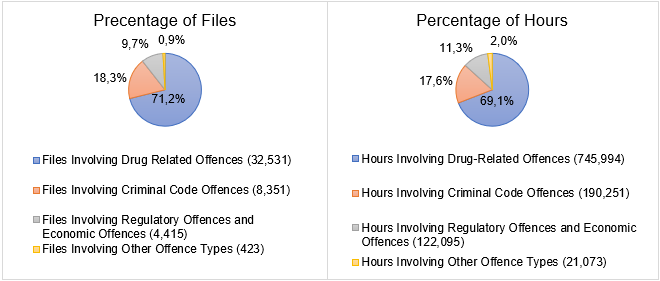
The graphs below illustrate the proportional values of PPSC national case files based on offence typeFootnote 8 for the fiscal year 2023-2024.
Text Version
| Files | Number | Percentage (%) |
|---|---|---|
| Files Involving Drug Related Offences | 32,531 | 71,2% |
| Files Involving Criminal Code Offences | 8,351 | 18,3% |
| Files Involving Regulatory Offences and Economic Offences | 4,415 | 9,7% |
| Files Involving Other Offences | 423 | 0,9% |
| Hours | Number | Percentage (%) |
|---|---|---|
| Hours Involving Drug Related Offences | 745,994 | 69,1% |
| Hours Involving Criminal Code Offences | 190,251 | 17,6% |
| Hours Involving Regulatory Offences and Economic Offences | 122,095 | 11,3% |
| Hours Involving Other Offences | 21,073 | 2,0% |
Stays of Proceedings Based on Delay
The Supreme Court of Canada decision in R v Jordan, established a new framework for the analysis of unreasonable delay pursuant to s. 11(b) of the Charter of Rights and Freedoms. The judgment set presumptive delay ceilings of 18 months for cases being tried at the Provincial Court level, and 30 months for cases being tried at a Superior Court level.
This reform has since led to certain changes in practice in order to advance cases before the courts. The courts and the parties are more vigilant and effective in addressing questions of fact or law that can be resolved prior to the trial, and prosecutors must ensure, among other things, that evidence is disclosed in a timely manner and that the case is not made needlessly complicated. Additionally, PPSC prosecutors must coordinate their efforts with their provincial counterparts to prioritize the most important cases, when appropriate. All this preparation and coordination creates additional work for prosecutors to ensure that the accused is tried within the timeframes set out in Jordan.
While they stop short of interfering with the prosecutor’s discretion, the courts are often more critical when choices relating to the number of charges, or the presentation of evidence result in unnecessary delays.
Despite this reform and the difficulty eliminating institutional delay in certain judicial districts, particularly in the Toronto and Montréal regions, there has not been a wave of stays of proceedings across the country.
The PPSC has always placed a priority on ensuring that cases are prosecuted in a principled and timely manner, which includes building upon existing practices and policies relating to file management. The Lesage/Code Report and the recent Bouchard Report have highlighted the PPSC’s role in the forefront of the efficient management of large, complex prosecutions.
Since the Jordan decision was issued, the PPSC formalized specific measures in the PPSC Deskbook, by adding a guideline, “Ensuring Timely Prosecutions.” The guideline outlines steps to be taken by PPSC counsel and agents to anticipate time requirements and minimize delays in prosecutions.
A national PPSC working group meets regularly to keep up to date on the latest developments in the case law, review the impact of institutional delay and exchange best practices to ensure better case management as mentioned above, all with the goal of minimizing stays of proceedings. For example, direct indictments that shorten timeframes are now part of the landscape of adaptation and change sought by Jordan.
The following table presents cases closed, between April 1st and October 31st, 2023, that resulted in a judicial stay or the Crown directed a stay of proceedings due to Crown delay.
| Judicially directed | Crown directed | 27 | 15 |
|---|
Drug Prosecutions under the Controlled Drugs and Substances Act and Cannabis Act
The PPSC is responsible for the prosecution of all offences in the CDSA and Cannabis Act, except in Quebec and New Brunswick.Footnote 9 The PPSC prosecuted more than 32,531 files under the CDSA and Cannabis Act in 2023–2024. Drug prosecutions represent approximately 71.2% of PPSC’s work.
There are currently two areas of focus pertaining to drug prosecutions that are given special consideration. First, in an effort to address large-scale importation, manufacture and importing of controlled substances, special consideration is given to the prosecution of offences tied to organized crime and commercial trafficking of controlled substances. Second, the opioid crisis is one of the most critical problems in Canadian society. With this in mind, special attention is given to prosecution strategies related to opioid offences, such as fentanyl, including alternative measures to prosecution for people who use drugs and appropriately severe sentencing for those involved in significant fentanyl commercial trafficking.
Addressing the Illicit Supply of Controlled Substances in Canada
The quantity of cocaine, methamphetamines, heroin, and other synthetic opioids being imported is increasing. Shipments of cocaine over 100 kilograms, for example, are not unusual and, at times, will involve couriers who have no knowledge of their role in such a scheme. Prosecution is more difficult as a result.
Technology is changing how and where crime occurs. Police are having to adapt, innovate and develop new techniques to protect the public. The provisions of the Criminal Code relating to the judicial authorization of such powers have not kept pace with the technologies. Trial procedures to justify the use of sensitive investigative techniques and the protection of information about sensitive police techniques during trials are challenging and time consuming. Lengthy investigations rely upon multiple court orders that each can be challenged in protracted pre-trial voir dires. There are an increasing number of prosecutions involving weapons being delegated to the PPSC by provincial prosecution services.
The increase in the complexity and sophistication of major drug cases is often due to the combination of telecommunications technology and evolving jurisprudence relating to expectations of privacy in public and quasi-public physical and virtual settings that has added to the complexity of cases. This has resulted in the need for more time and resources to effectively prosecute these major cases.
Appropriate Sentences for Commercial Fentanyl Trafficking
The PPSC has seen an increase in the number of fentanyl and synthetic opioids prosecution files over the past years. In response, a complete sentencing record relating to fentanyl and other novel synthetic opioids was created for the courts, including expert health evidence, in order to strenuously advocate for proportionate sentences that recognize the extreme danger posed by fentanyl trafficking and the devastating impact it has had on Canadian society. The PPSC is in the process of doing the same for new and emerging hazardous and toxic substances such as novel synthetic opioids and contaminants like Xylazine.
To ensure consistency of practice across all regions, the PPSC created a network of federal prosecutors appointed as specialists on fentanyl and other synthetic opioid issues in each region, coordinated from PPSC Headquarters. This working group shares information relating to relevant jurisprudence across the country, as well as emerging challenges and best practices. The PPSC has also created a fentanyl-sentencing database on its Knowledge Management intranet site that is regularly updated and accessible to all PPSC counsel. Fentanyl trafficking offences now attract the highest custodial sentences imposed by the courts in all regions in Canada.
Organized Crime Prosecutions
There are four specific criminal organization offences under the Criminal Code that may be considered in respect of serious predicate drug and other federal offences. The evidence gathered in organized crime investigations may establish the offences of participation in the activities of a criminal organization, recruiting persons to join the criminal organization, committing offences in association with the criminal organization and directing others to commit offences for the benefit of, at the direction of, or in association with the criminal organization. In each case, the Crown is required to lead evidence to prove that the group meets the Criminal Code definition of a criminal organization as a group of three or more persons which has, as one of its main purposes or activities, the facilitation or commission of indictable offences punishable by a maximum of five years or more imprisonment. The prosecutor may also introduce evidence that the offences were committed in relation to organized crime without charging the specific criminal organization offences. PPSC counsel receive guidance in relation to when it is most appropriate and effective to introduce criminal organization evidence as part of a prosecution charging the particular criminal organization offences or at the sentencing stage in relation to standard drug charges.
Most organized crime prosecutions are large, complex and transnational in scope.
- They generally involve the collection by the police of hundreds of thousands of pieces of electronic information which need to be assessed for purposes of disclosure to the defence. The dedication of significant police resources is required to gather and organize the fruits of the investigation and other peripheral disclosure materials, and to provide them to the Crown in a timely and organized manner. This may be further complicated by the impact of different legal regimes in respect to the admissibility of foreign acquired evidence. Prosecution plans and resourcing at the outset is also required for the Crown to discharge its duties in respect to the editing of disclosure materials to protect the identity of informers or other privileged information before disclosing them to the defence.
- Prosecutions often rely on the interception of communications. Most of the communications are now text-based. Accessing information, in many cases, will require the use of complicated technological tools to override security systems and break through complicated encryption. The volume of information gathered in these investigations and the sophistication of the technology used by investigators significantly add to the challenges of an investigation and prosecution.
- Other forms of investigation, such as undercover operations and civilian agents directed by the police, as well as the use of specialized investigative techniques, continue to form a significant part of investigations. All of these elements raise factual and legal issues that must be addressed by prosecutors with the police during an investigation and as part of the determination of the admissibility of evidence. The pre-trial motions on these issues may take considerably more time and effort to resolve than the actual trial on the merits of the prosecution’s case.
- In establishing the existence of the criminal organization, the prosecution will invariably draw upon the opinion evidence of a properly qualified expert concerning the structure, purposes and main activities of the criminal organization. This evidence may attract additional levels of complexity and its admission may raise particular scrutiny where the expertise is sought from multiple and international sources.
Special Consideration in Respect of Opioids
Canada is in the midst of a national opioid crisis. Between January 2016 and September 2024, 50,928 apparent opioid toxicity deaths have been reported in across the country.Footnote 10 This is due to the proliferation of a toxic supply of illicit drugs containing highly potent substances like fentanyl and other synthetic opioids.Footnote 11 In response, the PPSC has developed new approaches to the prosecution of offences involving people who use drugs and problematic substance use.
Non-Commercial Drug Offences and more Serious Drug Offences Associated with Substance Use Disorders
Simple Possession Prosecutions
The PPSC has developed a litigation approach which is intended to result in a limited and focused prosecutorial response to the possession of all controlled substances prohibited by section 4(1) of the CDSA. It was published on August 17, 2020, and is set out in Guideline 5.13 to the PPSC Deskbook.
The PPSC’s approach reflects three realities:
- substance use is primarily a public health issue;
- in addition to the personal health component, substance use may be associated with conduct that poses separate serious public safety concerns requiring a criminal enforcement component; and,
- simple possession may result in a criminal record as well as a fine or a short period of incarceration which may have a disproportionate effect for an individual accused.
This approach resulted in significant reduction in simple possession prosecutions for all substances across the country. It has also influenced the approach taken by law enforcement agencies across the country towards the possession of controlled substances.
In January 2023, Canada’s Minister of Mental Health and Addictions approved an exemption under s. 56 of the CDSA that applies to offences under subsection 4(1) of the CDSA relating to possession of certain controlled substances in the Province of British Columbia. PPSC has been working with federal and provincial partners, and law enforcement agencies, to adjust to the impacts of decriminalization in British Columbia for the three-year period when the exemption is in effect. Most important is the provision of advice to police about the impact of the exemption on the investigation of trafficking offences.
Alternative Measures and Drug Treatment Court Programs
Prosecutors are required to consider the alternatives to prosecution that may address the public safety elements in those circumstances. At the same time, prosecutors are being trained to recognize and consider the potential effects of bias and systemic discrimination upon the assessment of these cases.
In more remote communities, such as communities in Canada’s three northern territories outside of Whitehorse, Yellowknife and Iqaluit, the limited availability of alternative measures to prosecution has limited the ability to provide for treatment as part of a non-custodial sentence. Persons who would be eligible for treatment in the provinces through alternative measures or a drug treatment court program have no such options in the North.
The identification of partners and community involvement is a particular priority to attempt to address the over-representation of Indigenous accused in the criminal justice system.
Drug Treatment Courts are specialized courts that provide an alternative to incarceration by offering an opportunity to complete a drug treatment program under the supervision of designated justice system participants and treatment service providers. DTCs aim to reduce the frequency of crimes committed to support drug dependence and the harm people cause to themselves and others because of drug addiction. Offenders who meet specified criteria receive comprehensive substance use treatment, clinical case management and social services support. The number of DTCs continues to grow across the country with multiple new DTCs opening recently in Alberta and more anticipated to open soon in various regions across the country.
The PPSC has recently revisited its 6.1 Deskbook Guideline on DTC. Our prosecutors now have greater flexibility in determining eligibility for DTC programs. Individuals previously convicted of an offence involving violence or who are accused of committing a violent offence will no longer be automatically excluded from participating in a DTC program. These changes will result in the elimination of unnecessary barriers to entry that contribute to discrimination and the overrepresentation of marginalized groups in the criminal justice system, as well as to enhance public safety across Canada. Admission to a DTC will be assessed on a case-by-case basis and will depend on factors such as risk to public safety, circumstances of the underlying offence and background and systemic factors. Application to a DTC may now occur at any time throughout a prosecution and, where appropriate, will no longer require a guilty plea prior to enrollment. Prosecutors now also have flexibility to design graduation criteria that move away from total abstinence, which is not a realistic goal for all persons suffering from a substance use disorder and incorporate harm reduction principles that reinforce social determinants of health. The overall objective of these changes is to reduce criminal justice system involvement for people who use drugs. These initiatives will continue based on the 2021 federal budget that has allocated approximately $40 million in new funding to DTCs over the subsequent 5 years.
Some persons with an underlying substance use disorder are not ready or willing to participate in a DTC program but are amenable to medical assistance or other forms of alternative measures to address the aspects of their behaviour that raise public safety concerns. The PPSC has updated its Deskbook policies relating to alternative measures to remove unnecessary barriers to participating in diversion programs that offer an alternative to prosecution.
The Cannabis Act
On October 17, 2018, the Cannabis Act came into force, fundamentally changing the manner in which cannabis is possessed and accessed, and how cannabis-related offences are investigated and prosecuted in Canada. The PPSC is responsible for the prosecution of both criminal and regulatory offences under the Cannabis Act.
The Cannabis Act altered Canada’s approach to cannabis, shifting from a blanket prohibition for non-medicinal marihuana to a regime in which possession, consumption and distribution can be lawful, subject to restrictions by amount, age and location. The more serious cannabis offences, previously prosecuted under the Controlled Drugs and Substances Act, such as sale, importation and exportation remain offences under the Cannabis Act.
The legalization of possession of cannabis pursuant to the Cannabis Act has not had a measurable impact on PPSC operations as the resources dedicated to the prosecution of simple possession cases under the CDSA were not significant.
The Cannabis Act contains provisions allowing the police to issue tickets for offences within specific ranges. However, these provisions, in practical terms, are not in force given the scheme’s reliance on the provinces and territories (PTs) to produce and issue the actual tickets to the police. The Cannabis Act does allow prosecutors to elect to proceed as though a ticket had been issued. In order to make use of this discretion PPSC has worked with the PTs to put in place procedures to allow this election to be made in court and has issued guidance to federal prosecutors on the procedures to follow in cases where the ticketing election is appropriate.
A number of legal challenges to the Cannabis Act by First Nations communities, and individuals, are expected or underway, primarily in Ontario. To date, these challenges appear to be based on an argument that the Cannabis Act does not apply on aboriginal lands through the assertion that these areas are sovereign. The PPSC’s view is that the Act is constitutionally valid and, as a federal statute, applies across Canada. PPSC is working closely with the Department of Justice to address these challenges in the courts.
The introduction of a legal regime governing the sale of edible cannabis products and concentrates may pose additional evidentiary challenges for prosecutions given the complexity of the regime. The regulation of these new products is in large part based on the concentration of active ingredients. The science involved in establishing that a given sample falls outside of legal limits is considerably more complex than with cannabis in its natural form.
Proceeds of Crime and Money Laundering
The PPSC prosecutes the possession of proceeds of crime, as well as the laundering of proceeds of crime, across Canada. These prosecutions are usually related to money and property derived from drug offences.
Background
Offences of possession of property obtained by crime (possession) and laundering of proceeds of crime (laundering), trafficking in property obtained by crime and possession of property obtained by crime for the purpose of trafficking can be found in the Criminal Code:
- s. 354: Possession of property obtained by crime
- s. 462.31: Laundering proceeds of crime
- s. 355.2: Trafficking in property obtained by crime
- s. 355.4: Possession of property obtained by crime for the purpose of trafficking
The PPSC has the authority to prosecute these offences where the underlying offence which resulted in proceeds of crime is wholly or partly an offence for which the Attorney General of Canada has the power to commence. In the majority of cases, those charges are not required in order to obtain forfeiture of proceeds of crime directly associated with the drug offences for which the accused has been convicted.
Considerations
Investigations into laundering offences are long and complex. Over the years, launderers have significantly refined their techniques in order to mask the source of funds originating from criminal activities, particularly by using new technologies and virtual currencies.
Project Collecteur
Project Collecteur targeted a professional money-laundering network. Nineteen individuals were charged in Montreal in 2019, including network participants and the clients using their services.
Montreal-based money launderers would receive money from criminal groups during illegal meetings held in public places such as commercial parking lots and would send the money to Toronto-based money launderers.
These Toronto-based money launderers operated out of an exchange office that served a primarily Persian clientele. They also had exchange offices in Tehran, Iran, and Dubai, United Arab Emirates. They used the cash received from criminal clients to fulfill money transfer orders placed by individuals based in Iran. There were many of these orders because of the international sanctions on the Iranian banking industry. Consequently, the amounts held in Tehran and Dubai were significant.
The Montreal-based money launderers did not have an exchange office; instead, they received money from various clients in the Montreal area and then sent it to the Toronto-based group. The head of the Montreal network used numbered companies to issue invoices of convenience. Their clients received these invoices and wrote cheques to the money launderers. The money launderers gave them cash in return, which came from their profits or informal transfer commissions. The money launderers also had two collaborators in Lebanon, who controlled more modest local cash assets than the Iranian-owned network.
While the case continued before the court, a vast majority of the defendants had already been sentenced from six months of imprisonment to be served in community up to 9 years in prison, depending on their role in both laundering and implicit drug trafficking. Fines and forfeitures of proceeds of crime over $15 million were imposed.
Virtual Currencies in the Spotlight
Virtual currencies, which know almost no borders and are barely regulated, have become the currency of choice in money laundering schemes because of the anonymity offered by transactions involving them.
Section 462.321, a new addition to Part XII.2 of the Criminal Code, came into force on September 20, 2023. This provision allows electronic searches to identify the source as well as the seizure of virtual currency, a category of assets that is not well defined in the Code as it stands. Such searches and seizures are aimed at confiscating virtual currencies that are the proceeds of crime; the restraint and management orders already provided for in Part XII.2 will apply as needed. Law enforcement agencies have previously attempted to use other judicial authorizations but had mixed results, such as with the general warrant under section 487.01. The Ontario Superior Court recently issued a certiorari decision stating that the only procedural vehicle available to seize virtual currency is the new specific warrant provided under section 462.321.
PPSC recently set up a national working group to look at the challenges posed by the use of virtual currencies, both in terms of the legal advice to be given in the course of investigations and in terms of prosecutions involving this type of asset, including the impact of jurisprudence discussed in the previous paragraph.
National Security
The PPSC exercises primary responsibility for the carriage of cases relating to the national security of Canada. The PPSC has concurrent jurisdiction to prosecute terrorism offences under the Criminal Code and offences under the Security Offences Act and exclusive jurisdiction for offences under the Foreign Interference and Security of Information Act the Crimes against Humanity and War Crimes Act. The PPSC has delegated authority to consent on behalf of the Attorney General of Canada to the commencement of proceedings that relate to the national security of Canada. Functionally, one of the two Deputy DPPs has exercised this delegated authority.
The volume of national security investigations and prosecutions is significantly growing. Traditional ISIS inspired terrorism continues to generate significant cases and is augmented by high-risk detainees returning from camps and prisons in Syria. Ideologically motivated violent extremist (IMVE) activities, from concerted recruitment, incitement and violence committed by adherents of Incel movements, accelerationists, neo-Nazis and targeted haters of members of the 2SLGBTQIA+ community and Moslem Canadians, continue to be on the rise. Prosecution of offences related to foreign-influenced activities, principally associated to the targeting of intellectual property and Chinese Canadians continue to arise. Finally, significant investigations and prosecutions involving unauthorized disclosure of national security information have also become prominent.
In 2024-25 the PPSC will realign its prosecution priorities, to accommodate the increase and strengthen its capacity to conduct terrorism offence prosecutions. The organization will also continue to provide pre-charge advice and other assistance to the Royal Canadian Mounted Police (RCMP) and other police services across Canada.
The PPSC's Capacity to Conduct Terrorism Offence Prosecutions
The PPSC has established a practice of assigning terrorism files to a small group of senior prosecutors who are experienced in terrorism prosecutions. These prosecutors can be assigned to terrorism prosecutions anywhere in Canada. In addition, the PPSC has senior counsel at its headquarters who ensure that assigned prosecutors in the regions are provided the support they need to carry out their work.
PPSC counsel in the regional offices work at the investigative stage with the RCMP-led Integrated National Security Enforcement Teams. The PPSC has also established committees of regional terrorism prosecutors to address certain areas of focus such as foreign influenced activity, IMVE and issues related to section 38 of the Canada Evidence Act for the consideration of novel issues and for the dissemination of best practices.
Terrorism Offence Prosecutions and Proceedings
Since the Anti-Terrorism Act came into force in 2001, 84 individuals have been prosecuted for terrorism-related offences, including those individuals still before the courts. Thirty-nine individuals have been convicted and sentenced, and life sentences were imposed on nine (9) of these individuals. In addition to the life sentences, significant sentences of between 15 and 24 years have been imposed.
Furthermore, there have been a total of 54 applications pursuant to s. 810.011 Criminal Code, i.e., the terrorism peace bond provision. Of these applications, 3 are currently pending to be heard before the courts, 38 have resulted in the peace bond being entered into (with one being sentenced to jail for refusing to sign the bond), one application was dismissed by the Court, and 12 were withdrawn by the Crown at various stages.
The PPSC is currently prosecuting 20 terrorism cases.
Canadian Extremist Travelers
In 2013, offences specifically related to leaving or attempting to leave Canada for the purposes of committing certain terrorism offences were enacted in the Criminal Code. Since that time, a total of 19 individuals have been charged with specific travel-related terrorism offences: Eight have been convicted; three are before the courts; two have been acquitted; four have outstanding warrants; one has had charges withdrawn; and one saw her charges stayed. Note that these are included within the total of 79 individuals prosecuted for terrorism-related offences referenced above.
Prosecutions in the Northern Territories
Overview
The PPSC is responsible for the prosecution of all Criminal Code offences in the territories as well as offences under all other federal legislation, such as the Controlled Drugs and Substances Act, Cannabis Act, the Youth Criminal Justice Act, and the Fisheries Act.
Prosecuting in the northern territories presents unique challenges and opportunities. The high volume and complexity of territorial criminal prosecutions as well as the lasting and traumatic effects of colonization on the Indigenous populations necessitates a diverse, culturally sensitive, and well-resourced workforce. The northern PPSC offices have responded to these challenges, as well as to calls to action on reconciliation and violence against Indigenous women and girls, with innovative programs incorporating Indigenous worldviews, specialized sexual violence expertise, and novel recruitment methods into their daily operations. Ongoing support and funding are needed for these initiatives to continue.
PPSC Operations in the North
The PPSC has regional offices in each of the territorial capitals (Whitehorse, Yellowknife, and Iqaluit. As recruiting staff in the North is difficult, all three regional offices regularly need the services of fly-in counsel from other PPSC regional offices or prosecutors from provincial prosecution services to ensure adequate coverage of court commitments.
Crown Witness Coordinator Program
The unique cultural setting for prosecutions in the North led to the creation of the Crown Witness Coordinator (CWC) Program in 1988. The Program provides a service to bridge the cultural gap between the court system and First Nations and Inuit victims and witnesses engaged in the court process.
Currently, the PPSC’s northern regional offices employ 22 CWCs, in addition to three CWC Supervisors (one in each regional office). The CWC program is coordinated by a Crown Witness Program Coordinator.
The main role of CWCs is to help victims and witnesses understand the court process, the roles of the court participants and, for the victims, their rights and responsibilities under the Canadian Victims Bill of Rights. CWCs work closely with PPSC prosecutors and travel to communities during court circuits to assist victims and witnesses. They provide court updates, accompany witnesses to court, provide support during and after testimony, and assist with trial preparation. CWCs also act as liaisons between Crown counsel, victims, and witnesses to ensure that their concerns are considered during the justice process. As a large percentage of the workload of CWCs involves serious crimes of violence such as intimate partner violence, sexual assault and homicide, CWC responsibilities include identifying support needs of the victims and ensuring they are referred to appropriate territorial support agencies to address those needs.
Cultural Awareness
A significant percentage of the populations in the territories, particularly in communities other than the territorial capitals, is Indigenous. In the Yukon, approximately 25% of the population is Indigenous, while in the NWT, 50% is Indigenous. In Nunavut, 85% of the population is Inuit. Cumulatively, there are twenty Indigenous languages spoken in the territories.
Accordingly, cultural awareness training is of particular importance in the North. In 2022–2023, the PPSC developed a training curriculum for its prosecution teams that focuses on Crown-Indigenous relations, anti-racism, bias, trauma and Gladue reports. This curriculum is divided into four modules. The first module focuses on the historical relationship between the Crown and Indigenous peoples; the second, on cultural competency and current realities and aims to challenge stereotypes associated with Indigenous, First Nations, Inuit and Métis people; the third focuses on intergenerational trauma and trauma-informed practices; and the final module provides hands-on training on Gladue principles and the role of the Crown. The delivery of this training, including in the territories, will continue through the 2024–2025 fiscal year.
Specialized Treatment Courts in the North
Intimate Partner Violence Courts
A large proportion of offences in the North involve intimate partner violence (IPV). Each territory has specialized IPV treatment court programs to address IPV through a comprehensive multidisciplinary treatment-based approach aimed at ensuring IPV offenders receive therapy to eliminate or reduce recidivism. The Yukon’s Domestic Violence Treatment Options (DVTO) Court is located in Whitehorse, while the NWT’s DVTO Court covers the territory. Nunavut’s IPV Court is located in Rankin Inlet.
To participate in these specialized courts, the accused must accept responsibility by entering a guilty plea. They are then eligible to receive treatment focused on IPV and substance use disorders. Upon completion of the process, the offender receives a sentence mitigated by his or her involvement in the process, which usually means a community-based sentence.
Wellness Courts
The PPSC has also been an active partner in therapeutic court programs known as Wellness Courts. Wellness Court programs aim to reduce recidivism by providing support to chronic offenders by helping them deal with the substance use disorders and/or mental health issues that contribute to their criminal behavior. These programs involve judicially-supervised treatment providing multidisciplinary support for offenders with mental health issues, drug and alcohol use disorders or cognitive challenges. An offender who takes responsibility for the offence and then successfully undergoes the extensive treatment (generally over a year in length) associated with the program usually receives a community-based sentence.
Wellness courts were implemented in the Yukon in 2007 and in the NWT in 2014. In Nunavut, a therapeutic justice program pilot project, designed by Inuit for Inuit, began in April 2019 in Cambridge Bay and in 2021 in Arviat. PPSC prosecutors in the three northern regional offices actively support these therapeutic court programs.
Challenges Relating to Northern Prosecutions
Substance Abuse and Violence in the North
Abuse of alcohol in the North is rampant. The northern territories have the highest rate of hospital stays due to harm caused by alcohol and drugs in the country. In 2020–2021, the average number of standard drinks consumed per person aged 15 years and older in the Yukon and the NWT was almost double the national rate.
This abuse of alcohol contributes to high rates of violent crime. The territories have the highest rates of violent crime in the country, particularly as it relates to sexual abuse and intimate partner violence. There is also a high rate of homicide.
PPSC recognizes that most instances of prolonged high levels of consumption of alcohol relate to a health disorder. In the North, the abuse of alcohol in Indigenous and Inuit communities can be traced back to intergenerational trauma resulting from colonization, including the residential school system and its legacy of dislocation. The intersection of alcohol substance use disorders and trauma contributes to the ongoing overrepresentation of indigenous persons in custody. The northern PPSC offices are cognizant of this context and have responded by seeking abstain conditions for offenders with alcohol additions only where necessary for public safety and by using judicial referral hearings to address bail abstain breaches where appropriate, instead of seeking convictions.
The primary obstacle to addressing alcohol-related substance use disorders is the insufficient availability of in-person programming for alcohol abuse in the northern territories. Although in-person residential alcohol abuse treatment programs are available in Whitehorse, such programming is inaccessible for residents of other Yukon communities unless they travel to Whitehorse. In the NWT and Nunavut, there are no in-person residential programs addressing alcohol abuse. This reality constrains the use of alternative measures to address alcohol-related offences in the North.
High-Risk Offenders
There is a coordinated high-risk offender flagging process in place in all the Northern offices, resulting from the high rate of violent crime involving offenders with significant rates of recidivism. In each regional office, paralegals assist in coordinating the flagging of high-risk offenders in the territory. This enables a more effective and organized preparation of prosecution files in order to conduct long-term offender and dangerous offender applications effectively. Given the implications for the person subject to these orders, the consent of a Deputy DPP is required before an application can be brought.
Accessibility
PPSC prosecutors and CWCs attend court in over 60 communities across the North. Court is held at varying but regular intervals in each community, most of which are accessible only by air. All of the communities in Nunavut are accessible only by air. Communities in the NWT are mainly accessible by air. All of the communities in Yukon but one are generally accessible by car.
Consequently, core mandate travel for prosecutors and CWCs is a substantial part of northern regional office budgets. Employee travel costs for prosecutions in the North are significant: approximately $2.2M for 2023-24. In addition, the PPSC has become responsible for all civilian witness travel in the three territories. Traditionally, these costs were paid by the territorial governments. However, in 2015, the territorial governments refused to continue the arrangement, and the PPSC now books and pays all the civilian witness travel costs without an increased source of funds.
PPSC’s Response to the National Inquiry into MMIWG’s Calls for Justice
The PPSC contributes to the federal government’s response to the National Inquiry into MMIWG’s Calls for Justice. In 2021, the PPSC received $23.5 million over three years to implement initiatives that will increase support to victims of violence, promote culturally competent services to victims, incorporate Indigenous justice approaches and help address the overrepresentation of Indigenous persons in the criminal justice system. This funding has not been renewed.
MMIWG funding was being used to support four specific activities in three northern territories over the three-year term:
- create and staff four Inuktitut-speaking Inuit paralegal positions in Nunavut;
- improve the Inuit Justice training curriculum and develop new Justice training curriculums that reflect First Nations and Métis realities respectively;
- increase prosecutorial capacity, including Indigenous victim and witness support in the three territories; and
- develop and pursue a one-time engagement strategy.
Additional prosecutorial capacity and increased representation by Inuit as decision makers in the criminal justice system assisted the PPSC to establish trust with victims and properly prepare victims and witnesses of sexual and domestic violence for court proceedings. Supported and well-informed victims and witnesses are much more likely to engage in the court process, which in turn facilitates a timelier administration of justice.
In addition, engagement initiatives had been rolled out in the NWT and Nunavut, and the knowledge and lessons learned gathered from these activities will be shared with the Yukon Regional Office to assist them in developing an engagement strategy that is meaningful for their region.
Sexual Violence Prosecution Teams
Nunavut and NWT have the highest rates of sexual violence in the country. Sexual violence causes significant suffering and trauma to survivors. Additionally, offences involving sexual violence are legally complex and can be personally challenging for counsel to prosecute. In 2022, PPSC created the Specialized Sexual Violence Prosecution Team (SSVPT) in the NWT region in response to what we heard from the MMIWG about the experience of victims and witnesses during sexual offence prosecutions.
The SSVPT consists of two senior prosecutors, a paralegal, two CWCs, and a third prosecutor position which is filled on a rotating basis. The SSVPT’s overarching goal is to create institutional change in the way sexual violence cases are understood and addressed, especially those involving Indigenous women, girls or 2SLGBTQIA+ community. They aim to achieve this goal by reviewing every sexual violence file, providing strategic assistance, training and mentorship to prosecutors and police, providing improved and consistent support for victims, and engaging with external stakeholders on sexual violence.
The Nunavut region has also begun implementing a similar approach.
The Inuit Quajimajatuqangit Project
The Nunavut region is dedicating a team to work on implementing Inuit Qaujimajatuqangit (ᐃᓄᐃᑦ ᖃᐅᔨᒪᔭᑐᖃᖏᑦ) into prosecutorial decision-making. Inuit Qaujimajatuqangit is a difficult concept to define. It goes beyond “Inuit traditional knowledge” and instead provides a framework within which one can think about and approach life. Inuit Qaujimajatuqangit is a broad concept that changes between regions, communities, and even families. It is a fluid, organic system that relies on multiple sources of input (usually taking the form of Elders discussing an issue and coming to a common understanding). It remains adaptable as changes occur in society.
The goal of this project is for the PPSC to find a way to incorporate Inuit Qaujimajatuqangit into its Nunavut region’s practice and the criminal justice system without compromising its essence as a set of living principles. The Inuit Qaujimajatuqangit project will allow PPSC prosecutors to consult with Inuit Elders, benefitting from their knowledge and wisdom, and to further consider Inuit Qaujimajatuqangit in their assessment of a reasonable prospect of conviction and public interest. This project is expected to be launched in two pilot communities, Pangnirtung and Baker Lake (Qamini’tuaq).
The Nunavut Courtworker program
The Nunavut Regional Office is also implementing the Inuit Courtworker program, a first of its kind in the country. The Inuit Courtworker Program includes an intensive training program with internal and external courses to train junior courtworkers to become paralegals able to act independently on behalf of the PPSC in the Nunavut Justice of the Peace Court and in summary conviction matters throughout Nunavut. One of the Inuit Courtworkers is already leading the Justice of the Peace Court in Iqaluit and the PPSC seeks to fill two vacant Inuit Courtworkers positions.
Article 23 of the Nunavut Agreement
The Nunavut Act and the Nunavut Agreement created Nunavut, which became a territory on April 1, 1999. The Nunavut Agreement protects Inuit rights, including preferential employment opportunities, as set out in Article 23 of the Agreement. The legal obligation on the federal and territorial governments is to increase Inuit participation in government employment to a representative level of 85% of the population in all occupational groups and levels.
The Nunavut region is committed to increasing Inuit representation as decision-makers in the criminal justice system. The PPSC Inuit Employment Plan contains an employment strategy aimed at increasing the number of Inuit employees to a representative level. The Plan includes removing employment barriers, increasing Inuit representation on staffing panels, career laddering within the office and emphasizing the acquisition of leadership skills through formal and on-the-job training.
Recent measures have significantly improved Inuit employment levels in the Nunavut Regional Office. The PPSC has supported two Nunavut Regional employees enrolled in the Nunavut Law Program (NLP). Those employees successfully completed their law degree in April 2021 and returned to the Nunavut Regional Office as articling students. They were joined by two other Inuit articling students hired from the NLP graduates. One of them has graduated and the other three are scheduled to finish their articles and become lawyers within the next year. The PPSC has hired one other NLP graduate who has already been called to the bar as a lawyer, to start in August 2023.
Regulatory Prosecutions
The PPSC prosecutes a variety of offences created by federal statutes in support of the mandates and policies of other federal organizations, such as Environment and Climate Change Canada, Fisheries and Oceans Canada, the Canada Border Services Agency, Labour Canada and the Canada Food Inspection Agency.
Regulatory prosecutions represent a fundamental part of the PPSC mandate and PPSC has dedicated regulatory prosecution teams across the country that have experience in prosecuting offences pursuant to over 75 regulatory statutes and regulations aimed at protecting the environment and the safety, health, economic security, general welfare of the Canadian public. These statutes include the Canadian Environmental Protection Act, 1999 (CEPA), the Fisheries Act, the Canada Wildlife Act, the Species at Risk Act, the Wild Animal and Plant Protection and Regulation of International and Interprovincial Trade Act (WAPPRIITA), the Immigration and Refugee Protection Act (IRPA), and the Canadian Food Inspection Agency Act, the Food and Drugs Act and the Health of Animals Act.
In 2023–2024, Regulatory and Economic offences accounted for 9.7% of PPSC’s files and accounted for 11.3% of PPSC’s total hours.
Although many regulatory cases are routine, some are resource-intensive and complex and receive considerable media attention. Past examples include prosecutions:
- against large companies for depositing, in water frequented by fish, a deleterious substance exceeding the maximum authorized concentration of suspended solids;
- for fishing a variety of species, including lobster and elvers, when the commercial season was closed or outside designated fishing areas contrary to the Fisheries Act;
- for the unlawful removal and trafficking of fossils from a Canadian UNESCO heritage site contrary to the Canada National Parks Act;
- for illegal drone use during an active wildfire in Jasper National Park when helicopters were providing air support to firefighting efforts contrary to the National Parks of Canada Aircraft Access Regulations; and
- for offences arising out of breaches by returning travellers of the mandatory isolation orders pursuant to the Quarantine Act during the COVID-19 pandemic.
In prosecuting particularly complex regulatory offences, prosecutors are expected to have regard to the policy objectives of the investigative agencies and often provide advice and work closely with investigators at the investigative stage, prior to charges being laid. They also consult with counsel in the Department of Justice departmental legal service units who are the subject matter experts on the various statutes and regulations.
Of note, regulatory prosecutions often intersect with Indigenous rights and claims. These claims arise in prosecutions involving various subject matters, including production and distribution of cannabis, fishing for a variety of species, and collection and remission of federal taxes on reserve lands. Prosecutors must balance these rights and claims within PPSC’s mandate as a federal prosecution service. The constitutional questions advanced have tended to focus on section 35 claims but have also included Charter-based claims. These matters are actively before the courts, predominantly in the Atlantic provinces and in Ontario.
In addition to the regulatory regional prosecutions teams, the PPSC Headquarters Counsel Group also provides advice and support to regulatory enforcement agencies and their legal service units at the investigative stage and in developing policies to help the investigation and prosecution of regulatory offences.
In particular, and as part of this regulatory prosecutions mandate, PPSC HQ counsel were actively engaged from the onset of the COVID-19 pandemic with federal policy-makers and enforcement partners to ensure that federal measures, such as those under the Quarantine Act, could be effectively enforced and prosecuted.
PPSC HQ counsel are also currently engaged in providing advice and support to its regulatory counsel involved in the constitutional litigation of regulatory examinations of electronic devices at the border pursuant to s. 99(1)(a) of the Customs Act. The provision was declared unconstitutional by the Alberta Court of Appeal (ABCA) in R v Canfield 2020 ABCA 383 and is being re-examined by the Ontario Court of Appeal in the appeal of R v Pike, 2022 ONSC 2297. An amendment to the Customs Act to address the ABCA’s concerns with the absence of limits on the searches of such devices at the border is currently before Parliament.
The PPSC uses cost recovery to cover most of its costs for prosecuting offences under regulatory statutes. In effecting cost recovery for its prosecution services, the PPSC looks to the government organization whose minister is responsible for the regulatory legislation creating the offence underlying the prosecution. More detailed information about cost recovery is provided in the “Finance Overview” section located at Tab 8.
Charges may, from time to time, be laid under federal regulatory statutes against government departments, Crown corporations or their employees. These typically arise in matters related to workplace safety and environmental protection and are commonly referred to as PPSC “R v R” prosecutions. As an independent prosecution service, the PPSC prosecutes such offences when they arise.
Economic Crime
The PPSC prosecutes cases involving economic crimes committed under the Criminal Code and other federal statutes in support of the mandates and policies of other federal organizations, such as the CRA, the Competition Bureau, Employment and Social Development Canada and the Office of the Superintendent of Bankruptcy.
PPSC has jurisdiction to initiate proceedings related to fraud offences pursuant to section 380 of the Criminal Code. Other than the Criminal Code, other federal statutes contain offences for economic crimes for which the PPSC has the jurisdiction to conduct prosecutions. The Income Tax Act, the Excise Tax Act, 2001, the Customs Act, the Competition Act, the Employment Insurance Act and the Bankruptcy and Insolvency Act are some of the legislations that generate the largest number of economic crime prosecutions initiated by the PPSC.
Non-Criminal-Code Federal Legislation
Income Tax Act and Excise Tax Act, 2001
The PPSC prosecutes offences under the statutes enforced by the CRA and the Royal Canadian Mounted Police, notably those dealing with tax evasion and contraband tobacco and cannabis. Specialized PPSC prosecutors provide advice during the investigative stage, conduct prosecutions, and provide training to investigators. CRA investigations focus on complex tax evasion schemes, including cross-border crime and offences committed by organized groups.
Competition Act
PPSC is also responsible for prosecutions instituted under the legislation administered and enforced by the Competition Bureau, namely, the Competition Act, the Consumer Packaging and Labelling Act, the Textile Labelling Act and the Precious Metals Marking Act. It also provides general prosecution-related legal advice or more specific advice on Competition Bureau files.
The National Capital Regional Office of the PPSC handles most of this work nationally through its Competition Law Section (CLS). CLS counsel provide advice and work closely with investigators, usually from the outset of investigations, which are often legally and factually complex.
The Competition Bureau has an immunity and leniency program to encourage individuals or organizations who have information on anti-competitive business practices, such as collusion in bid submissions and price fixing, to report them to the Bureau. Decisions to grant immunity or leniency on the recommendation of the Competition Bureau are within the exclusive purview of the Crown and are granted on behalf of the DPP.
Recently, the Competition Bureau recommended to PPSC that leniency be granted to Canada Bread Company for its guilty plea and its cooperation in the investigation into a price-fixing arrangement in the wholesale commercial fresh bread market. On June 21, 2023, the Superior Court of Ontario imposed a $50 million fine on Canada Bread. This is the maximum amount ($70 million) applicable under the Competition Act less the credit granted to Canada Bread Company ($30 million) for cooperating with the investigation.
Corruption of Foreign Public Officials Act
The Corruption of Foreign Public Officials Act (CFPOA)was enacted in 1999 to implement the Organization for Economic Cooperation and Development (OECD) Convention on Combating Bribery of Foreign Public Officials in International Business Transactions, which was signed by Canada in 1997. The Act also acts as Canada’s basis for the implementation of the Inter-American Convention Against Corruption which Canada signed in 2001 and United Nations Convention Against Corruption which Canada signed in 2007. Canada is subject to ongoing review mechanisms under each of these treaties with the most recent being the OECD Phase 4 review in October of 2023. The CFPOA also requires an annual report to be tabled in Parliament. The Department of Justice and the Global Affairs Canada have the lead on preparing the annual reports and dealing with the review aspects of each international treaty.
The CFPOA creates an indictable criminal offence in Canada for anyone who pays, offers, or agrees to pay or offer a benefit of any kind to a foreign public official in order to obtain or retain an advantage in the course of business. The Act was amended in 2013 to, among other things, increase the maximum penalty to 14 years’ imprisonment and expand Canadian jurisdiction over the offence based solely on the nationality of the accused.
To date, the PPSC has prosecuted a total of 14 individuals and 3 corporations under the CFPOA. An additional two prosecutions of corporations have been conducted by the province of Alberta.
Special Economic Measures Act
The Special Economic Measures Act (SEMA) allows Canada to impose sanctions in four situations:
- when a grave breach of international peace and security has occurred and has resulted in, or is likely to result in, a serious international crisis;
- when an international organization calls on members to impose sanctions;
- circumstances of gross and systematic human rights violations; or
- when acts of significant corruption have been committed.
Under the SEMA, the Governor in Council may impose sanctions on a foreign state; any person in that foreign state; a national of that foreign state who does not ordinarily reside in Canada; or persons outside of Canada who are not Canadian under the specific SEMA regulations for that country regime.
To date, only two prosecutions have been conducted in relation to SEMA with the first in 2014 in relation to sanctions against Iran and the second in 2020 in relation to sanctions against Syria. Neither prosecution resulted in a conviction.
In response to the Russian invasion of Ukraine, Canada has imposed sanctions designating over 1500 individuals. Among the implications of this designation, it is an offence under section 8 of SEMA for anyone to:
- deal in any property, wherever situated, held by or on behalf of a designated person;
- enter into or facilitate, directly or indirectly, any transaction related to such a dealing;
- provide any financial or other related services in respect of such a dealing;
- make any goods, wherever situated, available to a designated person; or
- provide any financial or related service to, or for the benefit of, a designated person.
It should be noted that, pursuant to section 12 of SEMA, any proceedings with respect to an offence under this Act may only be commenced with the consent of the Attorney General of Canada.
Remediation Agreements
On September 19, 2018, Part XXII.1 of the Criminal Code came into force creating a new regime called “remediation agreements,” also known as deferred prosecution agreements, which will suspend the prosecution of a corporation for certain listed offences to implement the terms of the agreement.
The remediation agreement regime allows the prosecutor, with the consent of the Attorney General (at the federal level, the DPP) and under certain conditions, including whether it is in the public interest, to invite the corporation to negotiate a remediation agreement that will ultimately be approved by the court. The aim of the regime is to foster early self-disclosure by corporations and requires admission of wrongdoing and cooperation with the authorities to bring individuals to justice, as well as to pay penalties and restitution to victims. The regime allows corporations to avoid the negative impact that a prosecution and conviction of the corporation might have on innocent stakeholders, such as, for example, loss of employment. Another important feature of these agreements, where appropriate, is the independent monitoring of the corporation to satisfy the prosecutor and the court that measures are put in place to prevent the corporation from reoffending. If no agreement is reached or the court finds that the corporation has breached a term of the agreement, the prosecution is recommenced.
PPSC prosecutors examine the appropriateness of a remediation agreement for corporations charged with listed offences (mostly corruption and fraud) and make a recommendation to the DPP when satisfied that the statutory conditions are met for sending an invitation to negotiate. Chapter 3.21 of the PPSC’s Deskbook provides guidelines and the PPSC’s internal procedure for the treatment of recommendations on whether to seek DPP consent to negotiate.
To date, one remediation agreement has been entered into by the PPSC in the recent case of R v Ultra Electronics Forensic Technology Inc., which was approved by the Quebec Superior Court in 2023. UEFTI and four of its executives faced charges of corruption and fraud for bribing officials of the Republic of the Philippines in a scheme designed to secure the ongoing procurement of a ballistics identification system to the Philippine National Police. The prosecution against UEFTI is currently stayed pending the performance of the remediation agreement obligations. The payment of $10M in penalties and forfeiture has been made and a corporate compliance audit is underway until 2026. One of the four former executives has pleaded guilty. The prosecution against the other three is scheduled to go to trial in the fall of 2024.
Indian Act Bylaw Prosecutions
First Nations across the country are actively looking for mechanisms with which to enforce and prosecute their laws. Although the PPSC’s jurisdiction in this area is constrained by statute, the PPSC is working with other federal, provincial and First Nations partners to contribute, within the scope of its mandate and resources, to addressing gaps in the prosecution of First Nation laws.
During the COVID-19 pandemic, PPSC signed protocol agreements with 18 First Nations across the country to prosecute COVID-19 related Indian Act bylaw violations. While this initiative has largely ended, PPSC has since launched a pilot project for First Nation communities in Manitoba for prosecution of Indian Act bylaw violations more broadly. The pilot project will gather information and practical lessons from its Indian Act bylaw prosecutions to assist in the generation and consideration of options and opportunities for future federal, provincial, and First Nation-led policy initiatives.
Ongoing challenges in this area include questions surrounding the responsibility for reviewing First Nation Indian Act bylaws for validity and Charter compliance, limited resources and funding for these initiatives, and the overarching need for viable policy solutions to this longstanding issue. These challenges are playing out against the backdrop of an increased awareness of and push towards indigenous self-determination and criminal justice-related innovations.
The Manitoba Keewatinowi Okimakanak (MKO) Pilot Project
The PPSC still has protocol agreements in place with seven communities in Manitoba who are represented by the MKO, a Manitoba-based First Nations advocacy organization. On June 30, 2023, the PPSC agreed to an implementation framework for an expanded Indian Act bylaw prosecution pilot project with the MKO. The pilot project allows any of the 26 First Nations represented by the MKO to sign further protocol agreements to have the PPSC prosecute violations of their Indian Act bylaws that do not have to be related to the COVID-19 pandemic.
On August 11, 2023, the first protocol agreement under the MKO prosecution pilot project was signed. The protocol agreement provides the PPSC with jurisdiction to prosecute violations of the Manto Sipi Cree Nation’s recently enacted Intoxicants Bylaw. No additional protocol agreements have been signed under the pilot project to date.
In addition to providing immediate benefits to the First Nations involved, this two-year pilot project will evaluate the benefits and challenges associated with prosecuting violations of a broad range of bylaws that First Nations are authorized to enact under the Indian Act. This information is necessary because the scale of the COVID-19 initiative was insufficient to assess the expected volume of work and the corollary impact on internal resources associated with a federal commitment to prosecute violations of First Nation laws.
Considerations
Beyond the pilot project, until Canada has an overarching policy framework regarding the enforcement of First Nation laws that also considers provincial and First Nations roles and responsibilities, the PPSC will not enter into agreements to prosecute breaches of First Nation laws. However, the PPSC is willing to provide support in the form of prosecutorial capacity-building to First Nations (including private prosecutors they may retain) as opportunities and requests to do so arise. In terms of resources, the PPSC will absorb the costs of conducting the pilot project and providing capacity-building training.
Outstanding Supreme Court of Canada Appeals
Chief of the Edmonton Police Service v. John McKee, et al. (41110): This interlocutory appeal, by leave, concerns the scope of McNeil disclosure, including whether statutorily expunged findings of misconduct by police officers should be disclosed to an accused in criminal proceedings. The Crown possessed a police misconduct record that was disclosed in a previous file that was relevant and should be disclosed to the accused, John McKee. The Chief of Police opposed disclosure mainly because the misconduct record had been removed from the detective’s record of discipline pursuant to s. 22 of the Alberta Police Service Regulation. The accused brought an application for the disclosure of the misconduct record and the Chief of Police was granted intervener status. Justice Macklin from the Court of King’s Bench granted the disclosure application and ordered information about the misconduct to be disclosed. The Chief of Police filed an application for leave to appeal and it was granted on November 7, 2024. The hearing hasn’t been scheduled yet, it is likely to be heard in the fall.
Interventions
His Majesty the King v. Paul Eric Wilson (40990): This Crown appeal by leave from the Saskatchewan Court of Appeal addresses whether the exemption from “charge or conviction” in the Good Samaritan Drug Overdose Act—now found in s. 4.1 of the Controlled Drugs and Substances Act—includes immunity from arrest and, by extension, search incident to arrest. The DPP intervened to ask this Court to confirm the application of a common law safety search power under the ancillary power doctrine and to propose certain criteria which accused persons should meet to be able to invoke the limited immunity in the Good Samaritan Drug Overdose Act. The Court heard this appeal on January 14, 2025, and reserved judgment.
Awale Hussein v His Majesty the King (41015): This appeal by leave from the Ontario Court of Appeal concerns the application of the Corbett test, which circumscribes the scope of s. 12 of the Canada Evidence Act by recognizing a judicial discretion to exclude or edit an accused criminal record for the purposes of assessing their testimonial credibility. The appellant sought to “recalibrate” the test and the trial judge’s exercise of discretion, and to introduce a presumption of inadmissibility of prior criminal records. The DPP intervened to submit that the current Corbett test is sound in principle and workable in practice. The appeal was heard on January 23, 2025, and the Court reserved judgment.
His Majesty the King v Enrico Di Paola (40777): This Crown appeal by leave from the Quebec Court of Appeal concerns whether evidence of facts that demonstrate offence with which the offender was initially charged, but which is no longer pending and for which there was no verdict, is admissible as an aggravating factor for sentencing pursuant to s. 725(1)(c) of Criminal Code. The DPP intervened to argue that the bilingual interpretation of s. 725(1)(c) and the Larche decision of the SCC support the argument that the section applies to charges that have been stayed or withdrawn, and that the section is an essential judicial power. The appeal was heard on February 13, 2025, and judgment was rendered from the bench. The Court allowed the appeal, set aside the judgment of the Court of Appeal, and restored the sentence imposed by the Superior Court of Quebec with reasons to follow.
His Majesty the King v Wayne Lester Singer (41090):This Crown appeal by leave from the Saskatchewan Court of Appeal concerns the scope of the implied licence doctrine. The Court of Appeal found that police infringed the respondent s. 8 rights when the police, after receiving a tip about a potential drunk driver in the area, walked up the driveway, observed someone who appeared to be sleeping in the running vehicle, knocked on the window, and opened the door when there was no response. The Court of Appeal concluded that the implied licence doctrine was limited by the purpose of the police. The DPP intervened to argue that the implied licence doctrine should not be limited by investigative intention, to bring to light the potential implications of a narrow interpretation of the doctrine, and to provide a comparative law analysis. The Court heard this appeal on February 18, 2025, and reserved judgment.
Amari Donawa v His Majesty the King (41287): This appeal as of right from the Ontario Court of Appeal addresses the definition of “firearm” in s. 2 of the Criminal Code. The appellant is asking the Court to interpret the definition of a “firearm” in a way that would essentially require the Crown to prove that a device is loaded with a functional magazine in order to be considered a firearm. The DPP intervenes to argue that the appellant’s interpretation is inconsistent with a purposive interpretation of the definition of firearm and would have broad and absurd consequences for all federal gun-control legislation. The Court is set to hear this appeal on March 26, 2025.
His Majesty the King v Sharon Fox (41215): This appeal as of right from the Saskatchewan Court of Appeal concerns the interception of solicitor-client communications during the execution of a wiretap authorization. The respondent, a lawyer, was charged with attempting to obstruct justice after she was intercepted telling her client the police might execute a search warrant at his residence. The reviewing judge found that the call was partly protected by solicitor-client privilege. The non-privileged portion of the call constituted the core of the Crown’s case against the respondent. The DPP intervenes to explain the principles underlying solicitor-client-related minimization terms and to recommend that an issuing judge may impose a wide array of case-specific terms and conditions to protect solicitor-client privilege but that there is no constitutional requirement to prevent any recording of solicitor-client communications or to impose specific minimization terms. The appeal is scheduled to be heard on May 20, 2025.
- Date modified: