
Transition Book - 2024
Overview of the Public Prosecution Service of Canada
Who We Are / What We Do
As of March 1, 2024, the PPSC had 1284 employees, of which approximately 40% are prosecutors. The remainder of the PPSC staff is comprised of paralegals, support staff, functional specialists and management. In addition to its own prosecutors, the PPSC retains the services of 247 private-sector prosecutors known as Agents.
PPSC Headquarters is located in Ottawa, and the organization maintains a network of regional and local offices across Canada. The PPSC must provide prosecutors in each judicial district in Canada and has at least one permanent office in each of the three territories and each province, except Prince Edward Island.
Mandate
The mandate of the PPSC is set out in the DPP Act. Pursuant to the Act, the PPSC provides prosecutorial advice to law enforcement agencies and acts as prosecutor in matters that fall within the authority of the Attorney General of Canada.
Areas of Prosecution
The PPSC’s main areas of prosecution are the following.
Controlled Drugs and Substances Act and Cannabis Act
In most provinces and all territories, the PPSC is responsible for prosecuting all drug offences under the Controlled Drugs and Substances Act (CDSA) and the Cannabis Act, regardless of whether a federal, provincial, or municipal investigative agency lays the charges. The exceptions are the provinces of Quebec and New Brunswick, where the PPSC only prosecutes drug offences if they were investigated by the Royal Canadian Mounted Police (RCMP).
On October 17, 2018, the Cannabis Act came in effect and thereby altered Canada’s approach to cannabis. As of this date, serious cannabis offences, such as sale, importation, and exportation, previously prosecuted under the CDSA, fall under the jurisdiction of the new Cannabis Act. The PPSC is responsible for the prosecution of both criminal and regulatory offences under the Act.
In August 2020, a new guideline was issued by the DPP about the prosecution of simple possession offences under the CDSA. This new guideline provides guidance to prosecutors in determining the appropriate approach to the prosecution of such offences. The policy directs PPSC prosecutors to pursue prosecution only in the most serious cases raising public safety concerns and to otherwise pursue suitable alternative measures and diversion from the criminal justice system for simple possession.
Criminal Code
In the Yukon, Nunavut, and the Northwest Territories (NWT), the PPSC has exclusive jurisdiction for prosecuting all Criminal Code offences including homicides, sexual offences, other violent offences, firearms and other weapons offences, driving offences, property crimes and offences against the administration of justice.
In the provinces the PPSC has concurrent jurisdiction with provincial prosecution services to prosecute certain Criminal Code offences such as terrorism, criminal organization offences, money laundering and proceeds of crime, and fraud. Upon request of a provincial Attorney General or under specific arrangements with the provinces, the PPSC may also prosecute Criminal Code offences that are otherwise within provincial jurisdiction when the accused also faces charges within federal jurisdiction.
Federal Statutes
In all provinces and territories, the PPSC prosecutes violations of all other federal statutes, such as the Fisheries Act; the Income Tax Act; the Excise Act; the Customs Act; the Canadian Environmental Protection Act, 1999; the Competition Act; and the Immigration and Refugee Protection Act; as well as conspiracies and attempts to violate these statutes. In total, the PPSC may be called upon to prosecute offences under any of 250 statutes. In practice, however, the PPSC more routinely advises on and prosecutes offences under approximately 36 federal statutes.
Hot topics
Equity, Diversity, Inclusion and Accessibility
Office of the Auditor General’s Report#5 on Inclusion in the Workplace of Racialized Employees
PPSC was one of six (6) organizations audited by the Office of the Auditor General of Canada in 2022. The findings and recommendations have been shared. PPSC has assembled a Co-Development Team of approximately 16 employees. This team will bring life to an Action Plan that addresses the recommendations in unique and new ways. The team consists of corporate program leaders and several Black and Racialized individuals, particularly from our National Councils for Employees. The milestones for key activities are reasonably stretched over the next two (2) years.
Intentional and Targeted Diversity Hiring Commitment
Many drivers and the voices of our equity employees compel us to address under representation rates and ensure our organization is further diversified to better meet our organizational priorities. One method of achieving these goals is to implement an intentional and targeted diversity hiring commitment, endorsed by the DPP and Senior Management Team. Communiques, tools, and data are in development and will be shared broadly. An accountability framework will be embedded in this intention and reporting on progress will be essential.
Accessibility Support Centre
The implementation of a new Accessibility Support Centre (ASC) is underway since January 2024. The ASC provides neutral and specialized services to employees living with a disability, an injury or an illness and their supervisors or managers. It will modernize the way that our organization is dealing with accessibility and workplace adjustments. Guidance and training will continue to be provided to all employees, in order to navigate this culture change and the shift towards a social model of disability.
Reconciliation
The PPSC is committed to advancing reconciliation with all Indigenous and Inuit communities.
The Indigenous Justice and Reconciliation Committee continues to consider PPSC prosecutorial policies and practices that impact Indigenous communities and Indigenous persons and makes recommendations on legal issues and prosecutorial practice issues that relate to the interaction of Indigenous persons with the criminal justice system including issues relating to cultural bias, systemic discrimination and PPSC’s contribution to decreasing the victimization, incarceration and crime rate of Indigenous persons in Canada.
Working together with law enforcement agencies, Indigenous communities, and other partners in justice, the PPSC is advancing the Indigenous Justice Strategy to support Indigenous Courts and Policing initiatives.
The National Opioid Crisis
Since 2016, Canada has experienced an unprecedented increase in drug overdose deaths because of the rising toxicity of the illicit drug supply. The unintentional consumption of fentanyl and its analogues are responsible for the majority of these occurrences. This crisis is having a devastating impact on the health and safety of people who use drugs, their families and communities across the country. There are multiple factors responsible for this crisis. These include persistent stigma towards people who use drugs, the lack of access to social determinants of health (e.g. housing, employment, education and literacy, health, access to health services, etc.) and other factors. As a consequence of the devastating effects of this crisis, the PPSC has modified relevant guidelines in the PPSC Deskbook in recognition that substance use is a primarily a public health concern that is best addressed outside of the criminal justice system. For instance, the PPSC will only prosecute possession of controlled substances under subsection 4(1) of the CDSA in rare circumstances constituting the most serious manifestations of that offence. The PPSC has also modified the eligibility and graduation criteria for our Drug Treatment Courts (DTC) to provide prosecutors with greater flexibility in the design of DTC programs to make them more accessible to marginalized and vulnerable populations, and to allow for alternative approaches to treatment other than total abstinence. These are small but important steps that the PPSC has taken towards reducing stigma and making treatment accessible for people who use drugs who become involved in Canada’s criminal justice system.
Missing and Murdered Indigenous Women and Girls
The PPSC continues to contribute to the federal government’s response to the National Inquiry into Missing and Murdered Indigenous Women and Girls’ (MMIWG) Calls for Justice. Funding was provided in 2021 to implement initiatives that have and will continue to increase support to victims of violence, promote culturally competent services to victims, incorporate Indigenous justice approaches and help address the overrepresentation of Indigenous persons in the criminal justice system.
The number of crown witness coordinators in the three Territories has been increased to provide better support to victims. A specialized sexual violence prosecution team was created in the NWT and a similar program is now in Nunavut.
PPSC continues to support the Inuit Qaujimajatuqangit Project which promotes the Inuit principles of justice and allows counsel to consult with elders in the communities. The Inuit court worker program is in place and PPSC continues to promote those positions in Inuit communities to increase staffing.
National training was conducted for all employees of the PPSC which focused on historical and present Indigenous realities, trauma and Gladue reports to ensure that all employees are educated on the First Nations, Inuit and Métis realities.
Over Representation in the Justice System
The PPSC is committed to eliminate systemic racism and the overrepresentation of certain groups in the criminal justice system, such as members of Indigenous, Black, racialized and marginalized communities. This commitment now forms part of the PPSC’s mission statement and its values.
As part of this commitment, the National Prosecution Policy Committee has been tasked with reviewing the PPSC Deskbook to identify any policy, practice, or procedure that may contribute to discrimination, systemic racism, or overrepresentation in the criminal justice system. The broad policy objective is to make changes to ensure that the PPSC prosecutes cases fairly, impartially, and in a way that furthers the public interest, thus ensuring more equitable outcomes.
This review has led to modifications to foundational chapters of the PPSC Deskbook, such as the chapter on the decision to prosecute, the chapter on duty and responsibilities of Crown counsel, the chapter on resolution discussions, and the chapter on drug treatment courts. The NPPC is continuing its review of the PPSC Deskbook and will recommend changes to other chapters soon.
Internal Enablers
Corporate Services Branch
The Corporate Services Branch (CSB) plays a crucial role by providing essential support to the PPSC and its prosecutors. Within the CSB, several internal services ensure effective governance, adherence to government policy requirements, and fulfillment of administrative responsibilities.
Administration Services Directorate
The Administration Services Directorate, led by the Director General, Administration Services and Chief Information Officer, delivers corporate support across various areas, including Information Management Hub, Information Technology, Facilities Management and Accommodations, and Security Services.
Human Resources Directorate
The Human Resources (HR) Directorate is responsible for planning, managing, and delivering HR services.
Strategic Planning and Performance Measurement Unit
The Strategic Planning and Performance Measurement Unit coordinates strategic and business planning and reporting functions.
Communications and Parliamentary Affairs
Communications and Parliamentary Affairs includes the Access to Information and Privacy Office, Ministerial and Parliamentary Affairs, and Communications. These teams provide services, such as processing Access to Information and Privacy requests; investigating and reporting on privacy breaches; acting as the primary liaison between the PPSC and the Attorney General and their staff; coordinating parliamentary returns; leading internal and external communications; and media monitoring and relations.
National Fine Recovery program
The PPSC is responsible for administering the recovery of outstanding federal fines under the terms of an assignment issued by the Attorney General of Canada in September 2007 and this worked is managed by the National Fine Recovery Program.
Agent Affairs Division
The PPSC retains the services of with private-sector legal agents when regional offices are absent or when staff counsel isn’t practical or cost-effective. The Agent Affairs Division oversees agent administration management, ensuring quality legal services at a reasonable cost.
Finance and Acquisitions Directorate
The Finance and Acquisitions Directorate is led by PPSC Chief Financial Officer (CFO) who reports directly to the DPP. The CFO provides strategic financial and business advice and support to senior departmental managers The CFO is responsible for all aspects of financial management, program financing, acquisition of goods and services (excluding agents), financial reporting and disclosure of financial and procurement information.
Internal Audit Division
The Internal Audit Division provides independent assurance and advisory services to support informed decision making within the PPSC. The division contributes to evaluating and improving the effectiveness of risk management strategies and practices; management control frameworks, systems, and practices; and governance and oversight processes.
Human Resources Overview
The PPSC is a medium-sized organization that is spread throughout the country with 79% of employees working in regional offices and 21% located at Headquarters in Ottawa.
Regional Distribution
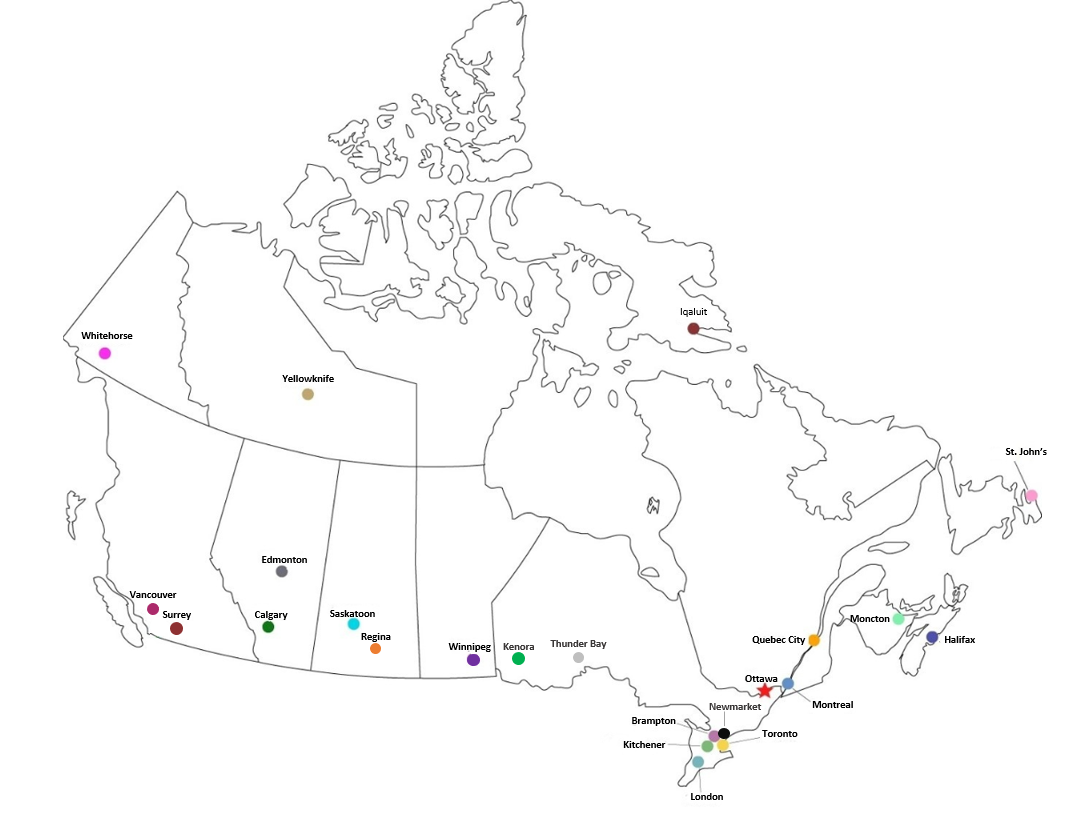
Text Version
A black and white map of Canada with the locations of PPSC offices designated with color-coded circles.
- Ottawa, Ontario (Headquarters & National Capital Region) – Red star
- Kenora, Ontario – Green
- Kitchener, Ontario – Light green
- London, Ontario – Grey-blue
- Newmarket, Ontario - black
- Thunder Bay, Ontario- Light grey
- Toronto, Ontario – Yellow
- Brampton, Ontario – Light purple
- Halifax, Nova Scotia – Periwinkle
- Moncton, New Brunswick – Mint Green
- St-John’s, Newfoundland and Labrador – Light pink
- Montreal, Quebec – Blue
- Quebec City, Quebec – Light orange
- Winnipeg, Manitoba – Purple
- Saskatoon, Saskatchewan – Aqua Blue
- Regina, Saskatchewan – Orange
- Edmonton, Alberta – Grey
- Calgary, Alberta – Forest green
- Vancouver, British Columbia – Dark pink
- Surrey, British Columbia - Brown
- Whitehorse, Yukon – Magenta
- Yellowknife, North Western Territories - Beige
- Iqaluit, Nunavut – Burgundy
Our Employees
The majority of PPSC employees are involved in delivering prosecution services. Approximately 80% are in legal positions and 20% in non-legal positions.
Employees can be categorized into the following key segments:
- Managers and Supervisors (EXs, LCs, other)
- Legal Professionals (LP)
- Legal Support (EC, PM, CR)
- Administrative Support (AS, CR).
- Functional Professionals (IM/IT, IS, PE, FIN)
Key Employee Data
- Workforce (As of March 1, 2024)
- Total Workforce – 1284
- Indeterminate – 1176 (92%)
- Term – 108 (8%)
- First Official Language
- English – 999 (78%)
- French – 285 (22%)
- Employment Equity Distribution (Based on voluntary Self-Identification)
- Women - 865 (67%)
- Indigenous – 81 (6%)
- Persons living with a Disability – 85 (7%)
- Racialized Persons – 275 (21%)
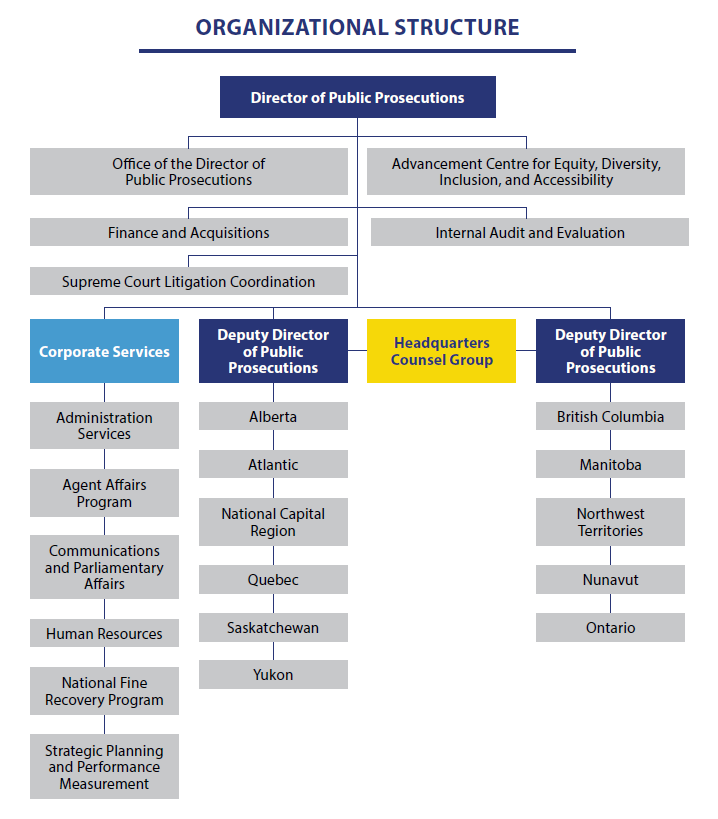
Text Version
- Director of Public Prosecutions
- Office of the Director of Public Prosecutions
- Advancement Centre for Employment Equity, Diversity, Inclusion, and Accessibility
- Finance and Acquisitions
- Internal Audit and Evaluation
- Supreme Court Litigation Coordination
- Corporate Services
- Administration Services
- Agent Affairs Program
- Communications and Parliamentary Affairs
- Human Resources
- National Fine Recovery Program
- Strategic Planning and Performance Measurement
- Deputy Director of Public Prosecutions
- Alberta Region
- Atlantic Region
- National Capital Region
- Québec Region
- Saskatchewan Region
- Yukon Region
- Headquarters Counsel Group
- Deputy Director of Public Prosecutions
- British Columbia Region
- Manitoba Region
- Northwest Territories Region
- Nunavut Region
- Ontario Region
Finance Overview
Comptrollership Considerations during Transition Period
Funding Process - Approval and Reporting Dates
Government expenditure Report Cycle
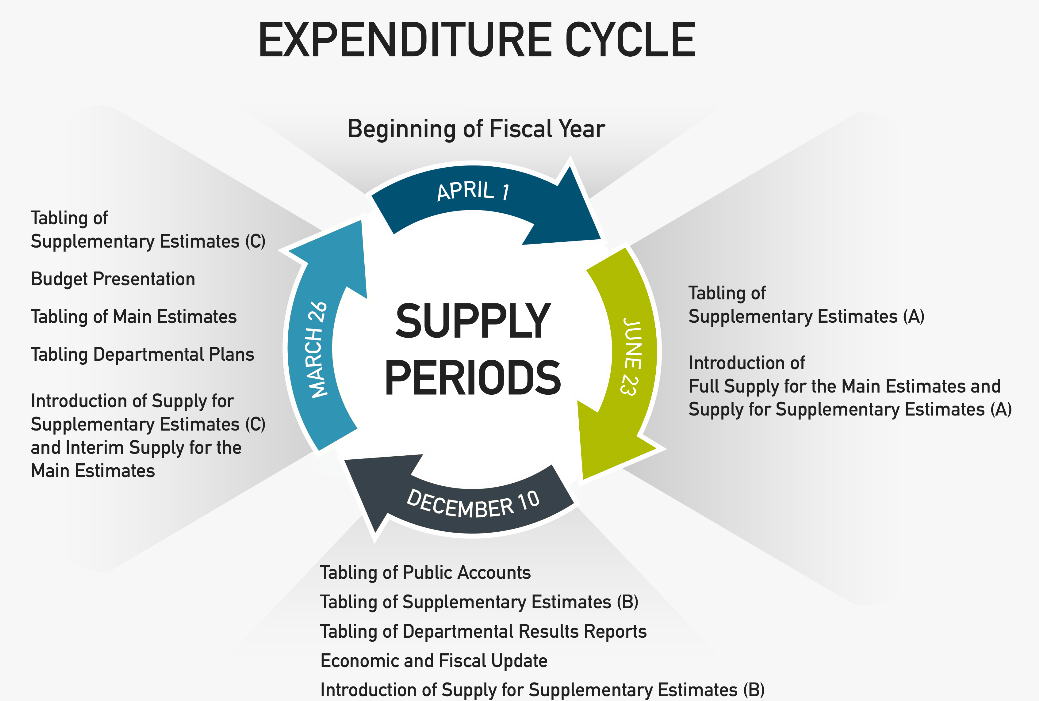
Text Version
- April 1
- Beginning of Fiscal Year
- June 23
- Tabling of Supplementary Estimates (A)
- Introduction of Full Supply for the Main Estimates and Supply for Supplementary Estimates (A)
- December 10
- Tabling of Public Accounts
- Tabling of Supplementary Estimates (B)
- Tabling of Departmental Results Reports
- Economic and Fiscal Update
- Introduction of Supply for Supplementary Estimates (B)
- March 26
- Tabling of Supplementary Estimates (C)
- Budget Presentation
- Tabling of Main Estimates
- Tabling Departmental Plans
- Introduction of Supply for Supplementary Estimates (C) and Interim Supply for the Main Estimates
In order to make expenditures, the government must receive Parliament’s approval, either through previously adopted legislation or, on an annual basis, through the introduction and passage of appropriation bills. Prior to the introduction of each bill, the President of the Treasury Board tables an Estimates publication (Main or Supplementary) in Parliament to provide information and details on spending authorities sought.
Departmental Authorities
| Main | PPSC |
|---|---|
| Main Estimates | PPSC Authorities 2024-25 |
| Vote 1 – Program Expenditures | 188 321 173 $ |
| Statutory | 20 131 848 $ |
| Total | 208 453 021 $ |
Voted Authorities
- Provided through appropriation acts, for one fiscal year.
- Supply is the process by which the government obtains these authorities.
- TB approval is required for an item to be included.
Statutory Authorities
- Expenditure authorities approved by Parliament through legislation (other than appropriations acts).
- The legislation sets out the purpose of the expenditures and the terms and conditions under which they may be made.
Departmental Forecasts
| Core responsibilities and internal services | 2024-25 Budgetary Spending (as indicated in Main Estimates) |
2024-25 Planned spending | 2025-26 Planned spending | 2026-27 Planned spending |
|---|---|---|---|---|
| Prosecution Services | 178,679,052 | 178,679,052 | 178,910,322 | 178,942,962 |
| Internal services | 29,773,969 | 29,773,969 | 29,986,235 | 30,056,211 |
| Total | 208,453,021 | 208,453,021 | 208,896,557 | 208,999,173 |
The PPSC’s planned spending is intended to support its mandate as an independent, accountable national prosecution service, whose primary objective is to conduct prosecutions under federal jurisdiction fairly and without undue influence.
| Core responsibilities and internal services | 2024–25 planned FTEs | 2025–26 planned FTEs | 2026–27 planned FTEs |
|---|---|---|---|
| Prosecution services | 880 | 880 | 880 |
| Internal services | 259 | 259 | 259 |
| Total | 1,139 | 1,139 | 1,139 |
Major Impact on the PPSC Financials
In the 2023 budget, the government committed to reducing spending by 14.1 billion dollars over the next five-year, starting in 2023-24, and by 4.1 billion annually after that. As part of meeting this commitment, the PPSC is planning the following spending reductions:
| Reductions | 2023-24 | 2024-25 | 2025-26 | 2026-27 and ongoing |
|---|---|---|---|---|
| Notional Reductions for Professional Services and Travel | 972,000 | 1,766,000 | 1,766,000 | 1,766,000 |
Please note that the 2024 federal budget conveys that the second phase will rely on ‘historical rates of natural attrition’ to decrease the public service by 5000 full-time equivalent positions from the current figure of about 368,000.
Previous Federal Budgets
The previous federal budgets have included the following items, which have had a positive impact on the organization’s funding:
Ongoing funding has been granted for the following initiatives:
- Improving Access to Drug Treatment Courts ($3.0M)
- Assists in Fighting Tax Evasion in a Complex Global Digital Environment ($2.7M)
Year-end Results 2022-23
- For 2022-23, the PPSC had net spending of $208.7M and total unused authorities of $20.4M.
- The unused authorities included $2.5M of funds that could not be carried over for use in 2023-24 because these funds were dedicated to the recovery of outstanding federal fines (special purpose allotment). The remaining unused funds of $17.9M were from the operating budget and $10.5M were carried forward to be spent in 2023-24.
2022-23 Detailed Expenses and Revenues
| Expenses | Prosecution Services | Internal Services | 2022-23 |
|---|---|---|---|
| 2022-23 | 2022-23 | ||
| Salaries | 120,750,482 | 20,346,048 | 141,096,531 |
| Communication | 771,869 | 1,098,718 | 1,870,588 |
| Travel and relocation | 5,206,737 | 352,962 | 5,559,699 |
| Information | 185,469 | 229,073 | 414,542 |
| Professional and special services - Counsel fees | 34,765,413 | 0 | 34,765,413 |
| Professional and special services - Other | 2,865,965 | 6,798,669 | 9,664,634 |
| Accommodation | 2,109,333 | 24,906 | 2,134,239 |
| Rentals | 53,823 | 568,117 | 621,940 |
| Repair and maintenance | 45,213 | 2,166,852 | 2,212,065 |
| Utilities, materials and supplies | 1,358,675 | 158,880 | 1,517,555 |
| Acquisition of machinery and equipment | 321,261 | 1,707,082 | 2,028,344 |
| Other | 696,461 | 2,607,408 | 3,303,869 |
| Gains on Foreign Exchanges | 0 | -86 | -86 |
| Total Expenses | 169,130,700 | 36,058,630 | 205,189,330 |
| Revenues | Prosecution Services | Internal Services | 2022-23 |
|---|---|---|---|
| 2022-23 | 2022-23 | ||
| Prosecution & Internal Services | -19,111,936 | -113,224 | -19,225,160 |
| Refunds of previous Years Expenditures | -278,697 | -268,623 | -547,320 |
| Adjustments of Previous Years Payable at Year-End (PAYE) | -1,316,818 | -350,758 | -1,667,576 |
| Gain on disposal of Capital Assets | 0 | 0 | 0 |
| Revenue from Fines | -77,945,876 | 0 | -77,945,876 |
| Rent from residential housing provided to employees | -745,742 | 0 | -745,742 |
| Miscellaneous | -352 | 0 | -352 |
| Total Revenues | -99,399,421 | -732,605 | -100,132,026 |
| Summary of the National Fine Recovery Program (NFRP) | 2022-23 |
|---|---|
| Salaries | 1,159,806 |
| Communication | 4,887 |
| Travel and relocation | 5,531 |
| Information | 410 |
| Professional and special services - Counsel fees | 0 |
| Professional and special services - Other | 254,834 |
| Rentals | 0 |
| Utilities, materials and supplies | 2,008 |
| Acquisition of machinery and equipment | 482 |
| Other | 22,874 |
| Total Expenses | 1,450,832 |
Financial Reporting & Submissions
- PPSC has several financial reports and submissions requiring ministerial briefing, review and/or approval.
- The table below highlights some of the most relevant reports.
| Reports | Timing | Director to Approve | Minister to Approve | Memorandum to Minister |
|---|---|---|---|---|
| Financial Statements | Send to the Treasury Board at the beginning of September | Yes | No | No |
| Letter of representation | June | Yes | No | No |
| Annual Report on Travel, Hospitality and Conferences Expenditures | Published in June | Yes | No | No |
| Quarterly Financial Reports | Published 60 days after the end of the quarter | Yes | No | No |
| Proactive disclosure of contracts | 30 days after the end of the first 3 quarters and 60 days after the end of the 4th quarter | Yes | No | No |
| Proactive disclosure of travel and hospitality expenses | Monthly Publication | Yes | No | No |
| Budgetary Appropriation | Before the end of March | Yes | No | No |
| Indigenous Procurement Planning | Beginning of April | Yes | No | No |
| Adhoc requests – Expense reimbursement in the event of an extension or exception to the provisions of the NJC Travel Directive | Not applicable | Yes | No | No |
Departmental Plan (DP)
|
Tabled in March | Yes | Yes | No |
Departmental Results Report (DRR)
|
Tabled in December | Yes | Yes | No |
Public Accounts of Canada
|
Tabled in December | Yes | No | Yes |
Treasury Board Submissions
|
As required | Yes | Yes | No |
Legal Assistance and Indemnification Submissions
|
As required | Yes | Yes | No |
Main, Interim and Supplementary Estimates
|
Throughout the funding process | Yes | No | Yes |
National Fine Recovery Program
Mandate
In 2007, the Attorney General of Canada assigned the function of recovering federal fines to the DPP under paragraph 3(3)(g) of the DPP Act. The National Fine Recovery Program’s (NFRP) mandate is to enforce sentences by recovering outstanding fines ordered against individuals and companies convicted under federal statutes. The NFRP’s mandate starts when a fine goes into default of payment according to the court order and ends with the remittance of the money recovered by the NFRP to the provinces and territories, or the write-off of the debt when deemed non-recoverable.
Background
The NFRP is a national program. It is part of the Corporate Services Branch and currently employs twenty (20) full-time employees (FTEs) located in various regional offices across Canada. The NFRP is a multidisciplinary team composed of Recovery Officers, Paralegals, a Legal Advisor, Administration Officers, and Program Support Clerks.
The federal fine regime in Canada is extremely complex. Sections 734 to 738 of the Criminal code (C.c.) provide a variety of powers the NFRP may use in the recovery of fines, such as the suspension of federal licenses and permits, the use of various civil recourses, warrants of incarceration, fine option programs, and others. While these provisions appear effective on paper, there are several gaps in the provisions pertaining to fines and forfeiture, which undermine the proper administration of justice in Canada. The Government continues to have very little leverage to enforce the payment of its federal fines. It does not issue the most common licenses, fine option programs have not been created at the federal level, and the Government does not have access to fine option programs in the provinces and territories where they do exist.
In 2020, the PPSC submitted a proposal to the Minister of Justice to consider amending sections 734.4 to 734.6 of the C.c. to reflect the provisions contained in sections 55.1 and 60 of the Cannabis Act.This would enable the PPSC to enter into agreements with the provinces and territories to benefit from their fine enforcement programs and infrastructure to enforce the payment of outstanding federal fines. The proposed legislative amendments are intended to preserve the integrity of the criminal justice system and confidence in public institutions, by providing additional tools for the enforcement of fines imposed under the C.c. and other federal legislations, and by ensuring that offenders do not intentionally default on paying fines with impunity.
Fine Inventory
As of February 2024, fines in default of payment that are due to the Government represent thirty-one thousand (31K) files, for a total value of two hundred and seventy-two million dollars ($272M). The NFRP processes, on average, five thousand (5k) files per year and recovers between one and three million dollars per year. Despite the provisions in the C.c. under s.734(2) regarding validation of an individual’s financial capacity to pay at the time of sentencing, this remains one of the biggest issues in the fine regime. In the last decade, only 5.3%Footnote 2 of the federal fines ordered have been paid, according to the court order. Inquiry into the ability to pay may be seen as perfunctory, rather than a necessary source of reliable and useful information. Civil enforcement mechanisms are onerous and costly, and they depend on the PPSC having access to current financial information. At the same time, the law also requires that mandatory minimum fines and fines "in lieu of forfeiture" be imposed on people with no means to pay, for certain offences. Work has begun to reintroduce a chapter in the PPSC Deskbook to build Crown Prosecutors’ awareness of this problematic issue, but the PPSC must continue to work with the Attorney General of Canada to develop solutions to stop the surge of unpaid fines resulting from PPSC’s prosecutions and sentences.
Program Reform
In 2019, the PPSC took steps to modernize its program operations and to experiment with new initiatives to increase recoveries. The NFRP has implemented a hybrid recovery model using new Government partners and programs and several external partners. A new online payment portal was launched in January of 2023, offering additional payment options to Canadians with outstanding fines. Discussions are also underway with the Canada Revenue Agency (CRA) to develop an agreement for information sharing to allow the NFRP to undertake advanced civil recoveries.
While many new initiatives have already been implemented as part of the ongoing program reform, the NFRP continues to work on addressing its two main challenges: the development of a direct link to all provincial & territorial court registries and the implementation of a functional IT solution to manage its recovery operations.
[Redacted]
- Date modified: