
Supporting Notes: Spending, Financial, and other Authorities
Spending, Financial, and Other Authorities
Effective February 6, 2020
Table of Contents
- 0 — PREAMBLE
- 0.1 Context
- 0.2 Objective
- 0.3 Types of Authorities
- 0.4 Structure
- 0.5 Principles and Procedural Requirements
- Mandatory Use of Specimen Signature Records (SSR)
- Mandatory Training
- Director of Public Prosecutions
- Associate Deputy Minister of PSPC
- Separation of Duties
- Personal Benefit from Transactions
- Electronic Authorization
- Inappropriate Use of Spending, Financial, and Other Authorities
- Limitation of Authorities
- Hierarchy of Documents
- Extent of Delegation and Dollar Values
- 0.6 Acronyms
- 0.7 Enquiries
- 1 – SPENDING AUTHORITY: EXPENDITURE INITIATION AUTHORITY
- Functional Oversight Authority Approval
- 1.1 Goods and Services
- 1.2 Travel
- 1.3 Hospitality
- 1.4 Conference
- 1.5 Events
- 1.6 Human Resources (e.g., salaries, wages, awards and recognition, and training)
- 1.7 Membership Fees
- 1.8 Relocation
- 1.9 Isolated Posts and Government Housing
- 1.10 Claims Against the Crown and Ex Gratia Payments
- 1.11 Claims Related to Phoenix Pay Issues
- 2 – SPENDING AUTHORITY: COMMITMENT AUTHORITY
- 3 — SPENDING AUTHORITY: TRANSACTION AUTHORITY
- Transaction Authority Approval Table
- 3.1 Services
- 3.2 Goods
- 3.3 Call-up Against Standing Offer and Supply Arrangements
- 3.4 Acquisition Cards – Goods and Services
- 3.5 Departmental Travel Expense Cards
- 3.6 Real Property – Lease, licence, transfer of administration and control
- 3.7 Emergency Contracts
- 3.8 Crown Agents Acting as Federal Prosecutors
- 4 — FINANCIAL AUTHORITY: CERTIFICATION AUTHORITY
- 5 — FINANCIAL AUTHORITY: PAYMENT AUTHORITY
- 6 — OTHER AUTHORITIES
- 6.1 Accountable Advances
- 6.2 Garnishments, Set-offs and Recoveries
- 6.3 Interest and Administrative Charges – Waive or Reduce
- 6.4 Debt Write-Off
- 6.5 Losses of Money
- 6.6 Disposals and Transfers of Materiel
- 6.7 Agreements with Other Entities
- 6.8 Journal Vouchers
- 6.9 Control of Receiver General Cheques
- 6.10 Legal Assistance and Indemnification for Crown Servants
- 6.11 Low-Value Amounts – Collection and Payment
- 6.12 Modifications to the Table of Equivalent Positions and to the Supporting Notes
- APPENDIX A — DEFINITIONS
0 — PREAMBLE
0.1 Context
The authority to spend money out of appropriations is approved by Parliament through appropriation acts or through legislation in the form of statutory spending authority. Spending, financial, and other related authorities are delegated by ministers to deputy heads in accordance with the Department of Public Works and Government Services Act, the Shared Services Canada Act and the Financial Administration Act (FAA) and any related regulations made pursuant thereto. Hence, by signing the PPSC Delegation of Spending and Financial Signing Authorities Chart, the Minister of Justice and Attorney General of Canada delegate those authorities to the Director of Public Prosecutions (DPP) who in turn, delegates these authorities in conformity with the relevant laws and policy instruments. Authorities are also delegated by the DPP in accordance with the Director of Public Prosecutions Act, except when specified otherwise.
0.2 Objective
These Supporting Notes explain the application of, and restrictions on, the delegated spending, financial, and other authorities for which designated persons are accountable. In so doing, this document ensures designated persons are familiar with concepts and requirements of the Treasury Board (TB) Directive on Delegation of Spending and Financial Authorities and the TB Guide to Delegating and Applying Spending and Financial Authorities.
0.3 Types of Authorities
Authorities can be delegated at operational and functional levels. A list of position titles for each delegated level is provided in the PPSC Table of Equivalent Positions.
Operational Authorities (levels 1 to 5)
Operational authorities are given to positions that are accountable for a budget. Such positions are generally occupied by Responsibility Centre Managers (RCM), but also include Business Coordinators and Administrative Staff.
Functional Authorities (levels 6 to 9)
Delegated functional authorities are given to positions occupied by specialists who can approve transactions on behalf of RCMs within their area of expertise. Functional specialists have specific expertise in areas such as finance, contracting, information technology (IT), Crown agent fees and disbursements, and other corporate functions. Upon the recommendation of the RCM, the DPP, the Chief Financial Officer (CFO) or the Deputy Chief Financial Officer authorizes the specimen signature records (SSR) for delegated levels 8 and 9.
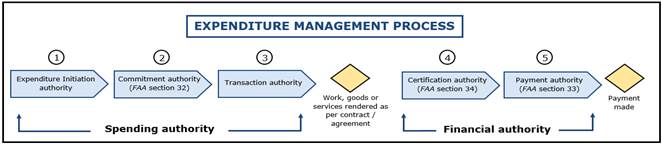
The above authorities constitute an integral part of the Expenditure Management Process, as depicted below:
0.4 Structure
| Section | Subject | FAA | Audience | Description | |
| Spending Authorities | 1 | • Expenditure initiation authority | N/A | • RCM • Functional Specialist |
• Designated persons make the initial decision on whether or not to obtain goods, to acquire services or to incur an expenditure |
| 2 | • Commitment authority | Section 32 | • RCM | • Designated persons ensure there is sufficient unencumbered balance available and funds are committed (decision recorded in the financial system) | |
| 3 | • Transaction authority | N/A | • RCM • Acquisitions Specialist |
• Designated persons negotiate, prepare and issue contracts based on the RCM's initial decision | |
| Financial Authorities | 4 | • Certification authority | Section 34 | • RCM • Functional Specialist |
• Designated persons certify contract performance and price, entitlement or eligibility for the payment |
| 5 | • Payment authority | Section 33 | • Financial Specialist | • Designated persons request payments to be issued to payees, certify that it represents a lawful charge against an appropriation and that appropriations have not been exceeded | |
| Other Authorities | 6 | • All other financial and administrative authorities from various laws or policy instruments | Various sections | • RCM • Functional Specialist |
• Designated persons exercise authorities for specific and complex financial transactions, and administrative authorities |
Appendix A |
N/A | • Definitions of frequently used terms | N/A |
• All | • Definition of common terms |
| RCM: Responsibility Centre Manager | |||||
0.5 Principles and Procedural Requirements
Mandatory Use of Specimen Signature Records (SSR)
Authorities must be delegated in writing to positions identified by title and not to individuals identified by name. The SSR is used to:
- Confirm the specific authorities that the incumbent of a delegated position can exercise as a result of the roles and responsibilities to be carried out; and
- Authenticate the signature that the incumbent uses when signing.
Incumbents may not exercise their authorities until their SSR has been completed, validated, and activated. A SSR is activated when the incumbent receives an email confirmation from the PPSC Delegation of Authorities / SPPC Délégation des pouvoirs mailbox.
The only exception to this requirement is for the Pay Verification Advisor positions at Public Services and Procurement Canada (PSPC), who are delegated FAA section 34 functional authority under level 9. The incumbents of these positions do not require an SSR to be completed, validated or activated for the incumbent to exercise this authority.
The steps to be followed to ensure that the spending, financial, and other authorities are properly delegated to the permanent or temporary incumbent of an existing position are described in the PPSC Procedure for Managing Specimen Signature Records.
Mandatory Training
Successful completion of mandatory training as identified in the TB Directive on the Administration of Required Training and the Canada School of Public Service is required for all individuals (incumbents and acting) before they can exercise delegated spending and financial authorities. This includes the knowledge assessment RCM must complete every five years. For an on demand period of four months or less, individuals with on demand delegated spending and financial authorities, at a higher level than they would normally possess, must successfully complete the minimum level 5 required training. When the on demand period is over four (4) months, they must have successfully completed the required training for the delegated level.
| Required Training Courses |
|
Director of Public Prosecutions
The CFO and DCFO are designated persons who may exercise delegated spending and financial authorities on behalf of the Director of Public Prosecutions (DPP), unless restricted in this document.
Associate Deputy Minister of PSPC
As delegated by the Minister of Justice, the Associate Deputy Minister of PSPC may exercise full functional authority for sections 33 and 34 approvals under the FAA for PPSC's salary expenditures in emergency situations associated with the pay administration system.
Separation of Duties
The following authorities shall be exercised by different designated persons on the same transaction:
- Transaction authority;
- Certification authority (FAA, section 34); and
- Payment authority (FAA, section 33).
Under exceptional circumstances where separation of duties is not possible, alternate control measures must be set up and documented. Consultation with the CFO or the DCFO is mandatory when this is considered.
For any specific transaction, certification authority and payment authority shall never be exercised by the same designated person. There are no exceptions to this rule.
Personal Benefit from Transactions
Designated persons shall not exercise their delegated spending, financial and other authorities for transactions from which they could personally benefit, directly or indirectly. The designated person's superior, the CFO, the DCFO, or the Director, Financial Services Division must exercise delegated authorities in such cases. Examples include travel, relocation, hospitality, membership fees, training, tuition fees, mobile devices and disposal and transfer of materiel.
Electronic Authorization
Electronic authorization allows the partial or full elimination of paper-based signatures, leading to simplified processes and faster transaction approval.
Designated persons may provide their electronic authorization either through an electronic signature authentication or through an email chain of communication that includes a digital signature using Entrust (to create accountability and confirmation of the identity of the sender). Computer access controls must be sufficient and effective to ensure that the electronic authorization is provided only by an authorized designated person and that the person can be identified and the signatures can be authenticated. The electronic authorization should provide sufficient information to allow authentication to take place, and to retain the authorization in accordance with documentation retention requirements.
Designated persons using electronic authorization should have sufficient training on the use of the system and on the use of the corresponding authorization. To ensure that electronic authorizations are being used correctly and to remind users to protect their electronic signature and passwords, the following internal controls from the TB Guide to Delegating and Applying Spending and Financial Authorities are to be implemented:
- Each individual's electronic authorization is unique and is authenticated through password protection;
- The signature of an authorized individual can be identified to that individual reliably; and
- The integrity of the delegated authorities reflected in the system are protected so they cannot be altered inappropriately.
Inappropriate Use of Spending, Financial, and Other Authorities
Designated persons are responsible for understanding sections 76 to 82 (Civil Liability and Offences) of the Financial Administration Act as well as sections 121 (Frauds on the government), 122 (Breach of trust by public officer), 322 (Theft) and 380 (Fraud) of the Criminal Code.
Limitation of Authorities
Delegations should be risk-based: where departmental controls and individual accountabilities are designed to balance the timely delivery of programs and the empowerment of designated persons. Designated persons cannot sub-delegate their spending, financial and other authorities to others (e.g., subordinates) and cannot allow them to use their delegation on their behalf.
Designated persons may restrict or revoke the authorities of their subordinates for reasons of abuse, wrongdoing, budgetary constraints, operational requirements, or repetitive non-compliance. The DPP and CFO have this authority in respect of any designated person.
Hierarchy of Documents
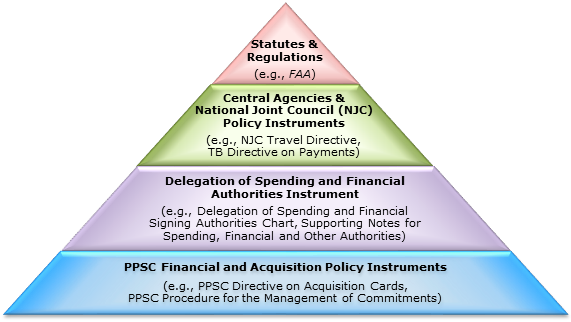
The PPSC Delegation of Spending and Financial Signing Authorities Chart and this document must be read in conjunction with other related documents in order of precedence within the following structured hierarchy. Any new or amended statute, regulation or policy instrument that comes into effect after the publication of the Supporting Notes shall supersede the information found in the Supporting Notes.
Extent of Delegation and Dollar Values
Designated persons may have full (F) or restricted (R) authorities – Full authorities are subject to an approved budget and area of authority. Restricted authorities are subject to an approved budget and area of authority, and subject to limitations and restrictions as set out by the appropriate statutes, regulations, policy instruments and this document.
The letters "K" and "M" in this document indicate that the amounts are expressed in thousands and millions of dollars, respectively.
VAT (Value Added Taxes) – Unless otherwise specified, all amounts in this document include applicable value added taxes, which, for the purpose of this document, is limited to GST, HST and QST.
Blank – A blank cell means no authority has been delegated.
0.6 Acronyms
A description of acronyms used in these notes is available in the list of acronyms related to finance and acquisitions.
0.7 Enquiries
Please direct enquiries about this document to PPSC Financial Policy / SPPC Politiques financières.
1 – SPENDING AUTHORITY: EXPENDITURE INITIATION AUTHORITY
Expenditure initiation authority is the first step in the expenditure management process. It is exercised when RCMs decide to obtain goods, to acquire services or to incur an expenditure. Before exercising this authority, RCMs must ensure that:
- the planned transaction is for a legitimate operational or business requirement;
- an authority exists that allows for the expenditure of public funds for that requirement; and
- the planned transaction represents the most efficient and economical means to meet the requirements.
Although RCMs may ask support staff to perform tasks related to the account verification, RCMs remain accountable for the correctness of the transaction.
RCMs must also obtain approval from, or consult with, the appropriate functional oversight authority, as indicated in the following table:
| Functional Oversight Authority Approval | |||
| Activities/Goods/ Services |
Description/Examples | Functional Oversight Authority | Requirements |
| Books and research databases | Includes print and digital resources for inclusion in headquarters and regional library collections or books kept exclusively at an employee's desk or at a unit's bookcase for their group's reference. Excludes training-related resources. | • Law Practice Management (PPSC Library) | • Approval |
| Claims related to Phoenix pay issues | A claim for income tax advice, impacts to income taxes and/or a claim for out-of-pocket expenses because of incomplete or inaccurate pay resulting from the implementation of the Phoenix pay system. | • Finance and Acquisitions Directorate (Claims Officer) | • Consultation |
| Communications | Advertising and public announcements. | • Communications Division | • Approval |
| Events | Involves gatherings of individuals (both public and/or non-public servants) engaged in activities other than operational activities of the PPSC. Examples of events include, but are not limited to management and staff retreats, participation in conferences, awards and recognition ceremonies and departmental celebrations. | • Finance and Acquisitions Directorate (Financial Services) | • Consultation |
| IT equipment | Acquisition (purchase or lease) of computers (e.g., servers, PCs, laptops, tablets, notebooks) and related equipment (e.g., monitor, docking station, keyboard, mouse or pointing device, digital pencil, printer, scanner, memory devices such as hard drives and USB/flash drive, CD/DVD writer/reader, webcams) that will be connected to GC IT systems at any point in time. | • Administration Services Division (Information Technology Section) | • Approval |
| IT-related services* | Consulting services for application development, feasibility studies. | • Administration Services Division (Information Technology Section) |
• Approval |
| Information products | Brochures, newsletters, posters, exhibits, promotional items with the PPSC or Government of Canada logo. | • Communications Division | • Approval |
| Media | Films, videos, multimedia productions, co-productions, co-distributions and evaluation of motion-picture films, videotapes and television programs, interactive videodiscs and multimedia presentations. | • Communications Division | • Approval |
| Moving of Furniture | Filing cabinets, desks, cubicle walls. | • Administration Services Division (Facilities Management Services Section) | • Approval |
| Office equipment (non-computer) that has an impact on power supply, floor load or air quality | Safe, electronic file shelving. | • Administration Services Division (Facilities Management Services Section) | • Approval |
| Office equipment — small appliances | Fans, space heaters, humidifiers, dehumidifiers, air purifiers, light therapy devices (refer to >PPSC Policy on Small Appliances and Devices). | • Local Occupational Health and Safety (OHS) Committee; or • Human Resources Directorate (OHS Section) |
• Consultation |
| Office furniture, including those stemming from ergonomic assessments | Desks, tables, workstations, workstation panels, bookcases, storage cabinets, chairs, electronic filing shelves. | • Administration Services Division (Facilities Management Services Section) • Local OHS Committee (for ergonomic assessments) |
• Approval • Consultation |
| Public opinion research | Polling, focus groups, syndicated surveys. | • Communications Division | • Approval |
| Real Property | Facilities, office accommodations, space planning and design services, office move. | • Administration Services Division (Facilities Management Services Section) | • Approval |
| Security items or equipment | Secure filing cabinets, security briefcases, safes. | • Administration Services Division (Security Services Section) | • Approval |
| Security items or equipment related to home alarm systems | Includes the cost of basic alarm system, maintenance, system upgrades and monthly charges. Approval of monthly charges is required annually. | • Administration Services Division (Security Services Section) | • Approval |
| Security items or equipment related to IT/Telecommunications | Secure telephones and fax machines, encryption devices and software. | • Administration Services Division (Information Technology Section) | • Approval |
| Software* | All software and applications, including new, additional copies, upgrades, and development. | • Administration Services Division (Information Technology Section) | • Approval |
| Subscriptions | Magazine, print newsletters and newspapers. | • Communications Division | • Consultation |
| Websites | Web content/sites intended for the PPSC's internet, intranet or extranet environments; web content/sites to be part of a non-PPSC site (e.g., Facebook, Twitter), that are to be hosted by another organization or that represent a partnership / collaboration. | • Communications Division | • Approval |
| Workplace accommodations for persons with disabilities | Work-related technical aids such as reading devices for the visually impaired, special computer technology, desks, tables, workstations adapted for wheelchairs. | • Human Resource Directorate; and • Administration Services Division (IT Section and Facilities Management Services Section) |
• Consultation • Approval |
| * Functional oversight requirement does not apply for expenditures falling within cost centre 91010 – HQ Case Management System | |||
1.1 Goods and Services
| Key Principles | Related Policy Instruments |
| • Goods are defined as tangible consumable supplies, stationery, office furniture and furnishings, equipment, software, library books, etc. • Services are defined as intangible consumables. Services cover a wide range of professional and consulting services, research and scientific studies, maintenance and repair, legal services, financial and administrative services, etc. • Legal services are services requiring technical or specialized knowledge and include litigation and legal advisory services, witness costs, expert witness services, escort costs, court filing fees, sheriff and bailiff fees, credit and search reports, and interpretation services. • Spending authorities for goods and services are required on all purchase orders and contracts. These authorities should be exercised in consultation with the appropriate functional oversight authority and may require their functional approval (see section 1). • When the expenditure is considered to be part of an event, section 1.5 also applies. |
• Director of Public Prosecution Act - subsection 8(2) • PPSC Contracting Directive for the Acquisition of Goods and Services |
Goods and Services Approval
Expenditure initiation for goods and services are delegated to levels 1 to 8 and restricted to the RCM's budget and area of authority.
- For delegated level 5, Business Coordinators and Administrative Staff may only exercise this authority up to a maximum of $1,000 as specified by their RCM on their SSR. Further, for any transaction where this authority is approved by a Business Coordinator or Administrative Staff, they must not exercise certification authority (section 34 of the FAA) for that same transaction. The RCM remains responsible for resulting charges to their budget.
- For delegated level 8, the authority is restricted to the Director, Financial Services Division.
Only delegated levels 1 to 4, 5 (restricted to directors and managers), 6 and 7, however, may exercise expenditure initiation for legal services to be performed by an agent previously appointed by the DPP through a fixed-term agreement to act as a federal prosecutor.
1.2 Travel
| Key Principles | Related Policy Instruments |
| • When the travel expenditure is considered to be part of an event, section 1.5 also applies. • Travel must always be pre-authorized unless there is a documented emergency or exceptional situation. • Specific provisions and the required authorizations are identified in the NJC Travel Directive. • Travel advances are not cost-effective and are discouraged. Instead, employees should consider the use of an individual designated travel card. • RCMs are responsible for considering alternative means to avoid or minimize travel costs before pre-authorizing travel requests. |
• National Joint Council (NJC) Travel Directive • TB Directive on Travel, Hospitality, Conference and Event Expenditures • TB Guide to Travel, Hospitality, Conference and Event Expenditures • TB Special Travel Authorities • PPSC Directive on Blanket Travel Authorities • PPSC Procedure on Blanket Travel Authorities • PPSC Travel Section • PPSC Forms: Blanket Travel Authority (PPSC-SPPC 0108) and Cost Comparison for Government Business Travel with Personal Leg (PPSC-SPPC 0161) • Government of Canada Form: Travel Authority and Advance (GC 72) |
Travel Approval
| Specific Travel Approval Restrictions | Delegated Level | ||||||
| 1 | 2 | 3 | 4 | 5 (Note 1) | 6 | ||
| Reimbursement of exceptions or extensions to the provisions of the NJC Travel Directive (Note 2) | $10K | ||||||
| International travel – outside Canada and continental USA (Note 3) | ✓ | ✓ | ✓ | ||||
| Business / executive-class air travel (Note 4) | ✓ | ✓ | ✓ | ||||
| Supplementary business insurance premium for privately owned vehicles | ✓ | ✓ | ✓ | ||||
| Travel costs for civilian witnesses (Note 5) | ✓ | ✓ | ✓ (Note 5) | ✓ | |||
| Travel within Canada and continental USA | ✓ | ✓ | ✓ | ✓ | ✓ | ||
| Local travel (within 65 km from the assigned workplace) | ✓ | ✓ | ✓ | ✓ | ✓ | ✓ | |
| Note 1 | Restricted to directors and managers | ||||||
| Note 2 | Level 1 can approve exceptions or extensions to the provisions of the NJC Travel Directive not exceeding $10,000. Those exceeding $10,000 need the approval of the TB Travel Program Authority. | ||||||
| Note 3 | Where available, business / executive-class air travel shall be authorized where continuous air travel exceeds nine hours. Continuous air travel starts at the scheduled flight departure time, and ends with the arrival at the destination terminal or with an overnight stop or layover equivalent to an overnight stop. | ||||||
| Note 4 | The standard for air travel is the economy class; first class air travel is not permitted. The use of business / executive-class air travel for trips of 850 air kilometres or more one way may be pre-authorized for eligible travellers at the following groups and levels, and above, in accordance with the TB Special Travel Authorities: Outside the National Capital Region: EX-1, LP-02, LC-1 In the National Capital Region: by EX-2, LP-03, LC-1 This authority cannot be extended to travellers accompanying employees entitled to travel in business / executive-class, except when the travellers are employees covered by this note. Additionally, it does not cover weekend travel home. If business / executive-class is unavailable, economy fares are to be used for booking. |
||||||
| Note 5 | Restricted to Chief Federal Prosecutors responsible for the Yukon Regional Office, the Northwest Territories Regional Office and the Nunavut Regional Office. | ||||||
1.3 Hospitality
| Key Principles | Related Policy Instruments |
|
• TB Directive on Travel, Hospitality, Conference and Event Expenditures • TB Guide to Travel, Hospitality, Conference and Event Expenditures • National Public Service Week: Serving Canadians Better Act • PPSC Form: Authority to extend hospitality (PPSC-SPPC 0006) |
Hospitality Approval
| Specific Hospitality Approval Restrictions | Delegated Level | ||||
| Minister | 1 | 2 | 3 | 6 | |
| • Hospitality activity for which the costs exceed $10,000 | ✓ | ||||
| • Alcoholic beverages will be provided | ✓ | ||||
| • Food and beverage costs exceed the maximum cost per person | ✓ | ||||
| • Entertainment activities will be provided | ✓ | ||||
| • Hospitality or entertainment activities will be provided to a person accompanying an event participant | ✓ | ||||
| • Hospitality paid by the federal government will be extended at the residence of a public servant | ✓ | ||||
| • Hospitality activity for which the costs exceed $3,000, but not $10,000 | ✓ | ✓ | |||
| • Hospitality provided as part of an awards ceremony | ✓ | ✓ | |||
| • Exceptionally, other reasonable measures deemed appropriate for reasons of courtesy, diplomacy, or protocol when public servants are required to accompany non-public servants | ✓ | ✓ | |||
| • Hospitality for the National Public Service Week: Serving Canadians Better Act | ✓ | ✓ | |||
| • Food and beverage costs per person exceeding the standard cost, but not the maximum cost per person | ✓ | ✓ | |||
| • Hospitality activity for which the costs exceed $500, but not $3,000 | ✓ | ✓ | ✓ | ✓ | |
| • Hospitality activity for which the costs do not exceed $500 | ✓ | ✓ | ✓ | ✓ | ✓ |
1.4 Conference
| Key Principles | Related Policy Instruments |
| • When a conference expenditure (e.g., conference attendance for one or multiple public servants) is considered to be part of an event, section 1.5 also applies. • When travel is involved, section 1.2 also applies. • When hospitality is involved, section 1.3 also applies. • Conference activities must contribute directly to government objectives and alternative means to avoid or minimize conference costs must be considered. |
• TB Directive on Travel, Hospitality, Conference and Event Expenditures • TB Guide to Travel, Hospitality, Conference and Event Expenditures • PPSC Policy on Learning, Training and Development |
Conference Attendance Approval
Conference attendance requires the approval of levels 1, 2, 3 (restricted to Senior Organizational Manager), or 6. All approvals must comply with the PPSC Policy on Learning, Training and Development.
Hosting a Conference Approval
Hosting a conference requires the approval of levels 1, 2 or 6. For the application of this authority, hosting a conference means:
- Paying for all the conference costs; or
- Sharing the conference costs, while being the main host; or
- Sharing the conference costs, while not being the main host.
1.5 Events
| Key Principles | Related Policy Instruments |
|
• TB Directive on Travel, Hospitality, Conference and Event Expenditures • TB Guide to Travel, Hospitality, Conference and Event Expenditures |
Event Approval
| Specific Event Approval Restrictions | Delegated Level | |||||
| Minister (Note 1) | 1 | 2 | 3 | 6 | ||
| Any event for which the total costs exceed $50,000 | ✓ | |||||
| Any event for which the total costs exceed $25,000, but not $50,000 | ✓ | ✓ | ||||
| Any event for which the total costs exceed $1,000, but not $25,000 | ✓ | ✓ | ✓ | ✓ (Note 2) | ✓ | |
| Any event for which the total costs do not exceed $1,000 | ✓ | ✓ | ✓ | ✓ | ✓ | |
| Note 1 | The Minister must be provided with the total estimated federal cost for all participating departments, including the total estimated travel costs, for information purposes, when their approval is required for an event hosted by the PPSC. It does, however, exclude salary and wage costs of public servants and other PPSC fixed operating costs. | |||||
| Note 2 | Restricted to positions reporting directly to the DPP. | |||||
1.6 Human Resources (e.g., salaries, wages, awards and recognition, and training)
| Key Principles | Related Policy Instruments |
| • Authority to initiate expenditures to account for salaries, wages, awards and recognition, training and all other areas of Human Resources (HR). • The PPSC Human Resources Directorate should be contacted for further information on HR delegated authorities. |
• PPSC Delegation of Human Resources Authorities • TB Policy Framework for the Management of Compensation • PPSC Terms and conditions of employment / collective agreements of various positions |
1.6.1 Human Resources Approval
Delegated levels 1 to 4, 5 (restricted to directors and managers), 6 and 7 can exercise expenditure initiation authority for Human Resources-related expenses not otherwise specified in sub-sections 1.6.2 to 1.6.4.
1.6.2 PPSC Awards and Recognition Approval
| Key Principles | Related Policy Instruments |
| • Terms and conditions, including eligibility and restrictions, are specified in the PPSC Awards and Recognition Policy. • Awards categories, criteria, financial considerations and the nomination process, are specified in the PPSC Awards and Recognition Program. |
• PPSC Awards and Recognition Policy • PPSC Awards and Recognition Program |
Approval table
| Awards and Recognition Type | Maximum Amount | Delegated Level | ||||||
| 1 | 2 | 3 |
4 |
5 (Note 1) | 6 | 7 | ||
| Achievement Award (Note 2) |
$435 for an individual $2,000 for a team ($250 per individual) |
✓ | ✓ | |||||
| Leadership Excellence Award (Note 2) | $350 | ✓ | ✓ | |||||
| Creativity and Innovation Award (Note 2) | $350 for an individual $1,000 for a team ($250 per individual) |
✓ | ✓ | |||||
| Instant Awards | $150 | ✓ | ✓ | ✓ | ✓ | ✓ | ✓ | ✓ |
| Long Service Awards | $350 | ✓ | ✓ | ✓ | ✓ | ✓ | ✓ | ✓ |
| Retirement Certificates | $70 | ✓ | ✓ | ✓ | ✓ | ✓ | ✓ | ✓ |
Note 1: Restricted to directors and managers
Note 2: Director General, Human Resources Directorate (Approves Budget)
Note 3: The amounts listed above do not include shipping and value added taxes.
1.6.3 Learning Activities Approval
| Key Principles | Related Policy Instruments |
| Delegated levels 1 to 4 and 5 (restricted the Directors and Managers) have full authority for learning activities with the following exceptions: • Full-time non-statutory language training requires the authorization of the Resource Management Committee and the approval of the RCM. • Career Development Programs (CDP) are subject to the approval restrictions listed below. |
• PPSC Career Development Application Form |
Career Development Programs (CDP)
| CDP Approval Restrictions | Delegated Level | ||||
| 1 | 2 | 3 | 4 | 6 | |
| Overall CDP costs are $25,000 or more | ✓ | ✓ | |||
| Programs of 65 days or more over a 3-year period | ✓ | ✓ | |||
| Leads to Master's Degree | ✓ | ✓ | |||
| Occurs outside of Canada | ✓ | ✓ | |||
| All other CDP requests that are $15,000 or more, but less than $25,000 | ✓ | ✓ | ✓ | ✓ | |
| All other CDP requests less than $15,000 | ✓ | ✓ | ✓ | ✓ | ✓ |
1.6.4 Representing the PPSC Approval
Any person representing the PPSC at training, a learning activity or a conference outside the PPSC, even if there is no cost, requires approval from designated persons at levels 1 to 4, 5 (restricted to directors and managers), 6 and 7. When the activity has an international component, the approval from designated persons at levels 1 or 2 is required. This process does not apply for the DPP.
1.7 Membership Fees
| Key Principles | Related Policy Instruments |
|
• TB Note on Membership Fees Provisions of Collective Agreements |
Membership Fees Approval
| Specific Membership Approval Restrictions | Delegated Level | |||||||
| 1 | 2 | 3 | 4 | 5 (Note 1) | 6 | 7 | ||
| • Membership in an organization that is primarily social, recreational or fraternal (only in highly exceptional circumstances) | ✓ | |||||||
| • More than one corporate membership in an organization in a given region and for which there is no federal, provincial or territorial statutory or collective agreement requirement | ✓ | ✓ | ✓ | |||||
| • All memberships not listed elsewhere in this table, including those in the name of an individual (Note 2) | ✓ | ✓ | ✓ | |||||
| • Corporate memberships when the receipt of specialized information relates directly to the programs of the PPSC (Note 2) | ✓ | ✓ | ✓ | ✓ | ||||
| • Corporate memberships when the organization provides an opportunity for contact with that segment of the public most concerned with the operations of the PPSC (Note 2) | ✓ | ✓ | ✓ | ✓ | ||||
| • Membership in more than one provincial or territorial law society for the same individual | ✓ | ✓ | ✓ | ✓ | ||||
| • Memberships that are a federal, provincial or territorial statutory requirement of a position (e.g., membership in a provincial law society when the incumbent is actively practicing law) (Note 3) | ✓ | ✓ | ✓ | ✓ | ✓ | ✓ | ✓ | |
| • Memberships reimbursable under the terms of a collective agreement (Note 4) | ✓ | ✓ | ✓ | ✓ | ✓ | ✓ | ✓ | |
| • Annual renewals of memberships (Note 5) | ✓ | ✓ | ✓ | ✓ | ✓ | ✓ | ✓ | |
| Note 1 | Restricted to directors and managers | |||||||
| Note 2 | A corporate membership should be held in the name of the PPSC or a position within the PPSC. Where this is not possible and the membership must be held in the name of an individual, it should be made clear that the resulting benefits and specialized information accrue to the PPSC. | |||||||
| Note 3 | Membership in the Canadian Bar Association is not reimbursed unless the membership is a requirement of the provincial law society and is required to carry out duties of the position. | |||||||
| Note 4 | The specific collective agreement must be examined for the conditions of reimbursement. Some collective agreements require reimbursement of membership fees when memberships are required for the continuation of the performance of the duties of the position. Other collective agreements specify an absolute requirement for reimbursement up to a specified amount (even when membership is not necessarily required to perform the duties.) | |||||||
| Note 5 | Memberships originally approved by designated persons at levels 1, 2, 6 or 7 may be renewed by the appropriate delegated level as indicated in this table. All other memberships must be reviewed and approved annually by designated persons at the appropriate level. | |||||||
1.8 Relocation
| Key Principles | Related Policy Instruments |
| • Relocation documents must be approved in writing and in accordance with the Integrated Relocation Program (IRP). This is done by the inclusion of relocation paragraphs stating such approval in a letter of offer or an agreement letter. • Specific provisions and benefits, and the required authorizations are identified in the IRP policy instruments, including the NJC Relocation Directive and the Initial Appointees Relocation Program. • It is strongly recommended that Responsibility Centre Managers and employees request advice from the PPSC Human Resources Directorate and from your Regional Relocation Coordinator as early as possible in the relocation process. |
• NJC Relocation Directive • TB Initial Appointees Relocation Program • TB Executive Group (EX) and Governor in Council Appointees (GIC) – Relocation Provisions • TB Appendix for Individuals Participating on Developmental Programs • NJC Isolated Posts and Government Housing Directive • PPSC Delegation of Human Resources Authorities • PSC Guide on Priority Entitlements: Part 1 - General information applicable to all priority entitlement types • NJC Work Force Adjustment Directive |
Relocation Approval
Levels 1 to 4, 5 (restricted to directors and managers), 6 and 7 can initiate and approve the relocation of individuals from one location to another. Refer to the PPSC Delegation of Human Resources Authorities for delegated approval levels for specific types of appointments (i.e., the approval of a letter of offer that includes relocation paragraphs).
Level 1 can approve exceptions or extensions to the provisions of the NJC Relocation Directive not exceeding $10,000. Those exceeding $10,000 need the approval of the TB Relocation Program Authority.
Levels 1, 6, 7 and 8 (restricted to Financial Specialists and to Business Coordinators and Administrative Staff who are designated as Departmental National Coordinator or Regional Relocation Coordinator) can approve exceptions in accordance with the NJC Relocation Directive.
1.9 Isolated Posts and Government Housing
| Key Principles | Related Policy Instruments |
| • Specific allowances and benefits, and the required authorizations are identified in the NJC Isolated Posts and Government Housing Directive (IPGHD). • Isolated posts and government housing allowances and benefits are designed to recognize the inherent disadvantages and abnormally higher costs of living and working in isolated posts. These provisions do not constitute income or other compensation that would open the way for personal gain. |
• NJC Isolated Posts and Government Housing Directive • Government of Canada Forms: Travel Authority and Advance (GC 72) and Isolated Posts Allowances (PWGSC-TPSGC 7631) |
Isolated Posts and Government Housing Approval
Expenditure initiation authority is delegated to levels 1 to 4, 5 (restricted to directors and managers), 6 and 7.
The DPP delegates the authority to initiate and approve expenditures to levels 2 and 3 (restricted to Chief Federal Prosecutors) for specific provisions of the IPGHD where it identifies that the Deputy Head's approval is required (e.g., transportation and travelling expenses in respect of non-elective medical or dental treatment, transportation of household and personal effects that exceed the weight limits, storage of personal effects or transportation of personal vehicles).
Level 1 can approve exceptions or extensions to the provisions of the NJC IPGHD not exceeding $10,000. Those exceeding $10,000 need the approval of the TB IPGHD Program Authority.
1.10 Claims Against the Crown and Ex Gratia Payments
| Key Principles | Related Policy Instruments |
| • A claim against the Crown is a request (in tort or extra-contractual) for compensation to cover losses, expenditures or damages sustained by a claimant. Claims can be settled in court (i.e., court awards) or out of court (i.e., settlements). • An ex gratia payment is a benevolent payment made by the Crown in the public interest for a loss or an expenditure incurred for which there is no legal liability on the part of the Crown. An ex gratia payment is an exceptional vehicle used only when there is no statutory, regulatory, or policy vehicle to make the payment. • Claims for public servants' personal properties are to be treated as claims against the Crown and not as ex gratia payments. Servants' properties include only those items that are considered to be reasonably related to the performance of a servant's duties at the time of the loss or damage. Compensation is based on the full cost to replace the property with an effect of the same or equivalent quality or the reasonable cost to repair them, whichever is most appropriate. |
• TB Directive on Payments, Appendix A: Standard on Payments of Claims Against the Crown and Ex Gratia Payments • TB Guide to Claims |
Claims against the Crown and Ex Gratia Payments Approval
For claims against the Crown, designated persons at levels 1 and 2 can exercise expenditure initiation authority for claims against the Crown, for which a legal liability on the part of the Crown has been determined (i.e., court awards or out of court settlements). A legal opinion must be obtained for all claims.
For Ex Gratia payments, designated persons at level 2 may exercise expenditure initiation authority up to $2,000. When a payment is greater than $2,000, delegated level 1 authority is required. A legal opinion must be obtained for all Ex Gratia payments.
1.11 Claims Related to Phoenix Pay Issues
| Key Principles | Related Policy Instruments |
| • Claims for income tax advice, or impacts to income taxes and/or claims for out-of-pocket expenses because of incomplete or inaccurate pay resulting from the implementation of the Phoenix pay system. • Claims for out-of-pocket expenses include, but are not limited to financial fees, penalties and interest charges resulting from missed or late payments on expenditures, such as household utilities, credit cards, car loans, mortgages or other ongoing monthly financial commitments. • Responsibility Centre Managers and employees must request advice from, and submit their claims to, the departmental claims officer. |
• TB Claims for expenses and financial losses due to Phoenix • PPSC Communique: Phoenix update for Out-of-Pocket Expenses Claims |
Claims related to Phoenix pay issues
Designated persons at levels 1, 2, 6, 7 and 8 (restricted to Director, Financial Services Division) can exercise expenditure initiation authority for claims for out-of-pocket expenses resulting from the implementation of the Phoenix pay system, in consideration of the following restrictions.
Claims related to Phoenix pay issues Approval
| Specific claims related to Phoenix pay issues Approval Restrictions | Delegated Level | |||||
| Treasury Board | 1 | 2 | 6 | 7 | 8* | |
| Claim related to Phoenix pay issues for which the total costs will exceed $500 | ✓ | |||||
| Claim related to Phoenix pay issues which is considered a complex claim | ✓ | |||||
| Claim related to Phoenix pay issues for which the total costs will not exceed $500 and is not considered a complex claim | ✓ | ✓ | ✓ | ✓ | ✓ | |
* Restricted to Director, Financial Services Division
2 – SPENDING AUTHORITY: COMMITMENT AUTHORITY
The second step in the expenditure management process is the authority to ensure that there is a sufficient unencumbered balance available before entering into a contract or other arrangement (subsection 32(1) of the FAA) and to record the expenditure initiation in a commitment record (subsection 32(2) of the FAA). Although often undertaken at the same time, expenditure initiation authority and commitment authority are two separate steps of the expenditure management process.
| Key Principles | Related Policy Instruments |
| • RCMs are responsible for ensuring that commitments are entered in the financial system in accordance with the PPSC Directive on Commitments and the PPSC Procedure for the Management of Commitments. Although the person who has delegated commitment authority may not necessarily be the same person inputting the commitment information into the financial system, he or she remains responsible for ensuring that this step is performed accurately. • Authorization of a planned expenditure before entering into the contract, human resources action or other arrangement, and making a commitment against the appropriation. • Commitments must be recorded in the Departmental Financial System for all legal obligations at the value expected to be paid or incurred, inclusive of all applicable fees or ancillary costs (e.g., shipping), but exclusive of value added taxes prior to making a payment or incurring an expense. • Although RCMs may ask support staff to perform tasks related to the account verification, RCMs remain accountable for the correctness of the transaction. |
• Section 32 of the Financial Administration Act • TB Directive on Delegation of Spending and Financial Authorities • TB Guide to Delegating and Applying Spending and Financial Authorities • PPSC Directive on Commitments • PPSC Procedure for the Management of Commitments |
2.1 All Expenditures
Designated persons at levels 1 to 5 may exercise commitment authority for expenditures that fall under their area of authority.
- For delegated level 5, Business Coordinators and Administrative Staff only have this authority for their RCM's budget up to the amount specified by their RCM on their SSR, which must not exceed any restrictions on their RCM's SSR. The RCM remains responsible for resulting charges to their budget.
Designated persons at level 6 and 7 may exercise commitment authority for any expenditures.
The following positions at level 8 may also exercise commitment authority under these restrictions:
- Within the Finance and Acquisitions Directorate, the Director, Financial Services Division has this authority for all expenditures.
- Within the Agent Affairs Division, the Director, Agent Affairs Division, and the Agent Supervisor have this authority for their area of authority.
3 — SPENDING AUTHORITY: TRANSACTION AUTHORITY
The third step in the expenditure management process is the authority to enter into a contract (negotiate and sign contractual documents), including acquisition card purchases, and is restricted to designated persons as indicated in the Transaction Authority Approval Table.
| Key Principles | Related Policy Instruments |
|
• Government Contracts Regulations • Federal Real property and Federal Immovables Act • TB Policy on Green Procurement • Department of Public Works and Government Services Act • Financial Administration Act • Indigenous and Northern Affairs Canada Procurement Strategy for Aboriginal Business • Canadian Free Trade Agreement and International Free Trade Agreements • PPSC Contracting Directive for the Acquisition of Goods and Services • PPSC Departmental Sustainable Development Strategy |
Transaction Authority Approval Table
| 3.1 - Services | 3.2 – Goods | 3.3 | 3.4 | 3.5 | 3.6 | 3.7 | 3.8 | ||||||||||||||||||||||
| Call-up Against Standing Offer and Supply Arrangements (Note 4) |
Acquisition Cards – Goods and Services (Notes 4 & 5) |
Departmental Travel Expense Cards |
Real Property – Lease, licence, transfer of administration and control (Note 6) | Emergency Contracts |
Crown Agents Acting as Federal Prosecutors, pursuant to section 7(2) of the DPP Act | ||||||||||||||||||||||||
| Competitive | Non Competitive (Note 1) |
Pursuant to section 8(2) of the DPP Act and legal services (Note 3) |
Competitive | Non-Competitive (Note 1) | |||||||||||||||||||||||||
| Entry + Amend | Former public servant | Entry + Amend | Former public servant (Note 2) |
Entry + Amend |
Entry + Amend | Entry + Amend | Entry | Entry | Entry | Annual | Total | Entry + Amend | Entry | ||||||||||||||||
| Operational Authority | 1 | $3.75M | $3.75M | $200K | $200K | Full | $750K | $100K | Full | Full | Full | $30K+VAT | $300K+VAT | $1M | Full | ||||||||||||||
| 2 | $1M | ||||||||||||||||||||||||||||
| 3 | |||||||||||||||||||||||||||||
| 4 | |||||||||||||||||||||||||||||
| 5 | |||||||||||||||||||||||||||||
| Functional Authority | 6 | $3.75M | $3.75M | $200K | $200K | Full | $750K | $100K | Full | Full | Full | $1M | |||||||||||||||||
| 7 | $3.75M | $3.75M | $200K | $200K | Full | $750K | $100K | Full | Full | Full | $1M | ||||||||||||||||||
| 8a | $3.75M | $3.75M | $200K | $200K | Full | $750K | $100K | Full | Full | $1M | |||||||||||||||||||
| 8b | $500K | $100K | $100K | $100K | $25K | $200K | $200K+VAT | ||||||||||||||||||||||
| 8c | $250K | $75K | $75K | $50K | $10K | $150K | $150K+VAT | ||||||||||||||||||||||
| 8d | $100K | $50K | $50K | $50K | $10K | $100K | $100K+VAT | ||||||||||||||||||||||
| 8e | $5K | $5K | $25K | $10K +VAT | |||||||||||||||||||||||||
| 8f | $10K+VAT | ||||||||||||||||||||||||||||
| 8g | $500K (Note 7) |
||||||||||||||||||||||||||||
| Position titles for level 8 – Acquisitions Specialists and others | |||||||||||||||||||||||||||||
| 8a | Chief Procurement Officer | ||||||||||||||||||||||||||||
| 8b | Senior Acquisitions Officer | ||||||||||||||||||||||||||||
| 8c | Senior Material Management and Procurement Officer | ||||||||||||||||||||||||||||
| 8d | Acquisitions Officer | ||||||||||||||||||||||||||||
| 8e | Material Management and Junior Procurement Officer | ||||||||||||||||||||||||||||
| 8f | Acquisition Card Holder | ||||||||||||||||||||||||||||
| 8g | Departmental Travel Expense Card Holder | ||||||||||||||||||||||||||||
| NOTES: | |||||||||||||||||||||||||||||
| Note 1 - Before any contract is entered into, the contracting authority shall solicit bids, except when one of the conditions of section 6 of the Government Contracts Regulations is met. Note 2 - Minister's approval is required in certain conditions. Consult Appendix C, Part 1, Schedule 5 of the TB Contracting Policy. Note 3 - Contracts for services of persons having technical or specialized knowledge of any matter relating to the DPP's work (pursuant to section 8(2) of the Director of Public Prosecution Act) such as legal services and expert witness services. Note 4 - Subject to the procurement tool limitations (e.g., standing offer and supply arrangement), and up to the limit established in the specific instrument. Note 5 - Per transaction. Note 6 - This authority can only be delegated by the Minister of Justice under the Federal Real Property and Federal Immovables Act. Note 7 - Up to the approved limit for each Departmental Travel Expense Card. |
|||||||||||||||||||||||||||||
| VAT: The amounts listed in this table include value added taxes (i.e., represent the maximum amounts for the contracting tool), except when specified (i.e., +VAT). | |||||||||||||||||||||||||||||
3.1 Services
This is the authority to enter into, sign, and amend service contracts with commercial suppliers or individuals, such as but not limited to, consulting and professional services, non-consulting services, legal services and expert witness services in accordance with the Government Contracts Regulations, the TB Contracting Policy and the PSPC Supply Manual. Additionally, it is the authority to engage the services of persons having technical or specialized knowledge of any matter relating to the DPP's work to advise and assist the DPP in performing any of the duties and functions of their office pursuant to section 8(2) of the Director of Public Prosecutions Act (DPPA).
3.2 Goods
This is the authority to purchase goods directly from suppliers when mandatory Standing Offers and Supply Arrangements established by PSPC do not exist for the required commodity group, in accordance with the Government Contracts Regulations, the TB Contracting Policy and the PSPC Supply Manual. When such Standing Offers and Supply Arrangements exist, section 3.3 must be used.
3.3 Call-up Against Standing Offer and Supply Arrangements
This is the authority to purchase specified goods and services directly from suppliers identified in the PSPC and Shared Service Canada (SSC) Standing Offers and Supply Arrangements. Call-ups for temporary help services are included under this authority. Goods and services must be purchased directly from suppliers identified in Standing Offers and Supply Arrangements, and up to the dollar limit (inclusive of all applicable value added taxes and amendments) established in these instruments. Acquisition cards can be used as a procurement tool to purchase goods and services identified in Call-up Against Standing Offers.
The purchase of select information technology goods required to deliver digital services and programs must be acquired under the following standing offers and limits:
| Specific Purchase of Select Information Technology Goods Restrictions | Delegated Level | ||
| Shared Service Canada | Designated Persons According to the Restrictions of the Transaction Authority Approval Table | ||
| • National Master Standing Offers for printers, scanners and toner | ✓ | Printers and scanners : $400K Toner : $25K |
|
| • Microcomputer National Master Standing Offers for peripherals, components and accessories, which includes docking stations, desktops, notebooks, tablets, monitors, and port replicators. | ✓ | $25K | |
| • Software | ✓ | ||
| Note | Refer to the limits identified on the Shared Service Canada IT National Master Standing Offer website. | ||
| The established limits in the Transaction Authority Approval Table for the authorities of section 3.3 take precedence over the authorities included in this approval table. | |||
3.4 Acquisition Cards – Goods and Services
This is the authority to use acquisition cards for the authorized purchases of goods and services.
Using an acquisition card does not preclude the requirement to adhere to government and PPSC policy instruments for the procurement of goods and services. Restrictions and prohibited purchases are identified in the PPSC Directive on Acquisition Cards. An acquisition card should be used for procurement and payment of goods and services when this payment method is accepted and it is efficient, economical, and operationally feasible to do so.
The cardholder must ensure that the appropriate designated persons have authorized the Expenditure Initiation Authority and the Commitment Authority for the transaction before using the acquisition card to purchase goods and services. The cardholder may not certify under section 34 of the FAA for purchases made using their own acquisition card.
Acquisition card issuance requires the authorization of the RCM and approval of the Departmental Acquisition Cards Coordinator.
3.5 Departmental Travel Expense Cards
This is the authority to use a Departmental Travel Expense Card (DTEC), in accordance with the TB Directive on Payments, in the acquisition of approved travel services. It is principally used for larger departmental purchases and situations where an Individual Designated Travel Card cannot be used.
The cardholder must ensure that the appropriate designated persons have authorized the Expenditure Initiation Authority and the Commitment Authority for the transaction before using the DTEC to purchase travel services. The cardholder may not certify under sections 34 of the FAA for purchases made using their own DTEC.
DTEC issuance requires the authorization of the RCM and the approval of Departmental Travel Cards Coordinator.
3.6 Real Property – Lease, licence, transfer of administration and control
This is the authority to acquire real property in accordance with section 3 of the Federal Real Property and Federal Immovables Act and the TB Transaction Approval Limits and Conditions for the Acquisition or Disposition of Real Property. Designated level 1 has the authority to effect transactions directly for minor temporary leases, licence, transfer of administration and control, such as the lease of a boardroom or other small space in a larger office or building.
3.7 Emergency Contracts
This is the authority to enter into emergency contracts. An emergency contract is initiated in response to a pressing emergency in which a delay in action would be injurious to the public interest. Following the exercise of this authority, a submission must be sent to the Treasury Board Secretariat within sixty (60) calendar days of the authorization or beginning of the work, as per paragraph 11.2.9 of the TB Contracting Policy.
3.8 Crown Agents Acting as Federal Prosecutors
This is the authority to sign "Fixed-term Agreements" with agents who have been selected and appointed by the DPP to act as federal prosecutors. Pursuant to section 7(2) of the DPPA, the DPP "may... retain... the services of barristers and, in the Province of Quebec, advocates to act as federal prosecutors and, with the approval of the Treasury Board, may fix and pay their fees, expenses and other remuneration". Also, pursuant to section 9(1) of the DPPA, the DPP may, subject to any restrictions or limitations that the DPP specifies, authorize a Crown Agent to act for or on behalf of the DPP in the exercise of any of the powers or the performance of any of the duties or functions that the DPP is authorized to exercise or perform under the DPPA or any other Act of Parliament, except the power to delegate under this subsection.
4 — FINANCIAL AUTHORITY: CERTIFICATION AUTHORITY
The fourth step in the expenditure management process is the Certification authority (section 34 of the FAA) delegated to specific positions and exercised by designated persons to certify, before payment, contract performance and price, entitlement or eligibility for the payment.
| Key Principles | Related Policy Instruments |
| • RCMs are responsible for certifying that the work has been performed, the goods have been received and the services have been rendered. Furthermore, RCMs are responsible for performing account verification on the transaction as per the TB Directive on Delegation of Spending and Financial Authorities. Although RCMs may ask support staff to perform tasks related to the account verification, RCMs remain accountable for the correctness of the transaction. • RCMs must not exercise certification authority without evidence that spending authority has been exercised (i.e., expenditure initiation authority, commitment authority and transaction authority). An audit trail must be kept for each certified transaction in accordance with the PPSC Procedure on Certification Authority. An audit trail identifies, among other things, the types of account verification performed and the individuals who performed them. • When it is appropriate to do so under sections 4.1 and 4.2 and within their area of expertise, functional specialists may certify transactions on behalf of, and in consultation with RCMs. • For any specific transaction, certification authority (section 34 of the FAA) and payment authority (section 33 of the FAA) must never be exercised by the same person. |
• Section 34 of the Financial Administration Act • TB Directive on Delegation of Spending and Financial Authorities • TB Guide to Delegating and Applying Spending and Financial Authorities • TB Directive on Accounting Standards • PPSC Procedure on Certification Authority |
4.1 All Expenditures (Excluding Salary Expenditures)
Designated persons at levels 1 to 7 may exercise certification authority for all payments and settlements, excluding salary (see section 4.2).
- For delegated level 5, Business Coordinator and Administrative Staff may only exercise this authority up to the amount specified by their RCM on their SSR, which must not exceed any restrictions on their RCM's SSR. They may only exercise certification authority when expenditure initiation authority has been exercised by the RCM. Further, for any transaction where this authority is approved by a Business Coordinator or Administrative Staff, they must not have previously used their acquisition card or their Departmental Travel Expense Card for that same transaction. The RCM remains responsible for resulting charges to their budget.
Designated persons at level 8 may exercise certification authority under these restrictions:
- Within the Finance and Acquisitions Directorate, only the Director, Financial Services Division has this authority.
- Within the Agent Affairs Division, only the Director, Agent Affairs Division and the Agent Supervisor have this authority.
Payables at Year End (PAYE)
Section 34 of the FAA is required at the time the payables are charged against the appropriations (i.e., old year) and when payables are settled (i.e., new year).
Court Clothing
Designated persons at levels 1 to 7 may exercise certification authority for the reimbursement of court clothing, in accordance with the PPSC Directive on Court Clothing Allowance. Some exceptions exist as follows:
- Delegated levels 1 to 3 (restricted to Chief Federal Prosecutors) may approve the reimbursement of additional shirts, shirt collars, and sets of tabs.
- Delegated levels 1 and 2 (restricted to Deputy Directors) may approve the reimbursement of other additional court clothing items.
4.2 Salary Expenditures
Under this authority, designated persons at delegated levels 1 to 4, 5 (restricted to directors and managers), 6, 7, 8 (restricted to financial specialists) and 9 (restricted to Pay Verification Advisor – PSPC) may exercise certification authorities for salaries, wages, and other HR-related expenditures. RCMs within the PPSC remain responsible for the pay certification and the remaining components of pay verification. The delegated authorities for level 9 Pay Verification Advisors (PSPC) are solely for the activities listed below as they relate to the pay input and verification function:
- Verify the payee information is accurate and complete;
- Verify all relevant collective bargaining agreements, court orders and tribunal orders have been complied with; and
- Verify amounts have been calculated accurately based on the following:
- Payment is not a duplicate;
- Entitlements and source deductions are accurate and complete; and
- Supporting documentation is complete (i.e., allows maintenance of an audit trail, demonstrates agreed price and other specifications, and demonstrates receipt of goods or services and authorization according to the delegation of spending and financial signing authorities).
Level 9 (restricted to the Associate Deputy Minister of the PSPC) is delegated the certification authority to approve the PPSC's salary expenditures in emergency situations associated with the pay administration system.
Designated persons who have FAA section 34 authorities for salary expenditures are still responsible for the certification of expenditures. By signing a letter of offer, the RCM (FAA section 34 approver) certifies that the employee's pay is in accordance with the collective agreement or terms and conditions of employment specified (including statutory pay increases and bilingual bonuses).
A list of all designated persons with FAA section 34 certification authorities for salary expenditures must be sent to the Phoenix pay system via Managed Secure File Transfer (MSFT).
5 — FINANCIAL AUTHORITY: PAYMENT AUTHORITY
The last step in the expenditure management process is the Payment authority (section 33 of the FAA) to requisition payments and to charge the appropriation after reviewing the legality of the payments.
| Key Principles | Related Policy Instruments |
|
• Section 33 of the Financial Administration Act • TB Directive on Payments • TB Directive on Delegation of Spending and Financial Authorities • TB Guide to Delegating and Applying Spending and Financial Authorities • PPSC Procedure on Payment Authority |
5.1 All Expenditures (Excluding Salary Expenditures)
Under this authority, designated persons provide payment authority for all payments and settlements (excluding salary expenditures – see section 5.2) with respect to operations and maintenance, capital acquisitions, etc. This authority is delegated to levels 1, 6, 7 and 8 (restricted to financial specialists).
5.2 Salary Expenditures
This is the authority to request payments for salaries, wages and all other HR-related expenditures. Exercise of this authority is delegated to levels 1, 6, 7, and 8 (restricted to financial specialists). Additionally, level 9 (restricted to the Associate Deputy Minister of the PSPC) is delegated payment authority to approve the PPSC's salary expenditures in emergency situations associated with the pay administration system.
6 — OTHER AUTHORITIES
6.1 Accountable Advances
Under this authority, designated persons can approve that a sum of money be advanced to an individual from an appropriation, pursuant to section 38 of the FAA and in accordance with the Accountable Advances Regulations, the TB Directive on Public Money and Receivables and the TB Guideline on Accountable Advances. Outstanding accountable advances as of March 31 of each fiscal year must be reported in the Public Accounts of Canada.
Designated persons at levels 1, 6, 7 and 8 (restricted to financial specialists) may exercise this authority.
Accountable Advances include two types of advances: temporary and standing advances.
Temporary advances are provided to holders or custodians on a temporary basis, according to the relevant policy instrument. They include travel and emergency salary advances.
Standing advances are provided to holders or custodians for an indeterminate period when it is necessary to make payments or disbursements on an ongoing basis. Standing advances can be issued for various purposes, including:
- Petty Cash:
Petty cash funds may never exceed $2,000, as stated in section 5(e) the Accountable Advances Regulations.
Petty cash funds up to $400 require approval from a designated person at level 1, 6, 7 or 8 (restricted to financial specialist). The approval of petty cash funds over $400 is restricted to a designated person at level 1 or 6.
- Travel:
Standing advances for travel purposes must only be used in the following exceptional circumstances:- An employee, other than an executive or excluded group employee, chooses not to obtain and use an Individual Designated Travel Card (IDTC);
- It is neither feasible nor economical to use a travel card; or
- The ability to withdraw cash using the travel card is restricted or unavailable.
Otherwise, the preferred method of payment for the authorized government travel expenses is an IDTC, in accordance with the TB Directive on Payments. An IDTC is not considered an accountable advance. Travel card issuance is requested by RCMs and authorized by the PPSC Departmental Travel Card Coordinator.
6.2 Garnishments, Set-offs and Recoveries
Full authority is delegated to levels 1, 2, 6 and 7, and restricted authority to levels 3, 4, 5 (restricted to directors and managers), 8 (restricted to financial specialists) and 9 (restricted to Pay Verification Advisor (PSPC)).
Garnishments
The garnishment from salaries payable to employees or fees owed directly to a personal services contractor is a joint responsibility between Finance and Human Resources, which ensure garnishments are administered in a timely and accurate manner consistent with the Garnishment, Attachment and Pensions Diversion Act, the Garnishment and Attachment Regulations and relevant provincial or territorial laws as well as the TB Guidelines for the Processing of Garnishments. This authority is delegated to levels 1, 2, 6, 7, 8 (restricted to financial specialists) and 9 (restricted to Pay Verification Advisors (PSPC)).
Set-offs
The expression "set-off" means using the refund or payment due by the Crown to an individual, a supplier, or a governmental corporation to reduce a debt due to the Crown by that same individual, supplier or corporation. A set-off by the federal government may be enacted by a specific statute or regulation or under the authority of section 155 of the FAA.
The TB Directive on Public Money and Receivables describes the general authority for the set-off of payments, but specific legislation may limit this authority. An example of a set-off activity is to apply the payment of an invoice due to a supplier against the federal income tax amount due to the Crown by the same supplier. Another example is to apply an employee's travel claim refund against a salary overpayment issued to the same employee.
- Request to Set-Off
Section 155(1) of the FAA authorizes the Minister, who is responsible for the collection of the debt, to request that the debt be set off or deducted from any sum of money that may be due by the Crown to the debtor. Within the PPSC, this authority is delegated to levels 1 to 4, 5 (restricted to directors and managers), 6 and 7.
- Consent to Set-Off
Section 155(4) of the FAA authorizes the Minister, who is responsible for any amount owing by the Crown to the debtor, to consent to the set-off. Within the PPSC, this authority is delegated to levels 1, 2, 6, and 7.
Recoveries
When a delinquent debtor has not opted to make voluntary arrangements to repay the debt due to the Crown, action may be initiated under a specific statute or regulation that permits set-off or recovery. Examples are the Income Tax Act, the Excise Tax Act, the Canada Pension Plan Act, the Unemployment Assistance Act, and section 155 of the FAA.
6.3 Interest and Administrative Charges – Waive or Reduce
Pursuant to section 155.1(4) of the FAA, and sections 9 and 12 of the Interest and Administrative Charges Regulations, this is the authority to waive or reduce interest on overdue accounts and administrative charges for dishonoured instruments.
This authority is delegated to levels 1, 6, and 7 and must be exercised in accordance with the circumstances outlined in the TB Directive on Public Money and Receivables and the TB Guide to Interest and Administrative Charges.
6.4 Debt Write-Off
This is the authority to write-off debts due to the Crown, which are considered to be uncollectible in accordance with section 25 of the FAA, the Debt Write-Off Regulations, 1994 and the TB Guideline on Collection of Receivables.
Designated persons may write off from the accounts of the department a debt, or a part of a debt, that has been determined to be uncollectible by demonstrating and certifying that:
- All reasonable collection action has been taken and all possible means of collection have been exhausted;
- There is no possibility now or in the foreseeable future of collection through set-off, and
- The information provided by the RCM in the Debt Write-Off Request and Approval Form (PPSC-SPPC 0160) is correct to the best of his or her knowledge.
The authority to write-off debts is delegated to levels 1, 6 and 7. Writing off debts exceeding $25,000 must be referred to a review committee for recommendations on the proposed write-off (section 8 of the Debt Write-Off Regulations, 1994). TB approval is required to write-off some types of debt, such as accountable advances (travel, petty cash), salary overpayments and debts arising from non-budgetary items (loans receivable and investments). This is a "bookkeeping" action only. The Crown retains the legal right to collect the debt in the future.
To grant relief and waive recovery action on compassionate or other exceptional grounds, debt write-off authority must not be used. Instead, a "forgiveness" authority, such as the remission under section 23 of the FAA, must be used. Debts that have been written off must be reported yearly in the Public Accounts of Canada, subsection 25(4) of the FAA.
6.5 Losses of Money
This is the authority to charge a RCM's budget for losses of assets such as petty cash shortages, in accordance with the TB Directive on Public Money and Receivables. This authority is delegated to levels 1, 6 and 7.
6.6 Disposals and Transfers of Materiel
| Key Principles | Related Policy Instruments |
| • This is the authority to dispose of, write-off, write-down, transfer and loan materiel that has been purchased, produced, or acquired by the PPSC, and of any trade-in of materiel or receipt of revenue from the sale of surplus materiel (including capital assets). Materiel includes inventory, capital assets and intangible assets, irrespective of whether they have been recorded in a database or not. • The PPSC Acquisition Services Division must be consulted in all instances. The PPSC Financial Services Division must be consulted to ensure disposal and write-downs are recorded correctly. • Designated persons must not exercise this authority with respect to materiel for which they are directly responsible; in such cases, the approval of a superior with a higher delegated level of authority must be obtained. |
• Surplus Crown Assets Act • Public Property Loan Regulations • TB Policy on Management of Materiel • TB Directive on Disposal of Surplus Materiel • TB Guide to Management of Materiel • TB Policy on the Planning and Management of Investments |
Disposals and Transfers of Material Approval
Designated persons with delegated levels 1 to 4, 5 (restricted to directors and managers), 6, 7, and 8 (restricted to Chief Procurement Officer, Senior Material Management and Procurement Officer, and Material Management and Junior Procurement Officer) may approve write-downs of the net book value of capital assets due to obsolescence or permanent removal from service and trade-ins.
Designated persons with delegated levels 1, 6, 7 or 8 (restricted to Chief Procurement Officer) may approve all other types of disposals (e.g., books, artwork, intellectual property) and transfers (e.g., Computer for Schools Program, transfer to an OGD or agency) in accordance with the TB Directive on Disposal of Surplus Materiel.
6.7 Agreements with Other Entities
Goods and Services and Cost Recovery (other than legal services)
This is the authority to enter into a contractual arrangement (such as a signed memorandum of understanding (MOU)) between the PPSC and another entity — e.g., other government departments (OGDs) and agencies, Crown corporations, other provincial, territorial or municipal entities (other governments), external non-government organizations (NGOs) — for the provision of goods and services by the entity or cost recovery for goods and services provided by the PPSC.
Contractual arrangements can be used with non-government organizations only when best value is provided through working with these organizations and in accordance with the TB Guidelines on Contracting Arrangements.
The authority for Goods and Services and Cost Recovery (other than legal services) is delegated to levels 1, 2, 6, 7 and 8 (restricted to Chief Procurement Officer).
Cost Recovery (legal services)
This is the authority to enter into cost recovery arrangements for legal services provided by the PPSC. The authority for Cost Recovery (legal services) is delegated to levels 1, 2, 3 (restricted to Director General and Senior General Counsel), 6, 7 and 8 (restricted to Chief Procurement Officer).
Staffing Activities
This is the authority to enter into staffing arrangements, such as secondments, assignments and Interchange Canada agreements, with other entities. The authority for Staffing Activities is delegated to levels 1 to 4, 5 (restricted to directors and managers), 6, 7, and 8 (restricted to Chief Procurement Officer).
OGD Suspense Advances
An OGD suspense advance account is an agreement between the PPSC and one or more other federal organizations. The PPSC can be the spending organization (does the job) or the funding organization (pays for the job being done). When the PPSC is the spending organization, it is responsible to administer an OGD's program; or incur expenditures for an OGD — e.g., making purchases on behalf of an OGD and within the OGD's specific program.
The authority for OGD Suspense Advances is delegated to levels 1, 2, 6 and 7.
This arrangement requires an agreement (e.g., MOU) between the two departments which states that the funding department has delegated its spending and financial authorities up to a specified limit to the spending department, and that the funding department has the legislative authority to carry out the activities delegated to the spending department. The funding department retains full accountability for resource use, and over the year, the spending department charges the OGD suspense account with all expenditures related to the program.
When a designated person signs an agreement that makes the PPSC the funding organization, the agreement authorizes the other organization (spending) to make expenditures for the delegated activities against their own appropriation, in accordance with their own delegation of authorities instrument.
When a designated person signs an agreement that makes the PPSC the spending organization, the agreement authorizes the PPSC to make expenditures for the delegated activities against its own appropriation, up to the specified limit (i.e., the amount advanced), in accordance with the PPSC's own delegation of authorities instrument. These expenditures (incremental costs only) are then charged back (recovered) against the OGD suspense account to restore the PPSC's appropriation to its original amount.
The delegation of financial authorities to other departments requires the signature of the Minister of Justice.
6.8 Journal Vouchers
Journal Vouchers (JVs) are used to transfer expenditures from one Cost Centre to another, to correct various coding errors or to record accrual accounting entries for all expenditures, including salary expenditures. Where the charge (debit) is transferred to another Cost Centre, the RCM of the new or receiving Cost Centre must sign the JV in order to certify the acceptance of the charge to their budget. All persons delegated with certification authority (i.e., FAA section 34) may sign off on JVs.
Internal corrections may be performed by a functional specialist. Designated persons with delegated levels 1, 6, 7 and 8 (restricted to financial specialists) may sign off on JVs within their area of expertise on behalf of RCMs and in consultation with them.
6.9 Control of Receiver General Cheques
Priority Payments
When priority payments are required, designated persons at levels 1, 6, 7 and 8 (restricted to financial specialists) may request that Receiver General cheques be returned to the PPSC instead of being sent directly to the payee by the Receiver General for Canada (PSPC), in accordance with the TB Directive on Payments and the Receiver General Directive 2016-2. The following rules apply:
- A cheque is not given to a person who has exercised either spending or payment authority for that payment or any other person engaged in any part of the payment requisitioning process.
- Cheques are not distributed to employees by officers engaged in any part of the staffing, classification, salary and wage assessment function or in the preparation and signing of reports of staffing transactions and pay input documents.
6.10 Legal Assistance and Indemnification for Crown Servants
This is the authority to provide PPSC Crown Servants (both current and former) with legal assistance, and/or to pay or reimburse amounts paid as a result of a judgment or settlement against them, in accordance with the TB Policy on Legal Assistance and Indemnification and the PPSC Corporate Counsel - Legal Assistance and Indemnification for Employees.
Legal Assistance and Indemnification for Crown Servants Approval
| Specific Legal Assistance and Indemnification Approval Restrictions | Delegated Level | ||||
| Clerk of the Privy Council | Treasury Board | Minister | 1 | ||
| For the Director of Public Prosecution | |||||
| • Legal Assistance and Indemnification | ✓ | ||||
| For Crown servants (other than those who fall under the exceptional circumstances of 6.1.8 of the TB Policy on Legal Assistance and Indemnification) | |||||
| • Indemnification | ✓ | ||||
| • Legal assistance provided by Department of Justice | ✓ | ||||
| • Legal assistance provided by private counsel | ✓ | $50K | |||
| For Crown servants (who fall under the exceptional circumstances of 6.1.8 of the Policy on Legal Assistance and Indemnification) | |||||
| • Indemnification | ✓ | $50K | |||
| • Legal assistance provided by Department of Justice | ✓ | ||||
| • Legal assistance provided by private counsel | ✓ | $50K | |||
| Note 1 | All limits specified in this table include all related costs (such as travel costs incurred in accordance with the NJC Travel Directive and the TB Special Travel Authorities, and all applicable taxes). | ||||
| Note 2 | The approval limits set out in this table represent an accumulative total of legal assistance or indemnification costs for a single proceeding irrespective of the number of requests. | ||||
6.11 Low-Value Amounts – Collection and Payment
| Key Principles | Related Policy Instruments |
| Low-value Amounts of $2.00 or less shall not be collected or paid, except in the following circumstances: • the type of payable is required to accumulate, and the accumulated amount exceeds the threshold within the accumulation period; • it is combined in a single payment of other invoices, due within the same week, with the total exceeding $2.00; • the low-value amount is owed by one department to another department (an interdepartmental settlement); • amounts payable by or to the Crown in currencies other than Canadian dollars; • immediate payments in exchange for goods and services; • amounts that are requested in writing by the recipient, if the request is sent to the appropriate Minister within 12 months after the day on which the amount becomes payable; • amounts related to public debt or interest on public debt. |
• Section 155.2 of the Financial Administration Act • Low-Value Amounts Regulations • TB Guide to Administering Low-Value Amounts • Receiver General Manual - Accounting treatment for low-value amounts |
Subsection 155.2 of the FAA provides the authority for any person authorized by the Minister not to collect or pay Low-value Amounts under certain exceptions and thresholds. The Low-Value Amounts Regulations provides further details on thresholds, accumulation of payments and exemptions.
Designated persons at levels 1, 6, 7 and 8 (restricted to financial specialists) may exercise this authority and consider the low-value amount(s) as nil when circumstances specified in the above "Key Principles" table are met.
Accounting for Low-Value Amounts
Low-Value Amounts are deemed to be nil and therefore removed from the accounting records. The fact that no payment or collection of Low-Value Amounts is done does not constitute a default to a contract, the amounts are not subject to interest during the accumulation period, and any requirements related to that amount are considered to be met. Low Value Amounts are still deemed nil and not paid in the event of an inconsistency between the FAA, and the Low-Value Amounts Regulations and a contract, regulation, order or agreement, as the FAA and the regulations supersede all of the other documents.
6.12 Modifications to the Table of Equivalent Positions and to the Supporting Notes
Designated persons at levels 1 and 6 may approve modifications to the Table of Equivalent Positions and to the Supporting Notes, except for modifications to the ministerial delegations. Designated person at level 1 must be informed of any modifications approved by level 6.
Designated persons at levels 1, 6 and 7 may authorize any other position in the Table of Equivalent Positions for levels 8 and 9.
In accordance with the TB Directive on Delegation of Spending and Financial Authorities, the CFO must review, at a minimum, annually, the delegation of spending and financial authorities.
APPENDIX A — DEFINITIONS
Accountable (imputable) – Subject to answering to authorities for delegated responsibilities, to report on results based on planned expectations, and to assume consequences of actions and decisions.
Acquisition Card (carte d'achat) – A credit card issued under a contract between the card provider and the Government of Canada for the procurement and the payment of goods and services that are authorized official government business transactions.
Acquisitions Specialist (spécialiste des acquisitions) – The incumbent of a position providing contracting and acquisition services and advice to Responsibility Centre Managers at all delegated levels. Includes Chief Procurement Officer, Senior Acquisitions Officer, Senior Material Management and Procurement Officer, Acquisitions Officer, and Material Management and Junior Procurement Officer.
Appropriation (crédit) – Any authority of Parliament to pay money out of the Consolidated Revenue Fund (CRF).
Area of Authority (secteur de compétence) – The organizational unit over which a designated person (including functional specialists) may exercise delegated authority.
Area of Expertise (domaine d'expertise) – The specific area where a functional specialist is considered an expert. Includes the areas of finance, contracting, information management, materiel management, human resources, training, facilities, communications, information technology, library services, Crown agent fees and disbursements, or other similar support functions as outlined in the Table of Equivalent Positions.
Authority (pouvoir) – The right or power to perform specific actions as authorized by law or policy instruments. A delegated authority is a responsibility conferred for which designated persons become accountable.
Certification Authority (pouvoir d'attestation) – The authority, according to section 34 of the Financial Administration Act to certify contract performance and price, entitlement or eligibility for payment.
Commitment Authority (pouvoir d'engager des fonds) – The authority, according to section 32 of the Financial Administration Act, to ensure that there is a sufficient unencumbered balance available before entering into a contract or other arrangement and to record the expenditure initiation in a commitment record.
Conference (Conférence) – Is an event and refers to a congress, convention, seminar, symposium or other formal gathering, which is usually organized by a third party external to government, where participants debate or are informed of the status of a discipline (e.g. legal, management).
Delegate (also delegated or delegation) (déléguer (aussi délégué ou delegation) – An action by which a designated person (i.e., delegator), vested with specific delegated authorities, assigns a specific power or function to the incumbent of a delegated position.
Delegated Level (niveau délégué) – The nine (9) generic levels with delegated authority on the Delegation of Spending and Financial Signing Authorities Chart. Incumbents of positions listed in the Table of Equivalent Positions may be authorized to exercise authorities in accordance with the associated generic level.
Delegation of Spending and Financial Signing Authorities Chart (Charte de delegation de signature des pouvoirs de dépenser et des pouvoirs financiers) – The document within the Delegation of Spending and Financial Authorities Instrument under which the minister and the deputy head formally delegate spending and financial signing authorities to delegated levels of the organization.
Departmental Travel Expense Card (carte ministérielle de frais de voyage) – A credit card issued in the name of an authorized individual. The card is linked to a Cost Centre and is used to pay authorized government travel expenses by public servants, non-public servants or other persons.
Designated Person (personne désignée) – An individual who has been formally appointed (designated) to exercise the specific authorities that have been delegated to a specific position. Designated persons include:
- Responsibility Centre Managers (delegated levels 1 to 5);
- Business Coordinators and Administrative Staff (delegated level 5);
- the Chief Financial Officer (delegated level 6);
- the Deputy Chief Financial Officer (delegated level 7);
- PPSC Functional specialists (delegated level 8); and
- Other Government Departments Functional specialists (delegated level 9).
Entertainment Activities (activités de divertissement) – Includes, but is not limited to tickets to musical, theatre, sporting or similar events, tours of local or other places of interest, and other similar activities for reasons of courtesy, diplomacy and protocol.
Event (événement) – Involves gatherings of individuals (public and/or non-public servants) engaged in activities other than operational activities of the department or related to formal training activities. Examples of events include, but are not limited to:
- Management and staff retreats;
- Participation in conferences;
- Awards and recognition ceremonies; and
- Departmental celebrations.
Expenditure Initiation Authority (pouvoir d'engagement des dépenses) – The authority to incur an expenditure (to spend funds) or to make an obligation to obtain goods or services that will result in the eventual expenditure of funds.
Financial Authorities (pouvoirs financiers) – Includes certification and payment authorities.
Financial Specialist (spécialiste des finances) – The incumbent of a position providing financial services and guidance, and exercising delegated authorities within the area of expertise. It is limited to employees in the Financial Management Group (i.e., FI) and includes Financial Officers, Financial Advisors and the Director of Financial Services Division.
Former Public Servant (ancien fonctionnaire) – any former member of a department as defined in the Financial Administration Act, a former member of the Canadian Armed Forces or a former member of the Royal Canadian Mounted Police.
Full Authority (pleins pouvoirs) – The authority subject to an approved budget and area of authority.
Functional Authority (pouvoir fonctionnel) – Delegated levels 6 to 9. Authorities are given to positions that can approve transactions on behalf of RCMs within their area of expertise.
Functional Specialist (spécialiste fonctionnel) – The incumbent of a position who exercises functional authorities and provides guidance within their area of expertise.
Hospitality (accueil) – Consists of the provision of meals, beverages, or refreshments in activities, which are necessary for the effective conduct of government business and/or for courtesy, diplomacy or protocol purposes.
Human Resources (ressources humaines) – All Human Resources-related disciplines, programs, activities, and areas. It includes human resources planning, organizational design, classification, recruitment, labour relations, compensation, employment equity, official languages, performance management, human resources information management systems, awards and recognition, learning and development, and other human resources related special programs.
Incumbent (titulaire) – The holder of a position including a person appointed to a position on an acting or temporary basis.
Local Travel (déplacements locaux) – Travel that occurs within 65 km from the assigned workplace.
Non-Public Servant (non-fonctionnaire) – Any person who is not currently paid a salary from the Consolidated Revenue Fund (CRF).
Operational Activities (activités opérationnelles) – Are those activities undertaken to deliver departmental programs and services including departmental internal services. For individuals, operational activities are those activities undertaken in the performance of their assigned tasks, as set out in position descriptions, terms of reference, statements of work or other like documents.
Operational Authorities (pouvoirs opérationnels) – Delegated levels 1 to 5. Authorities are given to positions that are accountable for a budget. Such levels are generally occupied by Responsibility Centre Managers, but also include Business Coordinators and Administrative Staff.
Other Authorities (autres pouvoirs) – Various financial and administrative authorities specified in section 6 of this document.
Payment Authority (pouvoir de payer) – The authority, according to section 33 of the Financial Administration Act to requisition payments, to certify that payments represent a lawful charge against an appropriation and that appropriations have not been exceeded.
Policy Instrument (instrument de politique) – Formal document that contains requirements and provides direction. It supports service delivery and decision making. Examples include directives, procedures, standards and interpretation bulletins.
Procurement (acquisition) – The function of obtaining goods and services, and carrying out construction and leasing through contractual arrangements.
Procurement Tool (outil d'acquisition) – An instrument used for obtaining goods and services, and carrying out construction and leasing through contractual agreements.
Public Servant (fonctionnaire) – A person who is currently paid a salary from the Consolidated Revenue Fund (CRF).
Refreshments (rafraichissements) – Includes beverages and/or food (e.g., light snacks), served between meals.
Responsibility (responsabilité) – The obligation to act in accordance with requirements.
Responsibility Centre Manager (gestionnaire de centre de responsabilité) – The incumbent of a position accountable for exercising delegated authority over human resources, finances and acquisitions in their area of authority. Each Responsibility Centre Manager is allocated a budget and has spending authority under the Financial Administration Act. They can also be delegated other authorities.
Restricted Authority (pouvoirs restreints) – The authority subject to an approved budget and area of authority, and subject to limitations and restrictions as set out by the appropriate statutes, regulations, policy instruments and the Supporting Notes for the Spending, Financial and Other Authorities.
Senior Organizational Manager (cadre supérieur organisationnel) – A Responsibility Center Manager reporting directly to a deputy head and also includes, where applicable, the most senior regional organizational managers.
Spending Authorities (pouvoirs de dépenser) – The authority to do the following:
- Make decisions to spend money (Expenditure Initiation Authority),
- Commit funds (Commitment Authority), and
- Enter into contractual agreements (Transaction authority).
Table of Equivalent Positions (tableau des équivalences de postes) – The document, within the Delegation of Spending and Financial Authorities Instrument, that assign specific organizational positions to delegated levels of authority.
Transaction Authority (pouvoir d'exécuter une opération) – The authority to enter into contracts, including acquisition card purchases, or sign-off on legal entitlements.
Value Added Taxes (taxe à valeur ajoutée) – All taxes not payable from PPSC's appropriation. For the purpose of this document, it is limited to the GST/HST payable under the Excise Tax Act and QST payable under the Act Respecting the Quebec Sales Tax.
- Date modified: