
Quarterly Financial Report for the Quarter ended June 30, 2025
Catalogue No: J77-1E-PDF
ISSN 2561-7044
Table of Contents
- 1.0 Introduction
- 2.0 Highlights of the fiscal quarter and fiscal year-to-date results
- 3.0 Risks and Uncertainties
- 4.0 Significant changes in relations to operations, personnel and programs
- 5.0 Approval by Senior Officials
- Appendix A
- Appendix B
Statement outlining results, risks and significant changes in operations, personnel and programs
1.0 Introduction
This quarterly report has been prepared by management as required by section 65.1 of the Financial Administration Act, and in the form and manner prescribed by the Treasury Board. It has not been subject to an external audit or review. This quarterly report should be read in conjunction with the 2025-26 Main Estimates.
1.1 Authority, mandate and core responsibility
The Office of the Director of Public Prosecutions (ODPP) was created on December 12, 2006, with the coming into force of the Director of Public Prosecutions Act. The ODPP is an independent prosecution service mandated to prosecute offences that are under the jurisdiction of the Attorney General of Canada.
The ODPP has one core responsibility, which is the provision of prosecution services in an independent, impartial and fair manner. The mandate of the ODPP includes:
- initiating and conducting federal prosecutions;
- intervening in proceedings that raise a question of public interest that may affect the conduct of prosecutions or related investigations;
- issuing guidelines to federal prosecutors;
- advising law enforcement agencies or investigative bodies on general matters relating to prosecutions and on particular investigations that may lead to prosecutions;
- communicating with the media and the public on all matters that involve the initiation and conduct of prosecutions;
- exercising the authority of the Attorney General of Canada in respect of private prosecutions; and
- exercising any other power or carry out any other duty or function assigned by the Attorney General of Canada that is compatible with the ODPP.
In addition, Internal Services are those groups of related activities and resources that the federal government considers to be services in support of programs and/or required to meet corporate obligations of an organization. Internal Services refer to the activities and resources of ten distinct services that support program delivery in the organization, regardless of the Internal Services delivery model in a department. These services are: Management and Oversight Services; Communications Services; Legal Services; Human Resources Management Services; Financial Management Services; Information Management Services; Information Technology Services; Real Property Management Services; Materiel Management Services; and Acquisition Management Services.
1.2 Basis of Presentation
This quarterly report has been prepared by management using an expenditure basis of accounting. The accompanying Statement of Authorities includes the Office of the Director of Public Prosecutions (ODPP) spending authorities granted by Parliament, and those used by the ODPP consistent with the 2025-26 Main Estimates. This quarterly report has been prepared using a special purpose financial reporting framework designed to meet financial information needs with respect to the use of spending authorities.
The authority of Parliament is required before moneys can be spent by the Government. Approvals are given in the form of annually approved limits through appropriation acts, or through legislation in the form of statutory spending authority for specific purposes.
When Parliament is dissolved for the purposes of a general election, section 30 of the Financial Administration Act authorizes the Governor General, under certain conditions, to issue a special warrant authorizing the Government to withdraw funds from the Consolidated Revenue Fund. A special warrant is deemed to be an appropriation for the fiscal year in which it is issued.
The ODPP uses the full accrual method of accounting to prepare and present its annual departmental financial statements that are part of the departmental results reporting process. However, the spending authorities voted by Parliament remain on an expenditure basis.
2.0 Highlights of the fiscal quarter and fiscal year-to-date results
This section highlights the significant items that have contributed to the net increase in resources available for the year and net changes in actual expenditures for the quarter ended June 30, 2025, in comparison to the prior year.
The Office of the Director of Public Prosecutions (ODPP) financial structure is mainly composed of voted budgetary authorities namely, Vote 1 Operating expenditures and vote-netted revenue (VNR) authority, as well as statutory authorities for contributions to Employee Benefit Plan (EBP).
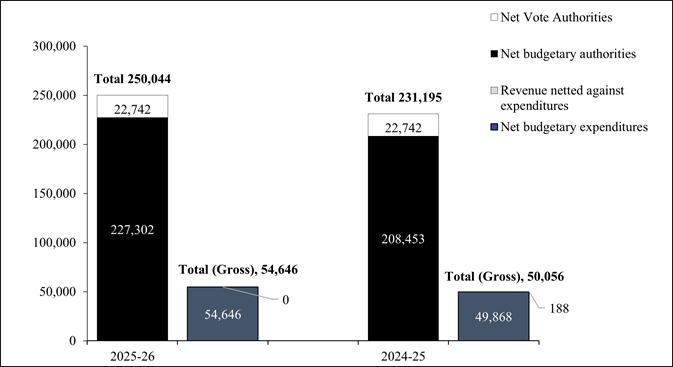
Text Description
The graph presents the ODPP's year-to-date net budgetary authorities and net budgetary expenditures as of June 30, 2025. The graph then presents the ODPP's total year-to-date net budgetary authorities and net budgetary expenditures as of June 30, 2024. The graph also shows the net vote authorities and the revenues netted against expenditures for the same period.
As of June 30, 2025, the net budgetary authorities of ODPP were $227,302 thousand and the net budgetary expenditures were $54,646 thousand. For the same period in the previous fiscal year, net budgetary authorities and net budgetary expenditures were $208,453 thousand and $49,868 thousand, respectively for the ODPP.
As of June 30, 2025, the net vote authorities of ODPP were $22,742 thousand and no revenues were recorded. For the same period in the previous fiscal year, net vote authorities and revenues netted against expenditures were $22,742 thousand and $188 thousand respectively.
As of June 30, 2025, the total budgetary authorities, combining net budgetary authorities and net vote authorities of ODPP totaled $250,044 thousand, and the total budgetary expenditures, combining net budgetary expenditures and revenues netted against expenditures totaled $54,646 thousand. For the same period in the previous fiscal year, the total budgetary authorities and the total budgetary expenditures totaled $231,195 thousand and $50,056 thousand, respectively for the ODPP.
2.1 Significant Changes to Spending Authorities
For the period ended June 30, 2025, the Office of the Director of Public Prosecutions (ODPP) had a total net spending authority of $227.3 million available for use as detailed in Chart 1 and Appendix A. This amount represents the authorities provided in the 2025-26 Main Estimates.
Overall, the ODPP’s total authorities for 2025-26 have a net increase of $18.8 million (9%) from the previous year’s total Main Estimates ($208.5 million). This increase in funding is primarily attributable to the following:
- an increase by $14.6 million dollars in funding received for collective agreements ratification;
- an increase by $4.4 million dollars in contributions to employee benefit plans adjustment; and
- a decrease of $0.2 million of dollars for the transfer from the ODPP to the Royal Canadian Mounted Police (RCMP) for the Law Enforcement Record Checks (LERCs) in support of the ODPP's Security Screening Program.
2.2 Significant Changes to Budgetary Expenditures and Revenues
As illustrated in Appendix B Departmental budgetary expenditures by Standard Object (unaudited), the total gross budgetary expenditure increased by $4.5 million (9%), from $50.1 million (2024-25), to $54.6 million in 2025-26 compared to the same quarter of the previous fiscal year.
The increase in operating expenditures, compared to the same quarter of 2024-25 is mainly attributable to:
- Personnel expenditures increase by $4.6 million. This is mainly due to an increase in salaries as a result of the ratification of collective agreements; and
- a decrease of $0.1 million in other various expenditures.
2.3 Revenues Netted Against Expenditures
The Office of the Director of Public Prosecutions (ODPP) has the authority to respend revenues received for providing prosecution services to other government departments and agencies. For the quarter ended June 30, 2025, no revenues were recorded, compared to $0.2 million during the same period in the previous fiscal year, as outlined in Appendix B. The variance in revenue is due to a delay in the approval of updated legal services rates, which has affected the timing of invoicing and revenue recognition.
3.0 Risks and Uncertainties
The Office of the Director of Public Prosecutions (ODPP) operates in a complex and evolving environment that presents a range of strategic, operational, and technological risks. These risks are identified and assessed through the organization’s Corporate Risk Profile (CRP), which was most recently updated following extensive consultations across the organization.
The CRP outlines six key corporate risks that could impact the ODPP’s ability to achieve its mandate and strategic objectives. These include:
- Information Technology Capacity
- Limitations in IT infrastructure and tools, combined with a high dependency on external service providers, constrain the ODPP’s ability to operate efficiently and securely. The organization is implementing a new IT governance model and its 2024–2027 IM/IT Plan to address this risk.
- Revenue Volatility
- The ODPP does not control the volume or nature of cases referred for prosecution, which may lead to fluctuations in revenue. This could affect the organization’s ability to allocate resources effectively. Ongoing efforts in digital modernization and resource planning are helping to mitigate this risk.
- Information and Personnel Security
- The sensitive nature of the ODPP’s work increases the risk of privacy breaches and threats to staff safety. A long-term security awareness strategy is being implemented to strengthen physical, information, and personnel security.
- Agent Affairs Program Oversight
- The current structure of the national Agent Affairs Program presents financial and operational oversight challenges. The ODPP is enhancing policies, procedures, and delegations to strengthen accountability.
- Workforce Capacity and Well-being
- Recruitment and retention challenges, particularly in remote and northern regions, may affect the ODPP’s ability to deliver services. The organization is investing in workforce planning, training, and employee wellness initiatives.
- Public Confidence and Accountability
- As a prosecutorial authority, the ODPP must maintain public trust through transparency, fairness, and independence. The organization continues to strengthen its governance, performance measurement, and stakeholder engagement practices.
The ODPP actively monitors these risks and implements mitigation strategies to ensure it can continue to deliver on its mandate effectively and responsibly.
4.0 Significant changes in relations to operations, personnel and programs
The Governor in Council has appointed Carol Shirtliff-Hinds as Office of the Director of Public Prosecutions (ODPP) new Deputy Director of Public Prosecutions (DDPP), effective April 14th, 2025.
5.0 Approval by Senior Officials
Approved in Ottawa, Canada, by:
George Dolhai
Director of Public Prosecutions and Deputy Attorney General of Canada
Mélanie Lamoureux, CPA
Chief Financial Officer
Appendix A
| (in thousands of dollars) | Fiscal year 2025-26 | Fiscal year 2024-25 | ||||
|---|---|---|---|---|---|---|
| Total available for use for the year ending March 31, 2026Table 1 Footnote * | Used during the quarter ended June 30, 2025 | Year-to-date used at quarter-end | Total available for use for the year ending March 31, 2025Table 1 Footnote * | Used during the quarter ended June 30, 2024 | Year-to-date used at quarter-end | |
| ||||||
| Vote 1 - Net Operating expenditures | 202,770 | 48,513 | 48,513 | 188,321 | 44,835 | 44,835 |
| Budgetary Statutory Authorities: Contributions to employee benefit plans | 24,532 | 6,133 | 6,133 | 20,132 | 5,033 | 5,033 |
| Total Budgetary statutory authorities | 24,532 | 6,133 | 6,133 | 20,132 | 5,033 | 5,033 |
| Total Budgetary Authorities | 227,302 | 54,646 | 54,646 | 208,453 | 49,868 | 49,868 |
| Total Authorities | 227,302 | 54,646 | 54,646 | 208,453 | 49,868 | 49,868 |
Appendix B
| (in thousands of dollars) | Fiscal year 2025-26 | Fiscal year 2024-25 | ||||
|---|---|---|---|---|---|---|
| Planned expenditures for the year ending March 31, 2026Table 2 Footnote * | Expended during the quarter ended June 30, 2025 | Year-to-date used at quarter-end | Planned expenditures for the year ending March 31, 2025Table 2 Footnote * | Expended during the quarter ended June 30, 2024 | Year-to-date used at quarter-end | |
| ||||||
| Expenditures: | ||||||
| Personnel | 184,872 | 46,781 | 46,781 | 166,015 | 42,144 | 42,144 |
| Transportation and communications | 7,326 | 1,026 | 1,026 | 6,872 | 1,011 | 1,011 |
| Information | 709 | 52 | 52 | 425 | 132 | 132 |
| Professional, special & other services | 45,439 | 4,729 | 4,729 | 45,765 | 4,862 | 4,862 |
| Rentals | 3,122 | 500 | 500 | 2,831 | 727 | 727 |
| Repair and maintenance | 781 | 411 | 411 | 2,272 | 9 | 9 |
| Utilities, materials and supplies | 1,315 | 654 | 654 | 1,557 | 648 | 648 |
| Acquisition of machinery and equipment | 2,064 | 59 | 59 | 2,083 | 135 | 135 |
| Other subsidies and payments | 4,416 | 434 | 434 | 3,375 | 388 | 388 |
| Total gross budgetary expenditures | 250,044 | 54,646 | 54,646 | 231,195 | 50,056 | 50,056 |
| Less Revenues netted against expenditures: | ||||||
| Legal services | (22,742) | 0 | 0 | (22,742) | (188) | (188) |
| Total net budgetary expenditures | 227,302 | 54,646 | 54,646 | 208,453 | 49,868 | 49,868 |
- Date modified: