
2026-27 Departmental Plan
The Honourable Sean Fraser, PC., M.P.
Minister of Justice and Attorney General of Canada
Public Prosecution Service of Canada
160 Elgin Street, 12th Floor
Ottawa, Ontario K1A 0H8
Also available on the Web in PDF and HTML formats
© His Majesty the King in Right of Canada, as represented by the Minister of Justice and Attorney General of Canada, 2026
Catalogue Number: J76-6E-PDF
ISSN 2560-9343
Aussi disponible en français sous le titre: Plan ministériel 2026-2027 du Service des poursuites pénales du Canada
On this page
- At a glance
- From the Director of Public Prosecutions and Deputy Attorney General of Canada
- Plans to deliver on core responsibility and internal services
- Department-wide considerations
- Planned spending and human resources
- Federal tax expenditures
- Corporate information
- Definitions
At a glance
This departmental plan details the Public Prosecution Service of Canada’s (PPSC)Footnote 1 priorities, plans, and associated costs for the upcoming three fiscal years.
These plans align with the priorities outlined in the Mandate Letter, as well as the PPSC’s Vision, mission, raison d’être and operating context.
Key priorities
The PPSC identified the following key priorities for 2026-27:
- Take Action Against Systemic Discrimination and Racism in the Criminal Justice System
We will continue to promote trust in the criminal justice system by contributing to the change necessary to support a criminal justice system that is more equitable and fairer to all Canadians, recognizing that systemic discrimination and racism can result in inequities for individuals and communities. - Build a Resilient, Inclusive Workplace Grounded in Trust, Engagement, Anti-racism, and Reconciliation with Indigenous Peoples
We will continue to build a culture of trust and engagement where all employees are resilient and treated with respect, dignity, and fairness, in an inclusive, equitable, diverse, and accessible workplace environment that recognizes and values diverse lived experiences, where all employees can thrive. - Modernize the Way We Work
We will continue to build an agile workforce and a modern criminal justice system. The PPSC will continue to modernize its tools and procedures, as well as its prosecutorial policies and practices, in ways that are accessible, inclusive and responsive to diverse needs. - Enhance the Prosecutorial Effectiveness in a Complex and Evolving Legal Landscape
We will focus on strengthening the organization’s ability to respond to rapidly evolving jurisprudence, rising evidence volumes, increasingly complex trial dynamics, and constitutional timeliness requirements, while supporting workloads and practices that nurture resilience and employee well-being.
Comprehensive Expenditure Review
The government is committed to restraining the growth of day-to-day operational spending to make investments that will grow the economy and benefit Canadians.
As part of meeting this commitment, the PPSC is planning the following spending reductions:
- 2026-27: $ (55,505)
- 2027-28: $ (940,555)
- 2028-29: $ (940,555)
It is anticipated that these spending reductions will involve a decrease of approximately nine full-time equivalents by 2028-29.
The PPSC will achieve these reductions by doing the following:
- Reduction in Internal Services.
The figures in this departmental plan reflect these reductions.
Highlights for the Public Prosecution Service of Canada in 2026-27
In 2026-27, the PPSC will advance initiatives that reinforce fairness, inclusion, and modernization across Canada’s criminal justice system.
To strengthen equity and reduce systemic barriers, the organization will continue reviewing prosecutorial policies through an intersectional and reconciliatory lens. Updates to key guidelines in the PPSC Deskbook will help prevent discrimination and reduce the over-representation of Indigenous, Black, racialized, and marginalized communities in the criminal justice system. At the same time, the PPSC will support the creation of new Drug Treatment Courts (DTCs), which provide alternatives to incarceration for individuals with substance use disorders. These programs combine judicial oversight with treatment and social supports, helping reduce recidivism and improve outcomes for vulnerable populations.
Building an inclusive and accessible workplace remains a priority. The PPSC will continue efforts to recruit, retain, and advance employees from equity-deserving groups. At the same time, the Accessibility Support Centre will continue to provide expert guidance to managers and employees on accommodation and accessibility for employees living with disabilities, injuries, or illnesses, while fostering a respectful workplace that values employee well-being, inclusion and belonging.
Modernization will also be a central focus. The organization will accelerate the adoption of secure, modern technologies to improve operational efficiency and support its prosecutorial mandate. This includes procuring new systems for evidence management and secure document transfer, while exploring the responsible integration of Artificial Intelligence (AI) tools to enhance workflows. All modernization efforts will be deliberate, secure, and aligned with the PPSC’s core values and prosecutorial responsibilities.
Together, these initiatives reflect the PPSC’s commitment to fairness, inclusion, and innovation, ensuring its work continues to meet the highest standards of justice and public trust.
In 2026-27, total planned spending (including internal services) for the PPSC is $229,440,707 and total planned full-time equivalent staff (including internal services) is 1,120.
Summary of planned results
The following provides a summary of the results the department plans to achieve in 2026-27 under its main areas of activity, called “core responsibilities.”
Core responsibility 1: Prosecution Services
The PPSC is responsible for prosecuting drug-related offences, regulatory and economic offences, national security offences, and all Criminal Code offences in the territories. It also provides high-quality legal advice to investigative agencies across Canada.
In 2026-27, the PPSC will:
- Strengthen prosecutions for serious and complex crimes, including large-scale drug trafficking, organized crime, national security offences, financial crime, tax evasion, and human smuggling, and advocate for the imposition of meaningful sentences against individuals convicted of these crimes.
- Provide law enforcement agencies and investigative bodies with timely and comprehensive legal advice. This support enables them to lawfully exercise all investigative powers provided under Parliament and the common law, gather and disclose evidence for prosecution, and maintain high standards of legal and advocacy excellence in court proceedings.
- Continue the re-evaluation of prosecutorial policies through an intersectional and reconciliatory approach to prevent the PPSC’s policies, practices, or procedures from contributing to discrimination, systemic racism, or over-representation of Indigenous, Black, racialized and marginalized groups in the criminal justice system.
- Advance specialized initiatives, such as expanding DTCs and supporting Specialized Sexual Violence Prosecution Teams to improve access to justice and community safety.
- Accelerate digital and technological modernization, by implementing advanced systems for evidence handling and secure document transfer to enhance security and compliance. At the same time, make progress on replacing legacy legal case management systems and integrating AI tools to support efficiency.
Planned spending: $197,706,150
Planned human resources: 918
More information about Prosecution Services can be found in the full plan.
For complete information on the PPSC’s total planned spending and human resources, read the Planned spending and human resources section of the full plan.
From the Director of Public Prosecutions and Deputy Attorney General of Canada

George Dolhai
Director of Public Prosecutions and
Deputy Attorney General of Canada
It is my great pleasure to present the Public Prosecution Service of Canada’s (PPSC) Departmental Plan for 2026-27. This plan reflects our commitment to strengthening how we deliver on our mandate and to reinforcing public confidence in the criminal justice system.
Over the past year, we have engaged in thoughtful reflection and dialogue, guided by employee feedback and our renewed three-year vision for People Management. We have set organizational priorities that support how we manage the organization internally and how we carry out our mandate. At the heart of this vision is a commitment to fostering a workplace where employees feel valued, supported, and able to thrive, while advancing initiatives that strengthen engagement, recruitment, retention, and professional development.
The review of our prosecution priorities reflects lessons learned and a forward-looking approach. In 2026-27, we anticipate shifts in these priorities to address rapidly evolving federal offences such as money laundering, and human smuggling, while continuing to focus on large-scale drug trafficking and importation. Our efforts will remain centered on cases that pose the greatest risks to public safety and national security, including those related to organized crime, complex regulatory prosecutions, and financial crimes. At the same time, we will pursue strategies to expand alternatives to prosecution for individuals whose criminality is linked to substance use disorders, supporting Drug Treatment Courts and other initiatives that promote rehabilitation and reduce recidivism. Together, these efforts aim to build safer communities.
Modernization remains a priority, undertaken thoughtfully and effectively. Work is underway to advance secure systems for evidence handling and document transfer, replace legal case management platforms, and responsibly integrate Artificial Intelligence tools. These improvements will enhance efficiency and transparency without compromising the values that define our mandate. As we advance digital transformation, our commitment to fairness, objectivity, and integrity remains unwavering. Prosecutors strive to ensure decisions are based on the merits of each case. This principle will continue to guide every innovation we adopt, ensuring that technological progress strengthens—rather than alters—the foundation of justice.
Looking ahead, we will continue to adapt to emerging challenges with integrity and innovation. I am proud of the professionalism and resilience of our employees, whose work ensures that the rule of law remains a cornerstone of Canadian society.
Plans to deliver on core responsibilities and internal services
Core responsibilities and internal services
Core responsibility 1: Prosecution Services
In this section
- Description
- Quality of life impacts
- Indicators, results and targets
- Plans to achieve results
- Gender-based analysis plus
- Planned resources to achieve results
- Program inventory
Description

The PPSC prosecutes criminal and regulatory offences under federal law in an independent, impartial and fair manner. Its mandate is established by the Director of Public Prosecutions Act.
This Act outlines the responsibilities of the Director of Public Prosecutions (DPP), which include initiating and conducting federal prosecutions; intervening in proceedings that raise a question of public interest that may affect the conduct of prosecutions or related investigations; issuing guidelines to federal prosecutors; and advising law enforcement agencies or investigative bodies on general prosecution matters and particular investigations that may lead to prosecutions. The DPP also exercises any other power or carry out duty or function assigned by the Attorney General of Canada that is compatible with the Office of the Director of Public Prosecutions. For the purpose of carrying out these statutory responsibilities, the DPP holds the function of Deputy Attorney General of Canada.
Quality of life impacts
The PPSC’s core responsibility contributes to the “Good Governance” domain of the Quality of Life Framework for Canada through its activities, more specifically to the “Crime Severity Index”, “Confidence in institutions”, “Discrimination and unfair treatment”, and “Confidence in access to fair and equal justice (criminal)” indicators. It also contributes to the “Society” domain’s “Indigenous languages” indicator.
Indicators, results and targets
This section presents details on the department’s indicators, the actual results from the three most recently reported fiscal years, the targets and target dates for Prosecution Services. Details are presented by departmental result.
Table 1: Timely and comprehensive legal advice is provided to investigative agenciesFootnote 2
| Departmental Result Indicators | Actual Results | 2026-27 Target | Date to achieve target |
|---|---|---|---|
| Percentage of respondents satisfied with the timeliness of legal advice. | 2022-23: Not availableFootnote 3 2023-24: Not availableFootnote 3 2024-25: Not availableFootnote 3 |
80% | March 2027 |
| Percentage of respondents satisfied with the comprehensiveness of legal advice. | 2022-23: Not availableFootnote 3 2023-24: Not availableFootnote 3 2024-25: Not availableFootnote 3 |
Greater than or equal to 65% | March 2027 |
Table 2: Federal prosecutions are completed in a timely mannerFootnote 4
| Departmental Result Indicators | Actual Results | 2026-27 Target | Date to achieve target |
|---|---|---|---|
| Number and percentage of cases that went to trial and resulted in a judicial stay of proceedings due to Crown delay. | 2022-23: 0.03% 2023-24: 0.06% 2024-25: 0.01%Footnote 5 |
Less than 4% | March 2027 |
| Number and percentage of cases that went to trial and resulted in the Crown directing a stay of proceedings due to Crown delay. | 2022-23: 0.07% 2023-24: 0.04% 2024-25: 0.04%Footnote 6 |
Less than 4% | March 2027 |
Table 3: Through professionally conducted prosecution-related work, the ODPP contributes to the administration of justice
| Departmental Result Indicators | Actual Results | 2026-27 Target | Date to achieve target |
|---|---|---|---|
| Number and percentage of prosecutions that result in a determination on the merits of the evidence. | 2022-23: 99.74% 2023-24: 99.64% 2024-25: 99.69%Footnote 7 |
Greater than or equal to 96% | March 2027 |
| Number and nature of judicial stays for abuse of process based on the conduct of a federal prosecutor. | 2022-23: 0 2023-24: 0 2024-25: 0 |
0 | March 2027 |
| Number and nature of successful malicious prosecution lawsuits. | 2022-23: 0 2023-24: 0 2024-25: 0 |
0 | March 2027 |
| Number and nature of substantiated complaints made pursuant to the PPSC’s Complaint Policy. | 2022-23: 0 2023-24: 1Footnote 8 2024-25: 0 |
0 | March 2027 |
Additional information on the detailed results and performance information for the PPSC’s program inventory is available on GC InfoBase.
Plans to achieve results
The following section describes the planned results for Prosecution Services in 2026-27.
Public Prosecution Service of Canada Deskbook Review
The PPSC Deskbook sets out the guiding principles that all federal prosecutors, and persons acting as federal prosecutors, must follow, and contains the directives and guidelines for federal prosecutions. Prosecutors are expected to discharge their duties with fairness, objectivity and integrity. Their role is not to win convictions at any cost, but to put before the court all available, relevant and admissible evidence necessary to enable the court to determine the guilt or innocence of an accused.
The PPSC has always placed a priority on ensuring that cases are prosecuted in a principled and timely manner, which includes building upon existing practices and policies relating to file management. Since the Jordan decision was issued, the PPSC formalized specific measures in the PPSC Deskbook by adding a guideline entitled: “Ensuring Timely Prosecutions.” The guideline outlines steps to be taken by PPSC prosecutors to anticipate time requirements and minimize delays in prosecutions.
Results we plan to achieve
- The PPSC’s National Prosecution Policy Committee will continue reviewing chapters within the PPSC Deskbook through an intersectional lens, recommending changes to policies or practices that may contribute to discrimination, systemic racism, or over-representation within the criminal justice system. This work reflects the PPSC’s commitment to acknowledging its influence within the criminal justice system and addressing the impacts of prosecutorial decisions on Indigenous, Black, racialized and marginalized communities.
National Security
The PPSC’s mandate notably covers terrorism offences under the Criminal Code, offences as defined under Section 2 of the Security Offences Act, the Foreign Interference and Security Information Act, and the Crimes Against Humanity and War Crimes Act. The organization is the prime legal advisor in that regard during the early investigative stages, and prime authority for initiating cases relating to the national security of Canada.
Results we plan to achieve
- Realign prosecution priorities to respond to the growing volume of national security investigations, including cases involving Ideologically Motivated Violent Extremism and terrorism offences involving young persons.
- Stay proactive to protect Canadians, including by using terrorism peace bonds when the appropriate threshold is met.
- Provide pre-charge advice and other assistance to the Royal Canadian Mounted Police (RCMP) and other police services across Canada.
Money Laundering and Proceeds of Crime
The PPSC plays an instrumental role in disrupting the profitability of illegal activities. This includes facilitating the seizure and forfeiture of proceeds of crime and prosecuting related offences such as money laundering and possession of proceeds of crime. These provisions apply to all designated offences under federal statutes, including indictable offences under the Criminal Code, the Controlled Drugs and Substances Act, the Income Tax Act, the Competition Act, and the Corruption of Foreign Public Officials Act.
The PPSC works with its partner agencies to prioritize the seizure and forfeiture of proceeds of crime to permanently deprive criminals of the profit derived from the commission of offences, and to return the value of that property to victims and governments. Across the PPSC’s regional offices, specialized teams focus on drug and financial crime prosecutions, including complex money laundering cases.
Results we plan to achieve
- Realign prosecution priorities to combat money laundering and proceeds of crime offences.
- Provide legal advice and assistance to law enforcement agencies, such as the RCMP, in the investigation of money laundering offences.
- Collaborate with federal partner agencies, including the RCMP, the Canada Border Services Agency (CBSA), and the Canada Revenue Agency (CRA), to address financial crime and bolster cooperation.
Drug Prosecutions under the Controlled Drugs Substances Act and the Cannabis Act
The PPSC is responsible for prosecuting offences under federal statutes across Canada, including drug-related offences under the Controlled Drugs and Substances Act and the Cannabis Act. In the territories, the PPSC prosecutes all Criminal Code offences and federal statutes and also prosecutes certain territorial offences on behalf of territorial governments. In Quebec and New Brunswick, the PPSC prosecutes drug offences only when investigated by the RCMP.
Results we plan to achieve
- Target prosecutions involving large-scale manufacturing and importation of controlled substances, particularly where links to organized crime are evident.
- Focus on cases involving large seizures of fentanyl, its analogues and other potent synthetic opioids that contribute to Canada’s toxic drug supply and seeking proportionate sentences for individuals involved in their distribution.
- Address the growing number of firearms-related charges, which are often connected to organized crime, drug trafficking activities and violence.
- Adapt to increasing file complexity, disclosure volumes, and digital evidence demands. Special attention will be given to opioids-related prosecutions, including the use of alternative measures to prosecution for eligible offences motivated by an underlying substance use disorder. Where public safety is not at risk, such alternatives are often more appropriate and better serve both individuals and society, while ensuring meaningful jail sentences for offenders involved in commercial trafficking.
Drug Treatment Courts
Drug Treatment Courts (DTCs) are important to address issues associated with problematic substance use within the criminal justice system. They are specialized courts that provide alternatives to incarceration by offering an opportunity to complete a drug treatment program under the supervision of designated justice system participants and treatment service providers. DTC programs generally involve judicial supervision, comprehensive substance abuse treatment, incentives and sanctions, clinical case management, and social services support. DTCs have been successful as a means of reducing criminal recidivism.
Results we plan to achieve
- Collaborate with DTC partners to best leverage local health and treatment resources while developing successful approaches to treatment to maximize program effectiveness.
- Assess processes for admissibility into DTCs through consultations with regional counsel and Federal-Provincial-Territorial partners.
- Support the creation of new DTCs, contribute to program development, and assist in operational efforts across Canada.
Tax Evasion Cases
As of 2023-24, the PPSC received additional funds to ensure it is equipped to handle new investigations stemming from the expansion of the CRA criminal investigation process. This ensures that the PPSC can make the necessary investments in the right people, with the right skills and tools, to successfully address complex tax evasion cases.
The PPSC prosecutes tax offences under the statutes enforced by the CRA, the CBSA, and the RCMP, notably those dealing with tax evasion and contraband tobacco and cannabis. Specialized PPSC prosecutors provide advice during the investigative stage, conduct prosecutions, and provide training to investigators. CRA investigations focus on complex tax evasion schemes, including cross-border crime and offences committed by organized groups.
Results we plan to achieve
- Provide legal advice to the CRA and other investigative agencies on complex tax investigations and prosecute referrals that meet our decision to prosecute test.
- Work closely with the CRA on issues arising in most complex tax cases, such as disclosure and solicitor-client privilege to ensure cases proceed on their merits. Some regions plan to add specialized prosecution resources to handle the increased volume of CRA referrals.
Human Smuggling Prosecutions under the Immigration and Refugee Protection Act
The PPSC is responsible for prosecuting the smuggling of migrants into Canada under the Immigration and Refugee Protection Act. Where migrants are being smuggled out of Canada, the PPSC prosecutes conspiracy to violate the immigration laws of the destination country under the Criminal Code. PPSC’s human smuggling prosecutions focus on the organizers of human smuggling who commit the offence for profit or association with criminal organizations.
Results we plan to achieve
- Focus on for-profit human smuggling, particularly where links to organized crime are evident.
- Maintain relationships with foreign and domestic enforcement and prosecution partners to increase the likelihood of success in prosecutions.
Prosecution in the North
The PPSC will continue to strengthen its role as the sole prosecuting authority for Criminal Code offences and federal statutes in Canada’s three territories: Yukon, the Northwest Territories, and Nunavut. These regions face unique challenges, including some of the highest rates of serious violent crime in the country. These offences often occur within a context of intergenerational trauma and systemic inequities, leaving victims particularly vulnerable. Through its initiatives in these territories, the PPSC aims to deliver more effective and culturally appropriate prosecution services and reinforce public confidence in the justice system.
Results we plan to achieve
- Maintain Specialized Sexual Violence Prosecution Teams (SSVPT), composed of prosecutors, paralegals, Crown Witness Coordinators, and support staff, to manage complex sexual violence cases. The SSVPT provide expertise in prosecutions, and continuity for victims and witnesses, contributing to increased confidence in the administration of justice in the North.
- Strengthen victim support services by adopting trauma-informed practices, and by improving communication and overall engagement with victims and witnesses of sexual violence, ensuring they receive consistent, culturally sensitive assistance throughout the prosecutorial process.
- Reinforce community engagement through deepened collaboration with territorial justice partners, Indigenous leaders, and service providers to improve continuity and responsiveness in prosecutions.
Gender-based analysis plus
The PPSC recognizes the importance of integrating gender-based analysis plus (GBA Plus) into its operations to uphold its values and advance organizational priorities, including Equity, Diversity and Inclusion (EDI). Executives and leaders across the organization are expected to ensure GBA Plus considerations are embedded not only in decision-making processes but also in the planning and execution of projects and initiatives. The GBA Plus Responsibility Centre, housed within the Strategic Planning and Performance Measurement Unit, oversees implementation and works in collaboration with the Advancement Centre for Equity, Diversity and Inclusion (ACEDI). Together, they lead awareness-raising and capacity-building efforts, develop tools and training related to intersectional analysis, and monitor progress through the departmental GBA Plus Implementation Plan.
The PPSC will strengthen its prosecutorial capacity by continuing the intersectional review of its prosecutorial guidelines (PPSC Deskbook). This ensures that prosecutorial decisions consider systemic and background factors and guard against bias. For the 2026-27 fiscal year, one (1) full-time equivalent will be dedicated to GBA Plus initiatives. This individual’s responsibilities include reviewing departmental submissions for GBA Plus content, organizing training and awareness sessions, and updating the Implementation Plan.
The PPSC is currently unable to generate any gender and diversity based statistical data for its Prosecution Services. This is due to limitations in its legal case management system, which supports file management and timekeeping but lacks the ability to provide demographic breakdowns or compile relevant GBA Plus metrics.
To address this significant data gap, the PPSC has been considering system enhancements and new data collection processes that enable disaggregated reporting by gender and other identity factors. Establishing such mechanisms is essential not only to fulfill GBA Plus obligations and align with frameworks such as the Quality of Life, Gender Results Framework, and Sustainable Development Indicators, but also to enable enhanced demographic and identity-based evidence to inform decision-making.
Planned resources to achieve results
Table 4: Planned resources to achieve results for Prosecution Services
| Resource | Planned |
|---|---|
| Spending | 197,706,150 |
| Full-time equivalents | 918 |
Complete financial and human resources information for the PPSC’s program inventory is available on GC InfoBase.
Program inventory
Prosecution Services is supported by the following programs:
- Federal Prosecutions
Additional information related to the program inventory for Prosecution Services is available on the Results page on GC InfoBase.
Internal services
In this section
- Description
- Plans to achieve results
- Planned resources to achieve results
- Planning for contracts awarded to Indigenous businesses
Description
Internal services are the services that are provided within a department so that it can meet its corporate obligations and deliver its programs. There are 10 categories of internal services:
- acquisition management services
- communications services
- financial management services
- human resources management services
- information management services
- information technology services
- legal services
- material management services
- management and oversight services
- real property management services
Plans to achieve results
This section presents details on how the department plans to achieve results and meet targets for internal services.
Corporate Services Branch:
The Corporate Services Branch (CSB) includes most internal services that support the organization and its prosecution teams as well as two national programs. Like all federal government departments, internal services help to ensure that the organization is effectively governed and meets government policy requirements and administrative responsibilities.
In 2026-27, the PPSC will continue expanding its project governance framework to include Facilities and Security initiatives, progressing at a steady pace while considering operational activities and resource availability. Additionally, the CSB will continue to strengthen its performance measurement framework as part of its long-term commitment to continuous improvement. Efforts will focus on consolidating data collection processes, exploring automation to streamline workflows, and promoting consistency across dashboard methodologies. This evolving approach is designed to enhance organizational effectiveness and reinforce accountability, while equipping senior leadership with reliable, data-informed insights to support sound decision-making. By maintaining a flexible implementation strategy, the CSB will remain well positioned to adjust the course as needed and ensure sustainable progress over time.
Human Resources:
In 2026-27, the PPSC, through its Human Resources Directorate (HRD)Footnote 9, will continue promoting the Employee Assistance Program and how to access these services. Information sessions will remain available, and tailored supports for equity-deserving groups will be delivered in collaboration with Health Canada.
Building on the renewed three-year vision for People Management, the PPSC reaffirms its commitment to fostering a workplace where everyone can thrive, grow, and feel valued. This vision provides an overarching roadmap for creating a workforce and workplace where all employees, regardless of roles, can contribute their best and feel that they belong.
The Federal Prosecutor Development Program (FPDP) redesign, initiated in 2024-25, will continue to progress and follow a phased approach. Planned activities for 2026-27 include updating training materials, incorporating feedback, and developing competency assessments. Facilitator training and multilingual training will ensure inclusivity, while stakeholder engagement will guide the final product. The program will launch with updated resources and informational sessions for seamless implementation.
Engagement with the Inuit community remains a priority. The HRD will continue to share information on available positions through Pilimmaksaivik-led outreach. In 2026-2027, the PPSC will release the Annual Report on its Inuit Employment Plan and aim to increase participation in career fairs, including Nunavut Sivuniksavut, to promote employment opportunities and strengthen connections with Inuit job seekers.
Administration Services Division:
In 2026-27, the PPSC, through its Administration Services DivisionFootnote 10, aims to select a product to replace its legacy internal legal case management system and begin a pilot project, subject to funding. During the same period, files will be relocated from legacy file storage systems to cloud-based platforms. The PPSC will also procure a system for evidence management and secure document transfer, contingent on the successful completion of the pilot in 2025-26 and funding.
In addition, beginning in 2026-27, the PPSC will introduce AI technologies through a multi-year phased approach. The first phase will make Generative AI available to all employees, followed by a specialized AI application in Finance and Acquisitions, and potentially Human Resources. An AI governance framework will also be established, to ensure proper oversight and define AI’s role within the Prosecution Services.
National Fine Recovery Program:
The PPSC is responsible for administering the recovery of outstanding federal fines under the terms of an assignment issued by the Attorney General of Canada in September 2007. The National Fine Recovery Program (NFRP) initiates and conducts legal proceedings on behalf of the Crown and enforces the collection of outstanding federal fines. The NFRP plays a significant role in preserving the integrity of the justice system by enforcing sentences ordered by the courts.
In 2026-27, the NFRP will continue to advance the development and implementation of its new fine management software, aimed at enhancing operational efficiency. Concurrently, the program will proceed with the rollout of its updated Policy Framework, which fosters a fair, efficient and transparent fine enforcement regime including civil litigation procedures. Fine enforcement and recovery activities will be implemented in the Northwest Territories, while ongoing consultations and efforts to secure access to court databases in Yukon and Nunavut will remain a priority.
Agent Affairs Program and National Agent Project:
In 2026-27, the PPSC, supported by the Agent Affairs Program (AAP), will finalize the implementation of the National Agent Project process following the successful pilot and approval of recommendations. Work will focus on supporting regions as they adopt the new processes, refining operational tools, and ensuring consistent, compliant financial management of agent expenditures. As part of this effort, the PPSC is also undertaking a restructuring of the AAP to better align roles, responsibilities, and support functions with the new national framework.
Efforts will focus on monitoring implementation progress, integrating organizational changes within AAP, and addressing operational challenges to ensure the new model effectively supports regional offices and strengthens Section 32/34 Financial Administration Act compliance.
Equity, Diversity, Inclusion:
At the PPSC, accountability means taking the responsibility for advancing Equity, Diversity and Inclusion (EDI) in all aspects of our work. This commitment goes beyond good intentions; it focuses on achieving measurable impacts through the advice provided, the decisions we make, and the prosecution services we deliver. Embedding EDI accountability builds public trust, improves access to justice, and ensures that both our workplace and services are inclusive and equitable.
In 2026-27, to strengthen accountability and advance EDI, the PPSC will report on progress and develop a follow-up product to the 2021-24 EDIA Action Plan with clear commitments and key performance indicators. The organization will continue to identify and use intersectional data, such as race, Indigeneity, and gender, to inform EDI initiatives. In addition, the PPSC will participate to the Treasury Board Secretariat’s pilot project to integrate anti-racist and inclusive behaviours into employee performance agreements, supporting cultural change across the organization.
Building on these efforts, the PPSC will advance EDI in the workplace by creating an environment where all employees are resilient, and treated with respect, dignity, and fairness. This goes beyond compliance; it is about fostering a culture that reflects Canada’s diversity and removes barriers to participation and advancement. A workplace rooted in EDI strengthens collaboration, innovation, and trust.
In 2026-27, the organization will provide independent, impartial and confidential resources for workplace issues, ensuring employees have a trusted, safe space for support without fear of reprisal. It will continue to support the National Council for Employees and the Regional Equity, Diversity, Inclusion and Accessibility Committees in advancing their priorities and objectives to leverage grassroots engagement. The PPSC will also deliver training on anti-racism and the lived experiences of equity-deserving groups to increase awareness and strengthen skills to recognize and address systemic discrimination. Additionally, it will promote sponsorship and mentorship opportunities for equity-deserving employees to support career advancement and improve representation in leadership roles reflective of Canada’s population.
Finally, the PPSC will continue its effort to address systemic discrimination and racism in the criminal justice system. Systemic barriers and racism continue to affect how justice is delivered and experienced in Canada, and reducing these barriers is essential to uphold fairness and maintain public confidence. In 2026–27, the organization will reinforce EDI content in the FPDP, equipping incoming prosecutors with essential knowledge in anti-racism and cultural competency as they transition into their roles. In addition, the EDI team will contribute to an approach to help fill the EDI gap including algorithmic inequities in the AI tools used by prosecutors.
Communications:
Building on work that began in 2024-25, the PPSC will continue to review its privacy policies and align them with new Treasury Board rules aimed at strengthening how the government protects privacy in a rapidly evolving environment. This work will help employees better understand their responsibilities when handling personal information and support them in identifying and managing privacy risks in new projects. Furthermore, the PPSC will continue offering new mandatory training to help all employees understand their access to information and privacy responsibilities. This training started in winter 2025-26 and is aligned with content rules set out in the Treasury Board policy.
Finance and Acquisitions:
In 2026-27, the Finance and Acquisitions Directorate (FAD)Footnote 11 will continue to provide its employees with the tools and training to build capacity and strengthen workforce development in support of service excellence. The FAD will increase awareness of individual accountability by introducing new processes to improve efficiency and the integrity of financial data.
The Directorate will also continue to promote collaboration and share best practices through teams, working groups, and advisory forums, offering expertise and guidance to support change and foster a culture of trust and success. Partnerships will be developed as needed, especially in the area of AI.
Audit and Evaluation:
In 2026-27, the Internal Audit and Evaluation DivisionFootnote 12 will continue the audits stated in the annual Risk-based Audit Plan and monitor the implementation of outstanding management action plans.
Planned resources to achieve results
Table 5: Planned resources to achieve results for internal services this year
| Resource | Planned |
|---|---|
| Spending | 31,734,557 |
| Full-time equivalents | 202 |
Complete financial and human resources information for the PPSC’s program inventory is available on GC InfoBase.
Planning for contracts awarded to Indigenous businesses
The PPSC supports the Government of Canada’s commitment by aiming to award a minimum of 5% of the total value of its contracts to Indigenous-led businesses. Since 2022-23, the PPSC developed an Indigenous procurement planning exercise across the organization. The department leverages existing provisions available in the federal government’s Procurement Strategy for Indigenous Business to seize opportunities through its procurement process.
Since implementation, the PPSC has shown a growing and strong commitment to supporting Indigenous businesses through various procurement strategies, such as:
- Procurement Planning: Identifying opportunities specifically for Indigenous businesses;
- Conditional or Voluntary Set-Asides: Applying these when practical in procurement solicitations;
- Large IT and Office Furniture Procurement: Setting these aside for Indigenous businesses; and
- Education and Promotion: Continuing to educate, provide tools, and promote contracts being awarded to Indigenous businesses.
This approach aims to create more opportunities and support the growth of Indigenous businesses.
The PPSC’s methodology does not include the cost of legal agents, which are required to support the mandate of the Director of Public Prosecutions, in accordance with the Director of Public Prosecutions Act.
Table 6: Percentage of contracts planned and awarded to Indigenous businesses
| 5% Reporting Field | 2024-25 Actual Result | 2025-26 Forecasted Result | 2026-27 Planned Result |
|---|---|---|---|
| Total percentage of contracts with Indigenous businesses | 9.26% | 5% | 5% |
Department-wide considerations
Related government priorities
Artificial Intelligence
The PPSC is exploring the responsible integration of AI tools to support its mandate of prosecuting offences under federal jurisdiction in a manner that is fair, impartial, and in the public interest. AI adoption presents a strategic opportunity to enhance operational efficiency, improve service delivery, and strengthen evidence-informed decision-making, while upholding the prosecutorial principles of independence, objectivity and integrity. The use of AI in our work is part of a larger digital transformation being undertaken in the department. This transformation includes the introduction of new evidence and case management systems.
AI implementation will proceed in three phases, under the leadership of senior executives at the PPSC Headquarters. The initiative will draw on the expertise of administrative professionals, paralegals, Crown witness coordinators, prosecutors, and their respective team leaders and managers.
The first phase, scheduled for completion by the end of 2025-26, focused on the rollout of Copilot Chat (up to Protected B) across the department. By introducing Copilot Chat first, we created a foundation for AI adoption that feels approachable and practical. It empowered employees to experience the benefits of AI—boosting productivity and sparking innovation across the organization. As part of this initial phase, we introduced a pilot use of Microsoft Copilot as a means of searching the PPSC Deskbook. This phase also included the development and dissemination of AI policy and training.
The second phase will focus on making it easier for employees to quickly find answers within our own documents, whether policies, guidelines, or case-related information. This phase will include a review of information management processes and the quality of data input. Prosecutors would benefit from AI tools, such as Copilot and Axon, capable of analyzing disclosure materials within case files, streamlining document review and identifying relevant evidence more efficiently, and facilitating the sharing of information with external justice partners. By using AI to search and interpret content, we aim to reduce time spent looking for information and improve efficiency across the organization.
The third phase will focus on automating key processes such as staffing and completing templates. By streamlining repetitive tasks, AI will help reduce the administrative burden, accelerate workflows, and free up time for higher-value work. In addition, the PPSC plans to develop a centralized, AI-accessible database that consolidates legal research, precedents, opinions, and related materials. This would allow AI tools to efficiently retrieve, and tailor information based on jurisdiction, court level, or legal context, enhancing the preparation of legal arguments.
While promising, the use of AI tools for prosecution files, however, raises important considerations. Prosecutors must adhere to strict confidentiality obligations, professional responsibilities to law societies, and their role as officers of the court. AI must not compromise the exercise of prosecutorial discretion or the integrity of legal reasoning. The PPSC’s commitment to justice requires more than majority consensus or statistical likelihood. On the contrary, it demands careful, principled analysis that respects diverse perspectives and legal nuances.
To support these objectives, and get started with AI, the PPSC will adhere to seven guiding principles:
- Leverage existing databases and file-specific disclosure materials (up to Protected B) to build on trusted knowledge;
- Use Government of Canada-approved software to ensure security compliance and minimize procurement delays;
- Reuse and adapt tools developed by other prosecution services and the Department of Justice;
- Assign key personnel to maintain focus on operational needs;
- Engage end users to validate tool effectiveness and ensure with real-world pressures and gains;
- Adjust budgets to support investments in efficiency and excellence; and
- Emphasize user responsibility and professionalism in the use of AI-generated outputs.
This approach ensures that AI adoption at the PPSC is deliberate, secure, and aligned with its core values and prosecutorial responsibilities.
Key risks
The PPSC operates within a dynamic and complex environment influenced by evolving legal frameworks, societal expectations, and technological advancements. As an independent prosecuting authority, the organization must fulfill its mandate to deliver impartial and principled prosecution services, while adapting to emerging challenges that may hinder the achievement of its objectives.
External factors shaping this environment include the increasing sophistication of criminal activities, rapid technological change, exposure to diverse external threats, and heightened public scrutiny of justice processes. These trends require the PPSC to maintain operational agility while safeguarding prosecutorial integrity and fairness.
Internally, the PPSC will continue to advance modernization initiatives to strengthen governance, digital capabilities, and knowledge management. These efforts are essential to mitigate vulnerabilities associated with legacy systems and to support secure and efficient operations. At the same time, the organization will remain committed to fostering a workplace culture that prioritizes equity, diversity, inclusion, and accessibility, recognizing that organizational resilience depends on a healthy and engaged workforce. This includes promoting diverse recruitment, talent development and succession planning across the organization.
The PPSC’s risk management approach emphasizes proactive identification and mitigation strategies. Key measures will include enhancing collaboration with investigative agencies and external stakeholders, leveraging technology to improve case management and secured evidence disclosure, and reinforcing internal controls to maintain compliance with legal and policy requirements.
Looking ahead, the PPSC will continue to integrate risk considerations into planning and decision-making processes through evidence-based approaches. By investing in modernization, strengthening partnerships, and promoting a culture of accountability, the organization aims to maintain public confidence in the administration of justice while effectively responding to emerging challenges.
Planned spending and human resources
This section provides an overview of the PPSC’s planned spending and human resources for the next three fiscal years and of planned spending for 2026-27 with actual spending from previous years.
In this section
Spending
This section presents an overview of the department’s planned expenditures from 2023-24 to 2028-29.
Budgetary performance summary
Table 7 Three-year spending summary for core responsibility and internal services (dollars)
| Core responsibility and Internal services | 2023-24 Actual Expenditures | 2024-25 Actual Expenditures | 2025-26 Forecast Spending |
|---|---|---|---|
| Prosecution Services | 181,214,587 | 213,502,409 | 201,589,895 |
| Internal services | 41,913,178 | 40,747,653 | 28,122,466 |
| Total | 223,127,765 | 254,250,062 | 229,712,361 |
Analysis of the past three years of spending
The total actual expenditures net increase from 2023–24 to 2024–25 is mainly due to the ratification of the collective of the Law Practitioner and the Law Management agreements.
The actual expenditures are expected to decline in 2025–26, reflecting the conclusion of the retroactive pay and lump-sum payments issued in 2024–25. These one-time adjustments contributed to higher spending in the previous fiscal year and will not recur going forward.
More financial information from previous years is available on the Finances section of GC Infobase.
Table 8 Planned three-year spending on core responsibility and internal services (dollars)
| Core responsibility and Internal services | 2026-27 Planned Spending | 2027-28 Planned Spending | 2028-29 Planned Spending |
|---|---|---|---|
| Prosecution Services | 197,706,150 | 197,706,150 | 197,706,150 |
| Internal services | 31,734,557 | 31,163,513 | 31,194,547 |
| Total | 229,440,707 | 228,869,663 | 228,900,697 |
Analysis of the next three years of spending
The PPSC’s planned spending reflects the amounts approved by Parliament to support the department’s core responsibility.
More detailed financial information on planned spending is available on the Finances section of GC Infobase.
Table 9: Budgetary gross and net planned spending summary (dollars)
| Core responsibility and Internal services | 2026-27 Gross planned spending (dollars) | 2026-27 Planned revenues netted against spending (dollars) | 2026-27 Planned net spending (authorities used) |
|---|---|---|---|
| Prosecution Services | 220,248,150 | -22,542,000 | 197,706,150 |
| Internal services | 31,934,557 | -200,000 | 31,734,557 |
| Total | 252,182,707 | -22,742,000 | 229,440,707 |
Analysis of budgetary gross and net planned spending summary
The 2026-27 planned revenues of $22.7 million represent the vote-netted authority for the PPSC which enables the department to re-spend the revenues received for providing services to other government departments and agencies.
Information on the alignment of the PPSC’s spending with Government of Canada’s spending and activities is available on GC InfoBase.
Funding
This section provides an overview of the department’s voted and statutory funding for its core responsibility and for internal services. For further information on funding authorities, consult the Government of Canada budgets and expenditures.
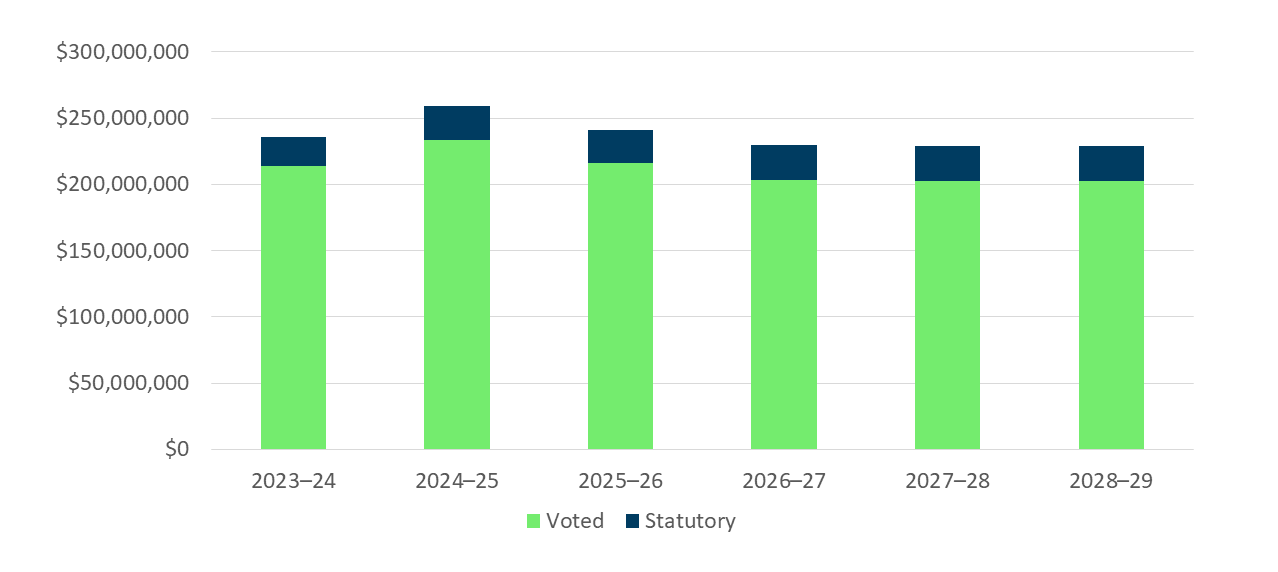
Graph 1: Approved funding (statutory and voted) over a six-year period
Graph 1 summarizes the department’s approved voted and statutory funding from 2023-24 to 2028-29.
Graph 1: Approved funding - Table
| Fiscal year | Total | Voted | Statutory |
| 2023-24 | 235,550,829 | 213,709,696 | 21,841,133 |
| 2024-25 | 259,451,219 | 233,672,476 | 25,778,743 |
| 2025-26 | 240,685,157 | 216,153,156 | 24,532,001 |
| 2026-27 | 229,440,707 | 203,084,260 | 26,356,447 |
| 2027-28 | 228,869,663 | 202,594,870 | 26,274,793 |
| 2028-29 | 228,900,697 | 202,625,904 | 26,274,793 |
Analysis of statutory and voted funding over a six-year period
- Funding for 2023-24 and 2024-25 represents the approved funding for the respective fiscal years, as reported in the Public Accounts.
- Funding for 2025-26 reflects projected allocations through the end of the fiscal year. The significant decrease is primarily due to one-time payments incurred in 2024-25 related to the retroactive pay and lump-sum payments for the ratification of collective of the Law Practitioner and the Law Management agreements.
- Planned funding for 2026-27, 2027-28, and 2028-29 reflects funds already brought into the department’s reference levels, as well as amounts to be authorized through the Estimates process as presented in the Department’s Annual Reference Level Update.
For further information on the PPSC’s departmental appropriations, consult the 2026-27 Main Estimates.
Future-oriented condensed statement of operations
The future-oriented condensed statement of operations provides an overview of the PPSC’s operations for 2025-26 to 2026-27.
Table 10 Future-oriented condensed statement of operations for the year ended March 31, 2027 (dollars)
| Financial information | 2025-26 Forecast results |
2026-27 Planned results | Difference (Planned results minus forecasted) |
|---|---|---|---|
| Total expenses | 276,317,385 | 277,371,982 | 1,054,597 |
| Total revenues | 19,830,448 | 22,742,000 | 2,911,552 |
| Net cost of operations before government funding and transfers | 256,486,937 | 254,629,982 | -1,856,955 |
Analysis of forecasted and planned results
The total planned revenues will be higher in 2026-27 due to an anticipated increase in time spent on prosecution services, resulting in a projected decrease in net cost of operations.
The total planned expenses are projected to be higher in 2026-27 due to increased costs in collective agreement expenditures in 2026-27.
A more detailed Future-Oriented Statement of Operations and associated Notes for 2026-27, including a reconciliation of the net cost of operations with the requested authorities, is available on the PPSC’s website.
Human resources
This section presents an overview of the department’s actual and planned human resources from 2023-24 to 2028-29.
Table 11: Actual human resources for core responsibility and internal services
| Core responsibility and internal services | 2023-24 Actual full-time equivalents | 2024-25 Actual full-time equivalents | 2025-26 Forecasted full-time equivalents |
|---|---|---|---|
| Prosecution Services | 920 | 942 | 918 |
| Internal services | 214 | 206 | 202 |
| Total | 1,134 | 1,148 | 1,120 |
Analysis of human resources over the last three years
The increase in 2024-25 full-time equivalents is due to the opening of a new office in Surrey, British Columbia.
The reduction in full-time employees is primarily driven by significant volatility in the North and across regional offices.
Table 12: Human resources planning summary for core responsibility and internal services
| Core responsibility and internal services | 2026-27 Planned full-time equivalents | 2027-28 Planned full-time equivalents | 2028-29 Planned full-time equivalents |
|---|---|---|---|
| Prosecution Services | 918 | 918 | 918 |
| Internal services | 202 | 193 | 193 |
| Total | 1,120 | 1,111 | 1,111 |
Analysis of human resources for the next three years
The PPSC does not anticipate any increase in Full Time Equivalent from 2026-27 to 2028-29.
Federal tax expenditures
The PPSC’s Departmental Plan does not include information on tax expenditures.
The tax system can be used to achieve public policy objectives through the application of special measures such as low tax rates, exemptions, deductions, deferrals and credits. The Department of Finance Canada publishes cost estimates and projections for these measures each year in the Report on Federal Tax Expenditures.
This report also provides detailed background information on tax expenditures, including descriptions, objectives, historical information and references to related federal spending programs as well as evaluations and GBA Plus of tax expenditures.
Corporate information
Departmental profile
Appropriate minister(s):
The Honourable Sean Fraser
Institutional head:
George Dolhai,
Director of Public Prosecution and Deputy Attorney General of Canada
Ministerial portfolio:
Justice
Enabling instrument(s):
Director of Public Prosecutions Act
Year of incorporation / commencement:
2006
Departmental contact information
Mailing address:
Public Prosecution Service of Canada
160 Elgin Street, 12th Floor
Ottawa, Ontario, K1A 0H8
Telephone:
613-957-7772
1-877-505-7772
Fax:
613-954-2958
Email:
info@ppsc.gc.ca
Website(s):
PPSC’s website
Definitions
- appropriation (crédit)
- Any authority of Parliament to pay money out of the Consolidated Revenue Fund.
- budgetary expenditures (dépenses budgétaires)
- Operating and capital expenditures; transfer payments to other levels of government, departments or individuals; and payments to Crown corporations.
- core responsibility (responsabilité essentielle)
- An enduring function or role performed by a department. The intentions of the department with respect to a core responsibility are reflected in one or more related departmental results that the department seeks to contribute to or influence.
- Departmental Plan (plan ministériel)
- A report on the plans and expected performance of an appropriated department over a 3-year period. Departmental Plans are usually tabled in Parliament each spring.
- departmental result (résultat ministériel)
- A consequence or outcome that a department seeks to achieve. A departmental result is often outside departments’ immediate control, but it should be influenced by program-level outcomes.
- departmental result indicator (indicateur de résultat ministériel)
- A quantitative measure of progress on a departmental result.
- departmental results framework (cadre ministériel des résultats)
- A framework that connects the department’s core responsibilities to its departmental results and departmental result indicators.
- Departmental Results Report (rapport sur les résultats ministériels)
- A report on a department’s actual accomplishments against the plans, priorities and expected results set out in the corresponding Departmental Plan.
- full-time equivalent (équivalent temps plein)
- A measure of the extent to which an employee represents a full person-year charge against a departmental budget. For a particular position, the full-time equivalent figure is the ratio of number of hours the person actually works divided by the standard number of hours set out in the person’s collective agreement.
- gender-based analysis plus (GBA Plus) (analyse comparative entre les sexes plus [ACS Plus])
-
Is an analytical tool used to support the development of responsive and inclusive policies, programs, and other initiatives. GBA Plus is a process for understanding who is impacted by the issue or opportunity being addressed by the initiative; identifying how the initiative could be tailored to meet diverse needs of the people most impacted; and anticipating and mitigating any barriers to accessing or benefitting from the initiative. GBA Plus is an intersectional analysis that goes beyond biological (sex) and socio-cultural (gender) differences to consider other factors, such as age, disability, education, ethnicity, economic status, geography (including rurality), language, race, religion, and sexual orientation.
Using GBA Plus involves taking a gender- and diversity-sensitive approach to our work. Considering all intersecting identity factors as part of GBA Plus, not only sex and gender, is a Government of Canada commitment.
- government priorities (priorités gouvernementales)
- For the purpose of the 2026-27 Departmental Plan, government priorities are the high-level themes outlining the government’s agenda in the 2025 Speech from the Throne.
- horizontal initiative (initiative horizontale)
- An initiative where two or more federal departments are given funding to pursue a shared outcome, often linked to a government priority.
- Indigenous business (entreprise autochtone)
- Requirements for verifying Indigenous businesses for the purposes of the departmental result report are available through the Indigenous Services Canada Mandatory minimum 5% Indigenous procurement target website.
- non‑budgetary expenditures (dépenses non budgétaires)
- Non-budgetary authorities that comprise assets and liabilities transactions for loans, investments and advances, or specified purpose accounts, that have been established under specific statutes or under non-statutory authorities in the Estimates and elsewhere. Non-budgetary transactions are those expenditures and receipts related to the government’s financial claims on, and obligations to, outside parties. These consist of transactions in loans, investments and advances; in cash and accounts receivable; in public money received or collected for specified purposes; and in all other assets and liabilities. Other assets and liabilities, not specifically defined in G to P authority codes are to be recorded to an R authority code, which is the residual authority code for all other assets and liabilities.
- performance (rendement)
- What a department did with its resources to achieve its results, how well those results compare to what the department intended to achieve, and how well lessons learned have been identified.
- performance indicator (indicateur de rendement)
- A qualitative or quantitative means of measuring an output or outcome, with the intention of gauging the performance of a department, program, policy or initiative respecting expected results.
- plan (plan)
- The articulation of strategic choices, which provides information on how a department intends to achieve its priorities and associated results. Generally, a plan will explain the logic behind the strategies chosen and tend to focus on actions that lead to the expected result.
- planned spending (dépenses prévues)
-
For Departmental Plans and Departmental Results Reports, planned spending refers to those amounts presented in Main Estimates.
A department is expected to be aware of the authorities that it has sought and received. The determination of planned spending is a departmental responsibility, and departments must be able to defend the expenditure and accrual numbers presented in their Departmental Plans and Departmental Results Reports.
- program (programme)
- Individual or groups of services, activities or combinations thereof that are managed together within the department and focus on a specific set of outputs, outcomes or service levels.
- program inventory (répertoire des programmes)
- Identifies all the department’s programs and describes how resources are organized to contribute to the department’s core responsibilities and results.
- result (résultat)
- A consequence attributed, in part, to a department, policy, program or initiative. Results are not within the control of a single department, policy, program or initiative; instead they are within the area of the department’s influence.
- statutory expenditures (dépenses législatives)
- Expenditures that Parliament has approved through legislation other than appropriation acts. The legislation sets out the purpose of the expenditures and the terms and conditions under which they may be made.
- target (cible)
- A measurable performance or success level that a department, program or initiative plans to achieve within a specified time period. Targets can be either quantitative or qualitative.
- voted expenditures (dépenses votées)
- Expenditures that Parliament approves annually through an appropriation act. The vote wording becomes the governing conditions under which these expenditures may be made.
- Date modified: