
Annual Report on the Access to Information Act 2013-2014
Table of Contents
- Introduction
- Mandate of the Public Prosecution Service of Canada
- Roles and Responsibilities of the Public Prosecution Service of Canada
- Access to Information and Privacy (ATIP) Office
- Roles and Responsibilities under the Access to Information Act
- Delegated Authorities
- Interpretation of the Statistical Report
- Part 1 – Requests under the Access to Information Act
- Part 2 – Requests closed during the reporting period
- Part 3 – Extensions
- Part 4 – Fees
- Part 5 – Consultations received from other institutions and organizations
- Part 6 – Completion time of consultations on Cabinet confidences
- Part 7 – Resources related to the Access to Information Act
- Informal Processes
- Training Activities
- New or Revised Policies, Guidelines and Procedures
- Complaints and Investigations
- Federal Court Review
- Monitoring of Processing time
- Reading Room
- Appendix A – Delegation Order
- Appendix B – Statistical Report on the Access to Information Act
Introduction
The Access to Information Act (Act) came into force on July 1, 1983. The purpose of the Act is to provide a right of access to information in records under the control of a government institution in accordance with the principles that government information should be available to the public, that necessary exceptions to the right of access should be limited and specific, and that decisions on the disclosure of government information should be reviewed independently of government.
The Public Prosecution Services of Canada (PPSC) became subject to the Act when it was established as an independent organization on December 12, 2006, with the coming into force of the Director of Public Prosecutions Act (Part 3 of the Federal Accountability Act).
In accordance with section 72 of the Act, the PPSC has prepared the 2013–2014 Annual Report on the Administration of the Act for tabling before both the House of Commons and Senate. The Report includes an interpretation of the information contained in the PPSC’s Statistical Report on the Administration of the Act. In addition, it reports on emerging trends, training activities and newly implemented or revised internal policies, guidelines and procedures.
Mandate of the Public Prosecution Service of Canada
The mandate of the PPSC is set out in the Director of Public Prosecutions Act. The Act empowers the Director of Public Prosecutions (DPP) to:
- initiate and conduct federal prosecutions;
- intervene in proceedings that raise a question of public interest that may affect the conduct of prosecutions or related investigations;
- issue guidelines to federal prosecutors;
- advise law enforcement agencies or investigative bodies on general matters relating to prosecutions and on particular investigations that may lead to prosecutions;
- communicate with the media and the public on all matters that involve the initiation and conduct of prosecutions;
- exercise the authority of the Attorney General of Canada in respect of private prosecutions; and
- exercise any other power or carry out any other duty or function assigned by the Attorney General of Canada that is compatible with the office of the DPP.
For the purpose of carrying out these statutory responsibilities, the DPP is the Deputy Attorney General of Canada.
The Director of Public Prosecutions Act also empowers the DPP to:
- initiate and conduct prosecutions under the Canada Elections Act; and
- act, when requested by the Attorney General of Canada, in matters under the Extradition Act and the Mutual Legal Assistance in Criminal Matters Act.
The DPP has the rank and status of a deputy head of a department, and in this capacity is responsible for the management of the PPSC as a distinct governmental organization.
With the exception of Canada Elections Act matters, the Attorney General of Canada can issue a directive to the DPP on a prosecution or assume conduct of a prosecution, but must do so in writing and a corresponding notice must be published in the Canada Gazette. In turn, the DPP must inform the Attorney General of any prosecution or planned intervention that may raise important questions of general interest. Similarly, the Attorney General can assign additional responsibilities to the DPP, provided the assignment is in writing and published in the Canada Gazette.
Roles and Responsibilities of the Public Prosecution Service of Canada
The PPSC prosecutes offences under federal statutes following an investigation by a law enforcement agency. The PPSC is not an investigative agency and does not conduct investigations. The separation of law enforcement from the prosecution function is a well-established principle of the Canadian criminal justice system. However, cooperation between investigators and prosecutors is essential, particularly in the context of large and complex cases. Certain investigative tools, such as an application for a wiretap authorization, are only obtained on application to the court by a prosecutor. As a result, the PPSC often provides legal advice and assistance to law enforcement officials at the investigative stage.
In all provinces and territories except Quebec and New Brunswick, the PPSC is responsible for prosecuting all drug offences under the Controlled Drugs and Substances Act, regardless of which police agency investigates the alleged offences. In Quebec and New Brunswick, the PPSC prosecutes only drug offences investigated by the Royal Canadian Mounted Police.
In all provinces and territories, the PPSC prosecutes charges under federal statutes such as the Income Tax Act, the Fisheries Act, the Excise Act, the Customs Act, the Canadian Environmental Protection Act, 1999, the Canada Shipping Act, and the Competition Act, as well as conspiracies and attempts to violate these statutes. In total, over 250 federal statutes contain offences that fall under the PPSC’s jurisdiction to prosecute, and the PPSC regularly prosecutes offences under approximately 40 of those statutes.
The PPSC is responsible for prosecuting all Criminal Code offences in the territories. In the provinces, the PPSC has jurisdiction to prosecute a limited number of Criminal Code offences, including those related to terrorism, criminal organizations, money laundering, proceeds of crime, and fraud. Under arrangements with the provinces, the PPSC may also prosecute Criminal Code offences that are otherwise within a provincial jurisdiction when the accused also faces charges within federal jurisdiction.
Access to Information and Privacy (ATIP) Office
The ATIP Office holds primary responsibility for the implementation and administration of the Access to Information Act. In collaboration with the Offices of Primary Interest (OPIs), the ATIP Office serves as the center of expertise in relation to the administration of the Act within the PPSC and is responsible for:
- processing access to information (ATI) requests in accordance with the Act, its Regulations and the Treasury Board of Canada Secretariat (TBS)’s policies, directives and guidelines;
- responding to consultations submitted by other federal institutions or other levels of government on PPSC records being considered for release;
- providing advice to PPSC managers and employees regarding the application and interpretation of the Act, its Regulations and relevant case law;
- responding to requests received from other federal institutions for the review of solicitor-client privilege in records related to criminal proceedings in which the PPSC is involved;
- reviewing PPSC policies, procedures and agreements to ensure that they comply with the requirements of the Act and making recommendations for amendments;
- monitoring the PPSC’s compliance with the Act, its Regulations and the TBS’s policies, directives and guidelines;
- communicating with investigators of the Office of the Information Commissioner of Canada (OIC) to resolve complaints filed against the PPSC;
- reviewing documents relevant to proactive disclosure, such as audits and evaluations and contracts over $25,000 prior to their publication on the PPSC’s website, in order to ensure that they do not contain information that is subject to exemptions or exclusions under the Act;
- delivering training sessions intended to familiarize PPSC managers and employees with the requirements of the Act, its Regulations and the TBS’s policies, directives and guidelines;
- updating the PPSC’s chapter of the federal government’s Info Source publication;
- submitting an annual Statistical Report on the Administration of the Act to the TBS;
- preparing an Annual Report on the Administration of the Act for tabling in both Houses of Parliament; and
- posting summaries of completed ATI requests on the PPSC’s website.
Roles and Responsibilities under the Access to Information Act
The following chart provides a diagram of the ATIP Office and the reporting relationships within the PPSC. It should be read in conjunction with the descriptions below which outline the roles and responsibilities of the employees, in ensuring that the PPSC meets its obligations under the Act.
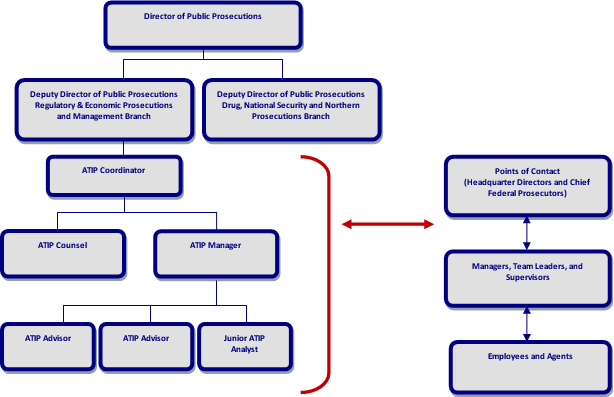
Director of Public Prosecutions (DPP)
As the designated “head of institution”
, the DPP has the overall responsibility to ensure that the PPSC complies with the requirements of the Act, its Regulations and the TBS’s policies, directives and guidelines.
ATIP Office Personnel
- ATIP Coordinator:
- The Executive Director and Senior Counsel, Ministerial and External Relations Secretariat, by delegated authority issued by the DPP under the Act, serves as the PPSC’s ATIP Coordinator and is responsible for the oversight of the application of the Act, its Regulations and the TBS’s policies, directives and guidelines.
- ATIP Manager:
- The ATIP Manager has direct responsibility for the daily management of the ATIP Office and is responsible for coordinating all activities relating to the operation of the ATI legislation. This includes managing and supervising staff, developing and implementing ATI policies and procedures, conducting in-house training, and reviewing PPSC policies, procedures and agreements to ensure that they comply with the Act, the Regulations and the TBS’s policies, directives and guidelines.
- ATIP Advisors:
- ATIP Advisors are responsible for processing complex and sensitive ATI requests, responding to consultations from other federal institutions or other levels of government, conducting in-house training and negotiating the resolution of complaints with investigators from the OIC. They also act as liaison between the applicant and the Points of Contact in PPSC Regional Offices and Headquarters. In addition, ATIP Advisors provide assistance to the ATIP Manager in updating the Info Source chapter, preparing the statistical and annual reports on the administration of the Act and drafting summaries of completed ATI requests for posting on the PPSC’s website.
- Junior ATIP Analyst:
- The Junior ATIP Analyst carries out the administrative duties of the ATIP Office, processes low-complexity ATI requests and responds to low-complexity consultations from other federal institutions or other levels of government. The Junior ATIP Analyst also acts as liaison between the applicant and the Points of Contact in PPSC Regional Offices and Headquarters and provides assistance to the ATIP Advisors and the ATIP Manager in the processing of ATI requests as required.
- ATIP Counsel:
- Counsel to the PPSC’s Ministerial and External Relations Secretariat also serves as the ATIP Counsel and is responsible for providing legal advice on the application and interpretation of the Act, the TBS’s policies, guidelines and procedures, and the relevant case law to the ATIP Coordinator, the ATIP Office and PPSC managers.
Headquarters and Regional Offices
While the ATIP Office is the focal point for the administration of the ATI legislation, managers and employees at headquarters and in regional offices also play a key role in ensuring that the PPSC fulfills its obligations under the Act.
- Deputy Directors of Public Prosecutions:
- The Deputy Directors of Public Prosecutions are responsible for assisting the DPP in ensuring that the PPSC complies with the requirements of the Act, its Regulations and related TBS policies, directives and guidelines.
- Headquarter Directors and Chief Federal Prosecutors:
- Headquarter Directors and Chief Federal Prosecutors are the points of contact of the ATIP Office and are responsible for ensuring that ATI requests that pertain to their area of responsibility are handled promptly and efficiently. They are also responsible for ensuring that their respective Office or Region operates within the requirements of the Act, its Regulations, and related TBS and PPSC policies, directives and guidelines, and that their employees and agents are instructed on ATI-related matters as appropriate.
- Managers, Team Leaders, Supervisors and Agent Supervisors:
- Managers, Team Leaders, Supervisors and Agent Supervisors, whether at National Headquarters or in Regional Offices, are responsible for coordinating the retrieval of records requested under the Act and advising the ATIP Office of issues that could arise from disclosure. They must also provide assistance and ATI-related instructions to their staff members as required. In addition, Managers, Team Leaders, Supervisors and Agent Supervisors must ensure that their respective programs operate within the requirements of the Act, its Regulations, and related TBS and PPSC policies, directives and guidelines.
- Employees and Agents:
- Employees and Agents must carry out their duties in a manner that is compliant with the Act, its Regulations, and related TBS and PPSC policies, directives and guidelines, including ensuring that any records they create are properly managed and easily retrievable.
Delegated Authorities
Under section 73 of the Act, the head of a government institution may, by order, designate one or more officers or employees of that institution to exercise or perform any of the powers, duties of function of the head of the institution under the Act.
The Executive Director and Senior Counsel, Ministerial and External Relations Secretariat and the ATIP Manager have both been granted full authority to exercise the powers and to perform the duties and functions of the DPP under the Act (see Delegation Order in Appendix A). The ATIP Manager exercises this authority in the absence of the ATIP Coordinator.
Interpretation of the Statistical Report
The following section provides an interpretation of the Statistical Report on the Access to Information Act located in Appendix B of this report. It also compares statistical data from 2013–2014 with data from previous reporting periods in order to identify possible trends.
Part 1 – Requests under the Access to Information Act
Number of requests
The PPSC received 44 formal ATI requests in 2013–2014, which represents an increase of 52% in the number of requests from the previous reporting period. Three (3) requests were also carried forward from fiscal year 2012–2013.
The following diagram displays the number of formal ATI requests that were received by the PPSC since the 2006–2007 reporting period.
| 2006-2007 (3) | 2007-2008 (11) | 2008-2009 (15) | 2009-2010 (18) | 2010-2011 (33) | 2011-2012 (24) | 2012-2013 (29) | 2013-2014 (44) | |
|---|---|---|---|---|---|---|---|---|
| 3 | 11 | 15 | 18 | 33 | 24 | 29 | 44 |
* Data from fiscal year 2006–2007 represents only the last quarter of that reporting period.
The figures show that the number of requests has been steadily increasing since the creation of the PPSC, reaching an all-time high of 44 in this reporting period.
Source of requests
| Public (23) | Media (10) | Business (6) | Organization (3) | Academia (2) | |
|---|---|---|---|---|---|
| 52% | 23% | 14% | 7% | 4% |
In total, 52% of all requests received in 2013–2014 originated from the general public. Media enquiries comprised the second largest source category, accounting for 23% of requests received. An additional 14% of requests originated from the private sector while requests from organizations and academic sources accounted for a combined 11% of requests received.
Part 2 – Requests closed during the reporting period
Disposition of requests
The PPSC responded to 40 formal ATI requests during 2013–2014. A total of 6,922 pages were reviewed in response to these requests, which represents a 434% increase in volume from the previous reporting period. Seven (7) outstanding requests were carried over to the next reporting period.
The completed requests were categorized as follows:
| All disclosed (10) | Disclosed in part (12) | All exempted (2) | No records exist (5) | Requests transferred (1) | Requests abandoned (10) | |
|---|---|---|---|---|---|---|
| 25% | 30% | 5% | 12% | 3% | 25% |
Requests where access could not be provided fell into the following categories:
No Records Exist
A total of 12% of requests could not be processed as no relevant records existed under the control of the PPSC. Where possible, applicants were advised of government institutions that may have records and how to contact those institutions to submit a request.
Request abandoned
An additional 25% of requests were abandoned by the applicants. In most cases, applicants were asked for clarification before material could be gathered. Since no clarification was provided, their requests were deemed abandoned.
Request transferred
Another 3% of requests were transferred to another government institution that had a greater interest in the subject matter.
The PPSC’s disclosure rates in 2013–2014 are consistent with the five (5) year average. The PPSC processed 144 formal ATI requests in fiscal years 2009–2010 to 2013–2014. The organization responded by releasing information in whole or in part in 54% of these requests. In only 4% of cases was the information requested exempted or excluded in its entirety. A total of 38% of requests were abandoned by the applicant or could not be processed as no relevant records existed under the control of the PPSC. The remaining 4% of requests were either transferred to another government institution or treated informally.
Completion time
The chart below displays the time required to process formal ATI requests during the 2013–2014 reporting period.
| 1 to 15 days (12) | 16 to 30 days (12) | 31 to 60 days (3) | 61 to 120 days (11) | 121 to 180 days (1) | 181 to 165 days (1) | |
|---|---|---|---|---|---|---|
| 30% | 30% | 7% | 27% | 3% | 3% |
Of the 40 requests that were completed in fiscal year 2013–2014, 24 were processed within the 30-day statutory response period. Three (3) requests were responded to within 31 to 60 days and 11 others within 61 to 120 days. Two (2) requests required between 121 to 365 days to complete.
Over the last five (5) reporting periods, the large majority of the PPSC’s formal ATI requests were responded to within the 30-days statutory deadline. A review of the data collected in fiscal years 2009–2010 to 2013–2014 revealed that 39% of all requests completed during that time period were processed in 15 days or less. An additional 32% of requests were processed within 16 to 30 days.
Exemptions
The right of access to information in government records is subject to limited and specific exceptions. Limitations to the right of access are set out in sections 13 through 24 of the Act. Section 26 of the Act also sets out an administrative exception relating to the publication of information.
The following diagram displays the exemptions that were invoked by the PPSC during the 2013–2014 reporting period.
| para. 18(a) | subs. 19(1) | para. 21(1)(a) | para. 21(1)(b) | para. 21(1)(c) | para. 21(1)(d) | s. 23 | subs. 24(1) | |
|---|---|---|---|---|---|---|---|---|
| 1 | 9 | 3 | 4 | 1 | 2 | 7 | 1 |
Given the PPSC’s mandate, the majority of the information exempted was subject to subsection 19(1) [Personal information] and section 23 [Solicitor-client privilege] of the Act.
Exclusions
Records or parts thereof to which the Act does not apply are said to be “excluded”
. Pursuant to section 68, the Act does not apply to published material or material available for purchase by the public, library or museum material preserved solely for public record, and material placed in Library and Archives Canada. Records containing Confidences of the Queen's Privy Council for Canada that have been in existence for less than 20 years are also excluded from the Act pursuant to section 69.
During the 2013–2014 reporting period, no exclusions pursuant to sections 68 and 69 of the Act were applied by the PPSC.
Format of information released
For requests where information was disclosed, responses were provided electronically either by e-mail or on a compact disk in 55% of cases. Paper copies of records were provided in 45% of cases.
Complexity
The mandate of the PPSC is to prosecute offences under federal jurisdiction and to provide advice on prosecution-related matters to investigative agencies. Due to the nature of the organization’s work, processing ATI requests at the PPSC is challenging. Records often contain information relating to criminal or regulatory investigations or prosecutions and to the PPSC's work involving other organizations and departments at the federal, provincial or territorial level.
During the 2013–2014 reporting period, the PPSC consulted with other government institutions on five (5) particularly complex requests. One (1) additional request was considered complex due to the need to prepare a fee assessment.
Deemed refusals
The PPSC was not considered to be in deemed refusal for any files during this reporting period.
Requests for translation
There were no requests for translation from one official language to the other.
Part 3 – Extensions
Section 9 of the Act allows government institutions to extend the 30-day statutory time limit for processing a request in cases where institutions are required to review or search through a large number of records, or when consultations with other institutions or third parties are necessary.
Reason for extensions
A total of 16 extensions were taken during the 2013–2014 reporting period. In 11 instances, the search through or review of a large number of records could not be completed within the original time limit without unreasonably interfering with the operations of the PPSC. On five (5) other occasions, consultations with other government institutions were necessary to comply with the request and could not reasonably be completed within the original time limit.
For purposes of reporting, if an extension on a particular file is taken under multiple paragraphs, the PPSC reports one (1) extension under each relevant paragraph.
Length of extensions
As illustrated in the chart below, the majority of the extensions sought in fiscal year 2013–2014 were for a duration of more than 30 days. In only 12.5% of cases were extensions of 30 days or less required.
| 30 days or less (2) | 31 to 60 days (9) | 61 to 120 days (2) | 121 to 180 days (2) | 181 to 165 days (1) | |
|---|---|---|---|---|---|
| 12.5% | 56.25% | 12.5% | 12.5% | 6.25% |
Part 4 – Fees
The Act authorizes the collection of fees for certain activities related to the processing of formal requests for information. In addition to the $5.00 application fee, search, preparation and reproduction costs may be recovered as specified within the Access to Information Regulations.
Total fees of $255.00 were collected by the PPSC during 2013–2014. This consisted of $160.00 in application fees and $95.00 in search fees. No production, programming, preparation or reproduction fees were charged during this reporting period.
The PPSC waived search fees that amounted to less than $25.00 in the case of one (1) request. An additional $40.00 in application fees was also waived.
Part 5 – Consultations received from other institutions and organizations
Number of consultations
The PPSC received 45 ATI consultations in 2013–2014, which represented an increase of 29% in the number of consultations from the previous reporting period. One (1) consultation was also carried forward from fiscal year 2012–2013.
Although the number of consultations has fluctuated since the creation of the PPSC, it has remained consistently higher than the number of formal requests received. The diagram below illustrates the trend.
| 2006-2007 | 2007-2008 | 2008-2009 | 2009-2010 | 2010-2011 | 2011-2012 | 2012-2013 | 2013-2014 | |
|---|---|---|---|---|---|---|---|---|
| ATI Consultations | 7 | 53 | 56 | 38 | 56 | 58 | 34 | 45 |
| ATI Requests | 3 | 11 | 15 | 18 | 33 | 24 | 29 | 44 |
* Data from fiscal year 2006–2007 represents only the last quarter of that reporting period.
Source of consultations
| DFO (8) | RCMP (5) | DoJ (4) | TBS (4) | CRA (3) | Finance (3) | Others (18) | |
|---|---|---|---|---|---|---|---|
| 18% | 11% | 9% | 9% | 6.5% | 6.5% | 40% |
Fisheries and Oceans Canada (DFO) forwarded the highest number of consultations with eight (8), followed by the Royal Canadian Mounted Police (RCMP) which sent five (5) consultations. The Treasury Board of Canada Secretariat (TBS) and Justice Canada (DoJ) each sent four (4) consultations while the Canada Revenue Agency (CRA) and the Department of Finance both sent three (3). Institutions which sent two (2) consultations or less are grouped together in the “Others”
portion of the chart above.
The number of consultations forwarded by any given government institution is not an accurate reflection of the work required to process the consultations. While the Canadian Food Inspection Agency (CFIA) only sent two (2) consultations, the page count in CFIA’s files accounted for 53% of the consultations material reviewed by the PPSC ATIP Office. It is common for a few organizations to represent a disproportionate part of the PPSC’s consultation workload since the records in question can form part of large prosecution cases.
Recommendations
The PPSC responded to 44 consultations during the 2013–2014 reporting period. A total of 3,595 pages were reviewed, representing an 11% increase in volume from the previous reporting period. Two (2) outstanding consultations were carried over to the next reporting period.
The completed consultations are categorized as follows:
| Disclosed entrirely (18) | Disclosed in part (21) | Exempted entirely (3) | Consult other institution (1) | Other (1) | |
|---|---|---|---|---|---|
| 41% | 48% | 7% | 2% | 2% |
The PPSC’s disclosure rates in 2013–2014 remain consistent with the five (5) year average. The PPSC processed 238 consultations from fiscal years 2009–2010 to 2013–2014. The organization responded by releasing information in whole or in part in 92% of cases. In only 3% of cases was the information requested exempted in its entirety. A total of 2% were closed by the consulting institution. The PPSC recommended that another institution be consulted in the remaining 3% of cases.
Completion time
The chart below displays the time required to complete the processing of consultation requests during the 2013–2014 reporting period.
| 1 to 15 days (30) | 16 to 30 days (7) | 31 to 60 days (2) | 61 to 120 days (3) | 121 to 180 days (1) | 181 to 165 days (1) | |
|---|---|---|---|---|---|---|
| 68% | 16% | 5% | 7% | 2% | 2% |
Of the 44 consultations that were completed in 2013–2014, 37 were processed within 30 days or less. Two (2) consultations were responded to within 31 to 60 days, and three (3) others within 61 to 120 days. Two (2) consultations required between 121 to 365 days to complete.
Over the last five (5) reporting periods, nearly three quarters of the ATI consultations received by the PPSC were responded to within 30 days. A review of the data collected from fiscal years 2009–2010 to 2013–2014 revealed that 48% of all consultations completed during that time period were processed in 15 days or less. An additional 26% were completed within 16 to 30 days.
Part 6 – Completion time of consultations on Cabinet confidences
No consultations containing Cabinet confidences were carried out by the PPSC during the 2013–2014 reporting period.
Part 7 – Resources related to the Access to Information Act
Costs
The PPSC spent a total of $214,297 administering the Act of which salaries accounted for $197,243 and Goods and Services accounted for $17,054. There were no overtime expenditures during this reporting period.
It is important to note that, for reporting purposes, the overall budget for the ATIP Office is divided between the administration of both the Access to Information Act and the Privacy Act. As the administration of the Access to Information Act has taken up more of the ATIP Office’s time during the 2013–2014 reporting period, more of its resource dollars are accounted for under this Act.
Informal Processes
As part of the Government of Canada’s commitment to openness and transparency, in September 2011 the PPSC started posting monthly summaries on its website of completed ATI requests. This was done in anticipation of the implementation of a TBS directive, which came into effect in January 2012. As a result of the posting of summaries, the PPSC processed two (2) requests for informal disclosure of previously released material during the 2013–2014 reporting period.
The PPSC website also contains other sources of information, such as the Federal Prosecution Service Deskbook, the Terms and Conditions of Fixed-Term Agreements of Agents, the Proposed Best Practices for Prosecuting Fraud Against Governments, the PPSC’s Annual Report and its Report on Plans and Priorities. As well, the website contains portals for the Agent Affairs Program, Proactive Disclosure listings, and other items of interest.
Training Activities
The ATIP Office experienced staff turnover during 2013–2014. As a result, no formal ATI-related training sessions were provided to PPSC employees during this reporting period. However, ATIP personnel did provide informal training to employees on various ATI-related matters (e.g. preparing a search estimate and determining the relevancy of records) throughout the year on an ad hoc basis.
New or Revised Policies, Guidelines and Procedures
In 2013–2014, the PPSC created internal procedures for processing requests under the Act. The procedures provide guidance to employees and agents of the PPSC who are required to assist the organization in fulfilling its legal obligations under the Act.
Complaints and Investigations
To ensure that government institutions comply with their ATI obligations and that all requesters are treated fairly, decisions made under the Act are subject to review. The first level of review is a formal complaint to the Information Commissioner of Canada; the second is an application for judicial review to the Federal Court.
A total of five (5) complaints were filed with the OIC against the PPSC in 2013–2014. One (1) additional complaint was carried over from the 2010–2011 reporting period. The following table provides a breakdown of the reasons for the complaints as well as the results of those complaints for which the OIC has issued its findings.
| Reasons for Complaint | Number of Complaints | OIC Findings |
|---|---|---|
| Exemptions were improperly applied so as to unjustifiably deny access to records, or portions thereof, requested under the Act. | 1 | The OIC has yet to issue its findings. |
| An unreasonable extension of time was claimed in order to respond to a request for records under the Act. | 2 | Both complaints were discontinued. |
| The fee notice failed to inform the applicant of the 60-day timeframe to file a complaint to the OIC. | 1 | Complaint was discontinued. |
| The PPSC failed to respond to a request within the time frame set out in the Act and is therefore deemed to have refused access. | 1 | Complaint was well founded. |
| The PPSC failed to provide all records responsive to a request made under the Act and improperly applied exemptions so as to unjustifiably deny access to records, or portions thereof, requested under the Act. | 1 | The OIC has yet to issue its findings. |
Federal Court Review
During this reporting period, no application for judicial review was filed with the Federal Court pursuant to section 44 of the Act. One (1) notice of application for judicial review that was filed during the 2010–2011 reporting period remains active.
Monitoring of Processing Time
The ATIP Office has established and maintains a comprehensive statistical reporting and performance measurement system. Monthly reports are provided to the ATIP Coordinator identifying the number of active ATI requests, the sources and due dates of the requests, as well as the length of any extensions taken.
Reading Room
Section 8 of the Access to Information Regulations requires that institutions maintain a reading room where the public can examine records. The PPSC’s main reading room is located at 160 Elgin Street, Ottawa, Ontario. Individuals who wish to examine records must schedule an appointment with the ATIP Office. Individuals located outside of the National Capital Region can make arrangements through the ATIP Office to examine records at one of our regional offices.
Appendix A – Delegation Order
The Director of Public Prosecutions, pursuant to section 73 of the Access to Information Act and the Privacy Act, hereby designates the persons holding the positions set out in the schedule hereto, or the positions, to exercise the powers and functions of the Director as the head of a government institution.
Schedule
| Position | Privacy Act and Regulations | Access to Information Act and Regulations |
|---|---|---|
| Executive Director and Senior Counsel, Ministerial and External Relations Secretariat | Full Authority | Full Authority |
| Manager, ATIP, Access to Information and Privacy Office | Full Authority | Full Authority |
Dated, at the City of Ottawa, this 11 day of January, 2010.

Brian Saunders
Director of Public Prosecutions
Appendix B – Statistical Report on the Access to Information Act
Name of institution: Public Prosecution Service of Canada
Reporting period: 01-04-2013 to 31-03-2014
Part 1 – Requests under the Access to Information Act
1.1 Number of Requests
| Number of Requests | |
|---|---|
| Received during reporting period | 44 |
| Oustanding from previous reporting period | 3 |
| Total | 47 |
| Closed during reporting period | 40 |
| Carried over to next reporting period | 7 |
1.2 Sources of requests
| Source | Number of Requests |
|---|---|
| Media | 10 |
| Academia | 2 |
| Business (Private Sector) | 6 |
| Organization | 3 |
| Public | 23 |
| Total | 44 |
Part 2 – Requests closed during the reporting period
2.1 Disposition and completion time
| Disposition of requests | Completion time | |||||||
|---|---|---|---|---|---|---|---|---|
| 1 to 15 days | 16 to 30 days | 31 to 60 days | 61 to 120 days | 121 to 180 days | 181 to 365 days | More than 365 days | Total | |
| All disclosed | 3 | 6 | 1 | 0 | 0 | 0 | 0 | 10 |
| Disclosed in part | 1 | 1 | 1 | 7 | 1 | 1 | 0 | 12 |
| All exempted | 0 | 1 | 0 | 1 | 0 | 0 | 0 | 2 |
| All excluded | 0 | 0 | 0 | 0 | 0 | 0 | 0 | 0 |
| No records exist | 4 | 1 | 0 | 0 | 0 | 0 | 0 | 5 |
| Request transferred | 1 | 0 | 0 | 0 | 0 | 0 | 0 | 1 |
| Request abandoned | 3 | 3 | 1 | 3 | 0 | 0 | 0 | 10 |
| Treated informally | 0 | 0 | 0 | 0 | 0 | 0 | 0 | 0 |
| Total | 12 | 12 | 3 | 11 | 1 | 1 | 0 | 40 |
2.2 Exemptions
| Section | Number of Requests |
|---|---|
| 13(1)(a) | 0 |
| 13(1)(b) | 0 |
| 13(1)(c) | 0 |
| 13(1)(d) | 0 |
| 13(1)(e) | 0 |
| 14(a) | 0 |
| 14(b) | 0 |
| 15(1) – International Affairs | 0 |
| 15(1) – Defence of Canada | 0 |
| 15(1) – Subversive Activities | 0 |
| 16(1)(a)(i) | 0 |
| 16(1)(a)(ii) | 0 |
| 16(1)(a)(iii) | 0 |
| 16(1)(b) | 0 |
| 16(1)(c) | 0 |
| 16(1)(d) | 0 |
| 16(2)(a) | 0 |
| 16(2)(b) | 0 |
| 16(2)(c) | 0 |
| 16(3) | 0 |
| 16.1(1)(a) | 0 |
| 16.1(1)(b) | 0 |
| 16.1(1)(c) | 0 |
| 16.1(1)(d) | 0 |
| 16.2(1) | 0 |
| 16.3 | 0 |
| 16.4(1)(a) | 0 |
| 16.4(1)(b) | 0 |
| 16.5 | 0 |
| 17 | 0 |
| 18(a) | 1 |
| 18(b) | 0 |
| 18(c) | 0 |
| 18(d) | 0 |
| 18.1(1)(a) | 0 |
| 18.1(1)(b) | 0 |
| 18.1(1)(c) | 0 |
| 18.1(1)(d) | 0 |
| 19(1) | 9 |
| 20(1)(a) | 0 |
| 20(1)(b) | 0 |
| 20(1)(b.1) | 0 |
| 20(1)(c) | 0 |
| 20(1)(d) | 0 |
| 20.1 | 0 |
| 20.2 | 0 |
| 20.4 | 0 |
| 21(1)(a) | 3 |
| 21(1)(b) | 4 |
| 21(1)(c) | 1 |
| 21(1)(d) | 2 |
| 22 | 0 |
| 22.1(1) | 0 |
| 23 | 7 |
| 24(1) | 1 |
| 26 | 0 |
2.3 Exclusions
| Section | Number of Requests |
|---|---|
| 68(a) | 0 |
| 68(b) | 0 |
| 68(c) | 0 |
| 68.1 | 0 |
| 68.2(a) | 0 |
| 68.2(b) | 0 |
| 69(1)(a) | 0 |
| 69(1)(b) | 0 |
| 69(1)(c) | 0 |
| 69(1)(d) | 0 |
| 69(1)(e) | 0 |
| 69(1)(f) | 0 |
| 69(1)(g) re (a) | 0 |
| 69(1)(a) re (b) | 0 |
| 69(1)(a) re (c) | 0 |
| 69(1)(a) re (d) | 0 |
| 69(1)(a) re (e) | 0 |
| 69(1)(a) re (f) | 0 |
| 69.1(1) | 0 |
2.4 Format and information released
| Disposition | Paper | Electronic | Other Formats |
|---|---|---|---|
| All disclosed | 5 | 5 | 0 |
| Disclosed in part | 5 | 7 | 0 |
| Total | 10 | 12 | 0 |
2.5 Complexity
2.5.1 Relevant pages processed and disclosed
| Disposition of requests | Number of pages processed | Number of pages disclosed | Number of requests |
|---|---|---|---|
| All disclosed | 408 | 408 | 10 |
| Disclosed in part | 6437 | 4460 | 12 |
| All exempted | 77 | 0 | 2 |
| All excluded | 0 | 0 | 0 |
| Request abandoned | 0 | 0 | 10 |
2.5.2 Relevant pages processed and disclosed by size of requests
| Disposition | Less than 100 pages processed | 101-500 pages processed | 501-1000 pages processed | 1001-5000 pages processed | More than 5000 pages processed | |||||
|---|---|---|---|---|---|---|---|---|---|---|
| Number of requests | Pages disclosed | Number of requests | Pages disclosed | Number of requests | Pages disclosed | Number of requests | Pages disclosed | Number of requests | Pages disclosed | |
| All disclosed | 9 | 99 | 1 | 309 | 0 | 0 | 0 | 0 | 0 | 0 |
| Disclosed in part | 3 | 88 | 1 | 122 | 8 | 4250 | 0 | 0 | 0 | 0 |
| All exempted | 2 | 0 | 0 | 0 | 0 | 0 | 0 | 0 | 0 | 0 |
| All excluded | 0 | 0 | 0 | 0 | 0 | 0 | 0 | 0 | 0 | 0 |
| Abandoned | 10 | 0 | 0 | 0 | 0 | 0 | 0 | 0 | 0 | 0 |
| Total | 24 | 187 | 2 | 431 | 8 | 4250 | 0 | 0 | 0 | 0 |
2.5.3 Other Complexities
| Disposition | Consultation required | Assessment of fees | Legal advice sought | Other | Total |
|---|---|---|---|---|---|
| All disclosed | 0 | 0 | 0 | 0 | 0 |
| Disclosed in part | 3 | 1 | 0 | 0 | 4 |
| All exempted | 1 | 0 | 0 | 0 | 1 |
| All excluded | 0 | 0 | 0 | 0 | 0 |
| Abandoned | 1 | 0 | 0 | 0 | 1 |
| Total | 5 | 1 | 0 | 0 | 6 |
2.6 Deemed refusals
2.6.1 Reasons for not meeting statutory deadline
| Number of requests closed past the statutory deadline | Principal Reason | |||
|---|---|---|---|---|
| Workload | External consultation | Internal consultation | Other | |
| 0 | 0 | 0 | 0 | 0 |
2.6.2 Number of days past deadline
| Number of days past deadline | Number of requests past deadline where no extension was taken | Number of days past deadline where an extension was taken | Total |
|---|---|---|---|
| 1 to 15 days | 0 | 0 | 0 |
| 16 to 30 days | 0 | 0 | 0 |
| 31 to 60 days | 0 | 0 | 0 |
| 61 to 120 days | 0 | 0 | 0 |
| 121 to 180 days | 0 | 0 | 0 |
| 181 to 365 days | 0 | 0 | 0 |
| More than 365 days | 0 | 0 | 0 |
| Total | 0 | 0 | 0 |
2.7 Requests for translation
| Translation Requests | Accepted | Refused | Total |
|---|---|---|---|
| English to French | 0 | 0 | 0 |
| French to English | 0 | 0 | 0 |
| Total | 0 | 0 | 0 |
Part 3 – Extensions
3.1 Reasons for extensions and disposition of requests
| Disposition | 9(1)(a) Interference with operations | 9(1)(b) Consultation | 9(1)(c) Third party notice | |
|---|---|---|---|---|
| Section 69 | Other | |||
| All disclosed | 1 | 0 | 0 | 0 |
| Disclosed in part | 8 | 0 | 3 | 0 |
| All exempted | 0 | 0 | 1 | 0 |
| All excluded | 0 | 0 | 0 | 0 |
| No records exist | 0 | 0 | 0 | 0 |
| Request abandoned | 2 | 0 | 1 | 0 |
| Total | 11 | 0 | 5 | 0 |
3.2 Length of extensions
| Length of extensions | 9(1)(a) Interference with operations | 9(1)(b) Consultation | 9(1)(c) Third party notice | |
|---|---|---|---|---|
| Section 69 | Other | |||
| 30 days or less | 1 | 0 | 1 | 0 |
| 31 to 60 days | 9 | 0 | 0 | 0 |
| 61 to 120 days | 0 | 0 | 2 | 0 |
| 121 to 180 days | 1 | 0 | 1 | 0 |
| 181 to 365 days | 0 | 0 | 1 | 0 |
| 365 days or more | 0 | 0 | 0 | 0 |
| Total | 11 | 0 | 5 | 0 |
Part 4 – Fees
| Fee type | Fee collected | Fee Waived or Refunded | ||
|---|---|---|---|---|
| Number of requests | Amount | Number of requests | Amount | |
| Application | 32 | $160 | 8 | $40 |
| Search | 1 | $95 | 1 | $10 |
| Production | 0 | $0 | 0 | $0 |
| Programming | 0 | $0 | 0 | $0 |
| Preparation | 0 | $0 | 0 | $0 |
| Alternative Format | 0 | $0 | 0 | $0 |
| Reproduction | 0 | $0 | 0 | $0 |
| Total | 33 | $255 | 9 | $50 |
Part 5 – Consultations received from other institutions and organizations
5.1 Consultations received from other government institutions and organizations
| Consultations | Other government institutions | Number of pages to review | Other organizations | Number of pages to review |
|---|---|---|---|---|
| Received during reporting period | 44 | 3118 | 1 | 3 |
| Outstanding from the previous reporting period | 1 | 498 | 0 | 0 |
| Total | 45 | 3616 | 1 | 3 |
| Closed during the reporting period | 43 | 3592 | 1 | 3 |
| Pending at the end of the reporting period | 2 | 24 | 0 | 0 |
5.2 Recommendations and completion time for consultations received from other government institutions
| Recommendation | Number of days required to complete requests | |||||||
|---|---|---|---|---|---|---|---|---|
| 1 to 15 days | 16 to 30 days | 31 to 60 days | 61 to 120 days | 121 to 180 days | 181 to 365 days | More than 365 days | Total | |
| Disclose entirely | 14 | 3 | 0 | 1 | 0 | 0 | 0 | 18 |
| Disclose in part | 13 | 3 | 2 | 0 | 1 | 1 | 0 | 20 |
| Exempt entirely | 0 | 1 | 0 | 2 | 0 | 0 | 0 | 3 |
| Exclude entirely | 0 | 0 | 0 | 0 | 0 | 0 | 0 | 0 |
| Consult other institution | 1 | 0 | 0 | 0 | 0 | 0 | 0 | 1 |
| Other | 1 | 0 | 0 | 0 | 0 | 0 | 0 | 1 |
| Total | 29 | 7 | 2 | 3 | 1 | 1 | 0 | 43 |
5.3 Recommendations and completion time for consultations received from other organizations
| Recommendation | Number of days required to complete requests | |||||||
|---|---|---|---|---|---|---|---|---|
| 1 to 15 days | 16 to 30 days | 31 to 60 days | 61 to 120 days | 121 to 180 days | 181 to 365 days | More than 365 days | Total | |
| Disclose entirely | 0 | 0 | 0 | 0 | 0 | 0 | 0 | 0 |
| Disclose in part | 1 | 0 | 0 | 0 | 0 | 0 | 0 | 1 |
| Exempt entirely | 0 | 0 | 0 | 0 | 0 | 0 | 0 | 0 |
| Exclude entirely | 0 | 0 | 0 | 0 | 0 | 0 | 0 | 0 |
| Consult other institution | 0 | 0 | 0 | 0 | 0 | 0 | 0 | 0 |
| Other | 0 | 0 | 0 | 0 | 0 | 0 | 0 | 0 |
| Total | 1 | 0 | 0 | 0 | 0 | 0 | 0 | 1 |
Part 6 – Completion time of consultations on Cabinet confidences
| Number of days | Number of responses received | Number of responses received past deadline |
|---|---|---|
| 1 to 15 days | 0 | 0 |
| 16 to 30 days | 0 | 0 |
| 31 to 60 days | 0 | 0 |
| 61 to 120 days | 0 | 0 |
| 121 to 180 days | 0 | 0 |
| 181 to 365 days | 0 | 0 |
| More than 365 days | 0 | 0 |
| Total | 0 | 0 |
Part 7 – Resources related to the Access to Information Act
7.1 Costs
| Expenditures | Amount | |
|---|---|---|
| Salaries | $197,243 | |
| Overtime | $0 | |
| Goods and Services | $17,054 | |
| • Professional services contracts | $15,707 | |
| • Other | $1,347 | |
| Total | $214,297 | |
7.2 Human Resources
| Resources | Dedicated full-time to ATI activities | Dedicated part-time to ATI activities | Total |
|---|---|---|---|
| Full-time employees | 3.05 | 0.07 | 3.12 |
| Part-time and casual employees | 0.00 | 0.00 | 0.00 |
| Regional staff | 0.00 | 0.00 | 0.00 |
| Consultants and agency personnel | 0.14 | 0.00 | 0.14 |
| Students | 0.00 | 0.00 | 0.00 |
| Total | 3.19 | 0.07 | 3.26 |
Appendix A
Previously released ATI package released informally
| Institution | Number of informal releases of previously released ATI packages |
|---|---|
| Public Prosecution Service of Canada | 2 |
Completed Privacy Impact Assessments (PIAs)
| Institution | Number of Completed PIAs |
|---|---|
| Public Prosecution Service of Canada | Nil |
| Number of Days | Fewer than 100 Pages Processed | 101-500 Pages Processed | 501-1000 Pages Processed | 1001-5000 Pages Processed | More than 5000 Pages Processed | |||||
|---|---|---|---|---|---|---|---|---|---|---|
| Number of Requests | Pages Disclosed | Number of Requests | Pages Disclosed | Number of Requests | Pages Disclosed | Number of Requests | Pages Disclosed | Number of Requests | Pages Disclosed | |
| Total | 0 | 0 | 0 | 0 | 0 | 0 | 0 | 0 | 0 | 0 |
| 1 to 15 | 0 | 0 | 0 | 0 | 0 | 0 | 0 | 0 | 0 | 0 |
| 16 to 30 | 0 | 0 | 0 | 0 | 0 | 0 | 0 | 0 | 0 | 0 |
| 31 to 60 | 0 | 0 | 0 | 0 | 0 | 0 | 0 | 0 | 0 | 0 |
| 61 to 120 | 0 | 0 | 0 | 0 | 0 | 0 | 0 | 0 | 0 | 0 |
| 121 to 180 | 0 | 0 | 0 | 0 | 0 | 0 | 0 | 0 | 0 | 0 |
| 181 to 365 | 0 | 0 | 0 | 0 | 0 | 0 | 0 | 0 | 0 | 0 |
| More than 365 | 0 | 0 | 0 | 0 | 0 | 0 | 0 | 0 | 0 | 0 |
| Number of Days | Fewer than 100 Pages Processed | 101-500 Pages Processed | 501-1000 Pages Processed | 1001-5000 Pages Processed | More than 5000 Pages Processed | |||||
|---|---|---|---|---|---|---|---|---|---|---|
| Number of Requests | Pages Disclosed | Number of Requests | Pages Disclosed | Number of Requests | Pages Disclosed | Number of Requests | Pages Disclosed | Number of Requests | Pages Disclosed | |
| Total | 0 | 0 | 0 | 0 | 0 | 0 | 0 | 0 | 0 | 0 |
| 1 to 15 | 0 | 0 | 0 | 0 | 0 | 0 | 0 | 0 | 0 | 0 |
| 16 to 30 | 0 | 0 | 0 | 0 | 0 | 0 | 0 | 0 | 0 | 0 |
| 31 to 60 | 0 | 0 | 0 | 0 | 0 | 0 | 0 | 0 | 0 | 0 |
| 61 to 120 | 0 | 0 | 0 | 0 | 0 | 0 | 0 | 0 | 0 | 0 |
| 121 to 180 | 0 | 0 | 0 | 0 | 0 | 0 | 0 | 0 | 0 | 0 |
| 181 to 365 | 0 | 0 | 0 | 0 | 0 | 0 | 0 | 0 | 0 | 0 |
| More than 365 | 0 | 0 | 0 | 0 | 0 | 0 | 0 | 0 | 0 | 0 |
| Number of Days | Fewer than 100 Pages Processed | 101-500 Pages Processed | 501-1000 Pages Processed | 1001-5000 Pages Processed | More than 5000 Pages Processed | |||||
|---|---|---|---|---|---|---|---|---|---|---|
| Number of Requests | Pages Disclosed | Number of Requests | Pages Disclosed | Number of Requests | Pages Disclosed | Number of Requests | Pages Disclosed | Number of Requests | Pages Disclosed | |
| Total | 0 | 0 | 0 | 0 | 0 | 0 | 0 | 0 | 0 | 0 |
| 1 to 15 | 0 | 0 | 0 | 0 | 0 | 0 | 0 | 0 | 0 | 0 |
| 16 to 30 | 0 | 0 | 0 | 0 | 0 | 0 | 0 | 0 | 0 | 0 |
| 31 to 60 | 0 | 0 | 0 | 0 | 0 | 0 | 0 | 0 | 0 | 0 |
| 61 to 120 | 0 | 0 | 0 | 0 | 0 | 0 | 0 | 0 | 0 | 0 |
| 121 to 180 | 0 | 0 | 0 | 0 | 0 | 0 | 0 | 0 | 0 | 0 |
| 181 to 365 | 0 | 0 | 0 | 0 | 0 | 0 | 0 | 0 | 0 | 0 |
| More than 365 | 0 | 0 | 0 | 0 | 0 | 0 | 0 | 0 | 0 | 0 |
| Number of Days | Fewer than 100 Pages Processed | 101-500 Pages Processed | 501-1000 Pages Processed | 1001-5000 Pages Processed | More than 5000 Pages Processed | |||||
|---|---|---|---|---|---|---|---|---|---|---|
| Number of Requests | Pages Disclosed | Number of Requests | Pages Disclosed | Number of Requests | Pages Disclosed | Number of Requests | Pages Disclosed | Number of Requests | Pages Disclosed | |
| Total | 0 | 0 | 0 | 0 | 0 | 0 | 0 | 0 | 0 | 0 |
| 1 to 15 | 0 | 0 | 0 | 0 | 0 | 0 | 0 | 0 | 0 | 0 |
| 16 to 30 | 0 | 0 | 0 | 0 | 0 | 0 | 0 | 0 | 0 | 0 |
| 31 to 60 | 0 | 0 | 0 | 0 | 0 | 0 | 0 | 0 | 0 | 0 |
| 61 to 120 | 0 | 0 | 0 | 0 | 0 | 0 | 0 | 0 | 0 | 0 |
| 121 to 180 | 0 | 0 | 0 | 0 | 0 | 0 | 0 | 0 | 0 | 0 |
| 181 to 365 | 0 | 0 | 0 | 0 | 0 | 0 | 0 | 0 | 0 | 0 |
| More than 365 | 0 | 0 | 0 | 0 | 0 | 0 | 0 | 0 | 0 | 0 |
- Date modified: