
1. The Public Prosecution Service of Canada - An Overview
The Public Prosecution Service of Canada (PPSC) is an independent and accountable prosecuting authority whose main objective is to prosecute offences under federal jurisdiction in a manner that is free of any improper influence and that respects the public interest. The PPSC was created on December 12, 2006 with the coming into force of the Director of Public Prosecutions Act, which is Part 3 of the Federal Accountability Act.
Mandate
The mandate of the PPSC is set out in the Director of Public Prosecutions Act. The Act empowers the Director of Public Prosecutions (DPP) to:
- initiate and conduct federal prosecutions;
- intervene in proceedings that raise a question of public interest that may affect the conduct of prosecutions or related investigations;
- issue guidelines to federal prosecutors;
- advise law enforcement agencies or investigative bodies on general matters relating to prosecutions and on particular investigations that may lead to prosecutions;
- communicate with the media and the public on all matters that involve the initiation and conduct of prosecutions;
- exercise the authority of the Attorney General of Canada in respect of private prosecutions; and
- exercise any other power or carry out any other duty or function assigned by the Attorney General of Canada that is compatible with the office of the Director.
The Director of Public Prosecutions Act also empowers the DPP to:
- initiate and conduct prosecutions under the Canada Elections Act; and
- act, when requested by the Attorney General of Canada, in matters under the Extradition Act and the Mutual Legal Assistance in Criminal Matters Act.
With the exception of Canada Elections Act matters, the Attorney General of Canada can issue a directive to the DPP about a prosecution or even assume conduct of a prosecution, but must do so in writing and a notice must be published in the Canada Gazette. In turn, the DPP must inform the Attorney General of any prosecution or planned intervention that may raise important questions of general interest.
Mission and Values
The PPSC’s mission and values statement articulates the essential principles that guide the organization.
Mission
The mission of the PPSC is to serve the public by:
- prosecuting cases with diligence, in a manner that is fair, impartial and objective;
- seeking to protect the rights of individuals and to uphold the rule of law; and
- working within the criminal justice system to help make Canada a safe and just society.
Values
We in the PPSC are guided by our key values in carrying out our mandate.
- Respect forms the basis of our relationship with our fellow employees and with the public.
- Integrity motivates us to apply the highest ethical and professional standards.
- Excellence inspires us in all aspects of our work.
- Leadership characterizes our efforts to improve the quality of criminal justice throughout Canada.
Assignments and Directives
In 2010-2011, no assignments or directives were issued by the Attorney General of Canada to the DPP, nor did the Attorney General assume conduct of any prosecutions.
Roles and Responsibilities
The PPSC is a prosecution service, not an investigative agency. It prosecutes charges of violating federal law laid following an investigation by a law enforcement agency. The independence of law enforcement agencies from the prosecution function is a well-established principle of the Canadian criminal justice system. However, cooperation between investigators and prosecutors is recognized as essential, particularly in the context of large and complex cases. As a result, the PPSC often provides legal advice and assistance to law enforcement officials at the investigative stage.
In all provinces and territories except Quebec and New Brunswick, the PPSC is responsible for prosecuting all drug offences under the Controlled Drugs and Substances Act, regardless of which police agency investigates the alleged offences. In Quebec and New Brunswick, the PPSC prosecutes only drug offences investigated by the Royal Canadian Mounted Police (RCMP).
In all provinces and territories, the PPSC prosecutes charges under federal statutes such as the Income Tax Act, the Fisheries Act, the Excise Act, the Customs Act, the Canada Elections Act, the Canadian Environmental Protection Act, the Canada Shipping Act and the Competition Act, as well as conspiracies and attempts to violate these statutes. In total, over 250 federal statutes contain offences that fall under the PPSC’s jurisdiction to prosecute. However, the PPSC is called upon to regularly provide prosecution services under approximately 60 of those statutes.
The PPSC is responsible for prosecuting all Criminal Code offences in the territories. In the provinces, the PPSC has jurisdiction to prosecute a limited number of Criminal Code offences, including those related to terrorism, criminal organizations, money laundering, proceeds of crime, and fraud. Under arrangements with the provinces, the PPSC may also prosecute Criminal Code offences that are otherwise within provincial jurisdiction when the accused also faces charges within federal jurisdiction.
Role of the Prosecutor
Prosecutors play a key role in the Canadian criminal justice system. Courts and the public have high expectations of them. Their role is quasi-judicial in nature, and has been described by the Supreme Court of Canada as a “Minister of Justice
” responsibility, which imposes on prosecutors the duty to be objective, independent, and dispassionate. They must see that all cases deserving of prosecution are brought to trial and prosecuted with competence, diligence, and fairness. Prosecutors must be of absolute integrity, above all suspicion of favouritism, and must exercise the considerable discretion bestowed on them fairly, in good faith, and without any consideration of the political implications of their decisions. Their role is not to win convictions at any cost, but to put before the court all available, relevant, and admissible evidence necessary to enable the court to determine the guilt or innocence of an accused.
About the Organization
As of March 31, 2011, the PPSC had 958 employees across Canada, the majority of whom were prosecutors. In addition to staff prosecutors, the PPSC retained the services of some 224 private-sector law firms, or 535 individually appointed lawyers, as standing agents.
PPSC Headquarters is located in Ottawa, and the organization maintains a network of regional and local offices across Canada. Some PPSC staff prosecutors are also co-located with the Competition Bureau in the National Capital Region and with integrated enforcement teams across Canada.
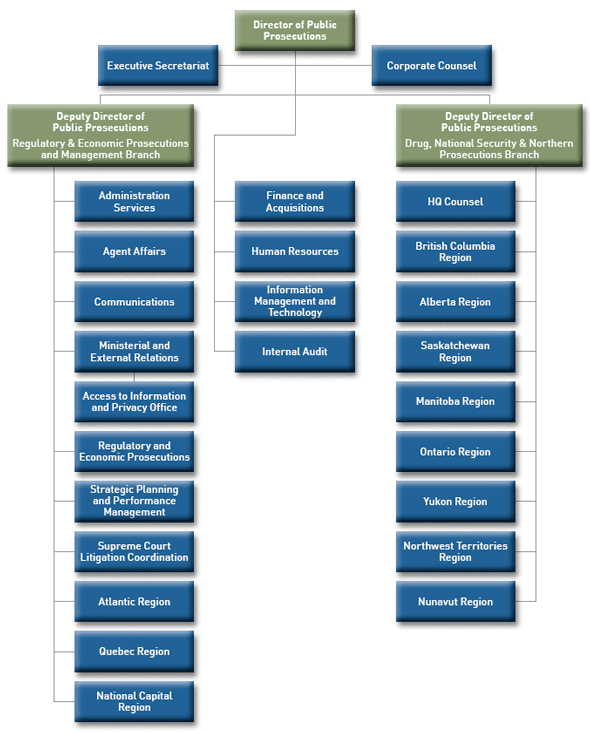
Organizational Structure
Partners
Department of Justice Canada
While the PPSC is an independent organization, it maintains a close and cooperative working relationship with the Department of Justice Canada. PPSC prosecutors consult Justice counsel in areas such as human rights law, constitutional law, Aboriginal law, and public law.
The PPSC continues to rely on the Department of Justice for a number of transactional administrative services. In Canada’s Northern territories, the PPSC provides transactional administrative services to the Department of Justice.
Investigative Agencies
An important aspect of the PPSC’s mandate is the provision of advice to law enforcement agencies during their investigations. By involving prosecutors early and continually during major investigations and in the implementation of national enforcement programs, the police and other investigative agencies benefit from legal advice to decide how best to enforce the law.
PPSC counsel provide advice on such issues as the disclosure of evidence required by law, and assist in obtaining key evidence-gathering orders, such as wiretap authorizations and orders to produce evidence.
Provinces
The federal and provincial governments share jurisdiction over criminal prosecutions. This makes cooperation and coordination essential to the effective enforcement of the law. In order to ensure effective enforcement, the PPSC and provincial prosecution services have arrangements that allow the prosecution service prosecuting an offence within its jurisdiction to also prosecute related “minor
” offences that would normally fall under the jurisdiction of the other prosecution service. Thus, the PPSC may prosecute a Criminal Code offence that is within provincial jurisdiction with the consent and on behalf of a provincial attorney general where it is related to a primary federal charge. Similarly, provincial prosecution services may prosecute federal offences when they come about in relation to a primary offence under the Criminal Code. The delegation relates only to the conduct of the prosecution. The prosecution service delegating the conduct of the prosecution retains ultimate control over the prosecution and over major decisions regarding the case.
Project Divide
The Zig Zag Crew was a club controlled by the Hells Angels. Following a 14-month investigation conducted by the Manitoba Integrated Organized Crime Task Force (comprised of RCMP and municipal police officers as well as some civilians) into the criminal activities of the Zig Zag Crew, 37 persons were arrested and charged.
Three of the accused were released upon entering into criminal organization “peace bonds
”, under s. 810.01 of the Criminal Code. The other 34 were charged with various criminal offences, including trafficking and conspiracy to traffic in controlled substances, trafficking in firearms, conspiracy to launder proceeds of crime, and participation in a criminal organization. As of March 31, 2011, 30 of the accused had pleaded guilty to various offences and been sentenced to terms of imprisonment ranging from 18 months to nine years. Four accused remain before the court.
- Date modified: