
Fighting Against Forced Labour and Child Labour in Supply Chains 2023-2024
ISSN: 2818-7288
Part 1: Government Institution
- Name
- Public Prosecution Service of Canada
- Financial Reporting Year
- April 1, 2023 – March 31, 2024
Part 2: Report Contents
2.1 Information on the Government Institution’s Structure, Activities, and Supply Chains
The Public Prosecution Service of Canada (PPSC), established in 2006, is an independent federal agency with approximately 1,100 employees across Canada. Its primary objective is to prosecute cases under federal jurisdiction impartially. Governed by the Director of Public Prosecutions Act (2006), the PPSC initiates federal prosecutions, intervenes in public interest cases, issues guidelines, advises law enforcement agencies, communicates with the media, and more. The PPSC prosecutes cases under various federal statutes referred by law enforcement agencies, with a focus on drug-related cases and Criminal Code offences in the territories.
The following shows the organizational structure of the PPSC:
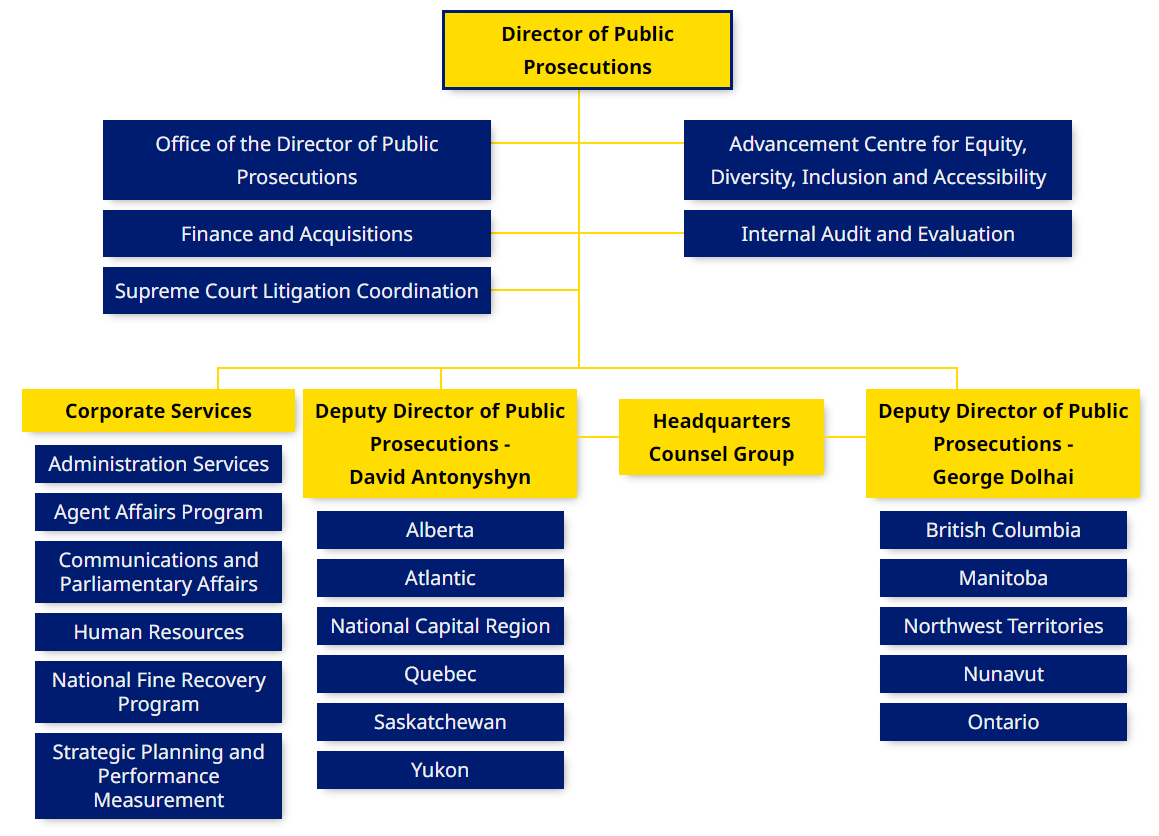
Text Version
- Director of Public Prosecutions
- Office of the Director of Public Prosecutions
- Advancement Centre for Employment Equity, Diversity, Inclusion, and Accessibility
- Finance and Acquisitions
- Internal Audit and Evaluation
- Supreme Court Litigation Coordination
- Corporate Services
- Administration Services
- Agent Affairs Program
- Communications and Parliamentary Affairs
- Human Resources
- National Fine Recovery Program
- Strategic Planning and Performance Measurement
- Deputy Director of Public Prosecutions
- Alberta Region
- Atlantic Region
- National Capital Region
- Québec Region
- Saskatchewan Region
- Yukon Region
- Headquarters Counsel Group
- Deputy Director of Public Prosecutions
- British Columbia Region
- Manitoba Region
- Northwest Territories Region
- Nunavut Region
- Ontario Region
The PPSC’s organizational structure is decentralized, with 11 regional offices and headquarters in Ottawa. The Finance and Acquisitions Directorate manage procurement, focusing on commodities like legal services, IT products, guard services, library subscriptions, and storage.
The PPSC is committed to social, ethical and environmental responsibility in its supply chains. Our main commodities of goods of services include:
- Legal Services;
- Information Technology Products and Services;
- Guard Services;
- Library Subscription Services;
- Storage and Warehousing.
The main commodities of goods procured within the PPSC for financial year 2023-2024 are:
| GSIN Code | GSIN Description | Contracts Total |
|---|---|---|
| N5810 | Communications Security Equipment and Components | $125,942.53 |
| N7010 | Automatic Data Processing Equipment, System Configuration | $403,879.63 |
| N7030 | ADP Software | $1,492,582.71 |
| N7050 | ADP Components | $334,254.11 |
| N7520 | Office Devices and Accessories | $378,550.48 |
The PPSC awarded 273 contracts within financial year 2023-2024 for a combined total of $8,956,579.76. The total cost of goods procured is $3,305,881.13.
2.2 Steps Taken to Prevent and Reduce the Risk of Forced Labour or Child Labour
The PPSC integrates the Public Services and Procurement Canada’s (PSPC) General Conditions and Code of Conduct for Procurement into its purchasing activities to prevent forced labour or child labour risks. It utilizes PSPC’s tools like Standing Offers and Supply Arrangements. Additionally, the PPSC undertakes its procurement authority activities, ensuring compliance with ethical standards.
2.3 Policies and Due Diligence Processes
Effective April 1, 2023, the PPSC incorporates PSPC’s Code of Conduct for Procurement into its contracts, ensuring compliance with laws and regulations, including prohibitions on forced labour. The PPSC requires vendors and subcontractors to adhere to Canada’s anti-forced labour laws.
2.4 Risk Assessment and Management
The PPSC has initiated the process of identifying risks related to forced labour or child labour in its supply chains. It has utilized PSPC’s risk analysis and is monitoring the development of an Ethical Procurement Policy.
2.5 Measures Taken to Remediate Forced Labour or Child Labour
No remediation measures have been undertaken as forced labour or child labour has not been identified in PPSC’s activities and supply chains.
2.6 Measures Taken to Remediate Loss of Income
The PPSC has not implemented measures to remediate the loss of income resulting from eliminating forced labour or child labour in its activities and supply chains.
2.7 Employee Training
Currently, the PPSC does not provide training to employees on forced labour or child labour. It plans to utilize PSPC’s awareness-raising materials once developed.
2.8 Assessment of Effectiveness
The PPSC does not have specific policies or procedures in place to assess its effectiveness in ensuring the absence of forced labour or child labour in its activities and supply chains.
This report reflects the PPSC's commitment to ethical procurement and its efforts to mitigate risks associated with forced labour and child labour in its supply chains.
- Date modified: